![GreenPort[PortStrategy]](https://www.portstrategy.com/greenport/wp-content/uploads/sites/4/2026/09/GreenPortPortStrategy.svg)


Bridging the gap
Finding access that will adapt to suit future ship design changes can be a challenge, Stevie Knight explains
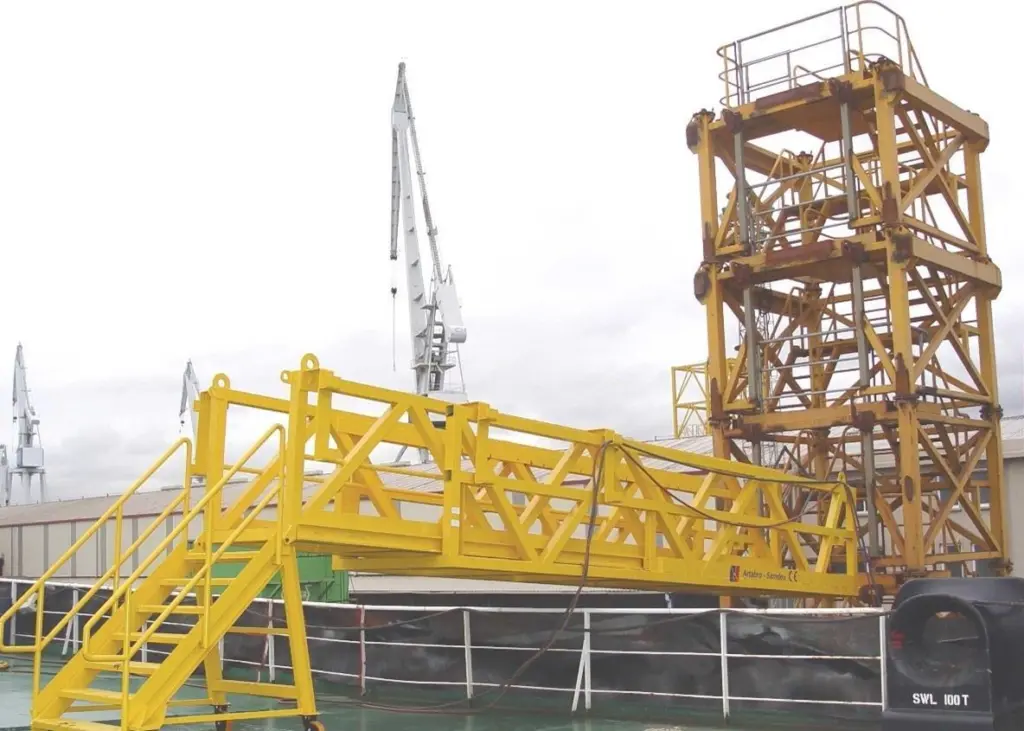
The ship to shore interface has become the final frontier when it comes to seamless port operations. Access to ever-changing ship design means that gangways and jetties can, quite literally, never stand still.
The starting point of any ship access project is the operational envelope, but this envelope can be expected to contain a rather a lot, says Scott Johnston of Clow Group.
This is because a jetty complex is designed for a typical range of ships, a calculation that begins with the height of the deck of smallest, fully laden ship at the berth and the height of the deck of the largest unladen vessel. Unfortunately time doesn’t stand still, and ships evolve.
So, although any access manufacturing company will ask for drawings of the vessels which are, or are likely, to call before they can get down to the details, things change.
Mr Johnston explains: “Ships are constantly changing in both design and functionality. Existing access can only be modified to a certain extent and over a period of years the final product can become bulky, over designed and complicated.” He adds that because of this constant evolution, “by the time you get a system that meets the functionality of the vessel it’s almost out of date and ready to be modified…”
Landing gear
For example, one change came from disaster-spurred legislation that resulted in a double-hull ship designs. It meant tankers switched to putting reinforcement strings out on the deck instead of just being tucked away inside. Unfortunately these reinforcements don’t take into account the access system and so finding a suitable spot to land the gangway can be difficult – even though some tanker designs specify a platform above the metal web, many don’t and it doesn’t cover all eventualities. Likewise pressurised LNG ships have spherical tanks rising from the superstructure so once again space to land the gangway can be rather limited.
It’s an ongoing issue as although its possible to ask for as many drawings as you like up front, there is still a risk that the next tanker won’t be covered, and retrofits are a fact of life.
Mr Johnston adds that one particular retrofit design for a fuel company resulted in a system that could swivel 180 degrees, pivot up and down and extend and contract.
He says, “Initially the gangway had to be able to telescope to accommodate different ships as a new ship added to the fleet could not get close enough to utilise the current system. Then another significantly larger vessel required the gantry to pivot upwards and finally a vessel with multiple access points that needed to be accessed while stationary meant the gantry had to be able to rotate.”
Costs
Obviously, costs issues are next on the list. There are a multitude of possibilities and some companies have a strategy which encompass a couple of different tried and trusted basics which help to nail costs down.
One fairly common type is a column with a telescopic gangway and a fixed height hinged platform, which are useful for a limited vertical range. There are also tower designs with an independent telescopic gangway, good for terminals that service both very small ships and ultra large carriers. Having said this, the complexity adds to the price and there are peripheral considerations, such as alarms to alert personnel to a move.
But despite any superficial similarities, these structures have to quite literally bridge two, very individual sets of objectives, one from the land side, the other from the ship.
This means a balancing act as there are special needs both big and visible, like LNG pumping equipment or small and specific, such as paint treatments and alarms which all up the price. Alongside this is the most common challenge: a limited landside footprint.
The problem with involving the access systems late in the process is that there are some practical considerations that aren’t immediately obvious, for example ending up with a design where the tilting point of the gangway is rather close to the face of the jetty which can mean putting in a cantilevered section to avoid a steep lift… again, more expense. So, keeping the budget down means, once again, the quay and lift designers should – ideally – work hand in hand.
Related Articles
 CONTAINER & CARGO HANDLING
 CONTAINER & CARGO HANDLING