![GreenPort[PortStrategy]](https://www.portstrategy.com/greenport/wp-content/uploads/sites/4/2026/09/GreenPortPortStrategy.svg)



Bulk bonus
From generation games to port progress, conveyors offer their own prizes for terminals, finds John Bensalhia
In the 1970s, Bruce Forsyth and Larry Grayson led lucky hopefuls to the end game conveyor belt on The Generation Game. Forty-five seconds to remember as many prizes as possible. Lava lamps, fondue sets and cuddly toys would pass before each contestant: as a result, the conveyor belt cemented its place in TV nostalgia.
But conveyor belts are not just the prerogative of 1970s television: they are vital tools for ports. With this high demand, conveyor belt manufacturers are researching and developing new initiatives to ensure safe, economic and environmentally-friendly solutions.
Conveyor belts are a popular choice of transportation at ports. As Larry Goldbeck, manager of conveyor technology of Martin Engineering explains, they save time and money. “Conveyor belts can move large amounts of material, over long distances, with a minimal amount of attention,” says Mr Goldbeck. “Large ships can be loaded in a minimal amount of time. Conveyor belts can handle small amounts of conveyed material, or can handle several thousand tons of material per hour. Conveyor belts are usually the lowest cost per ton for transporting material and loading ships.”
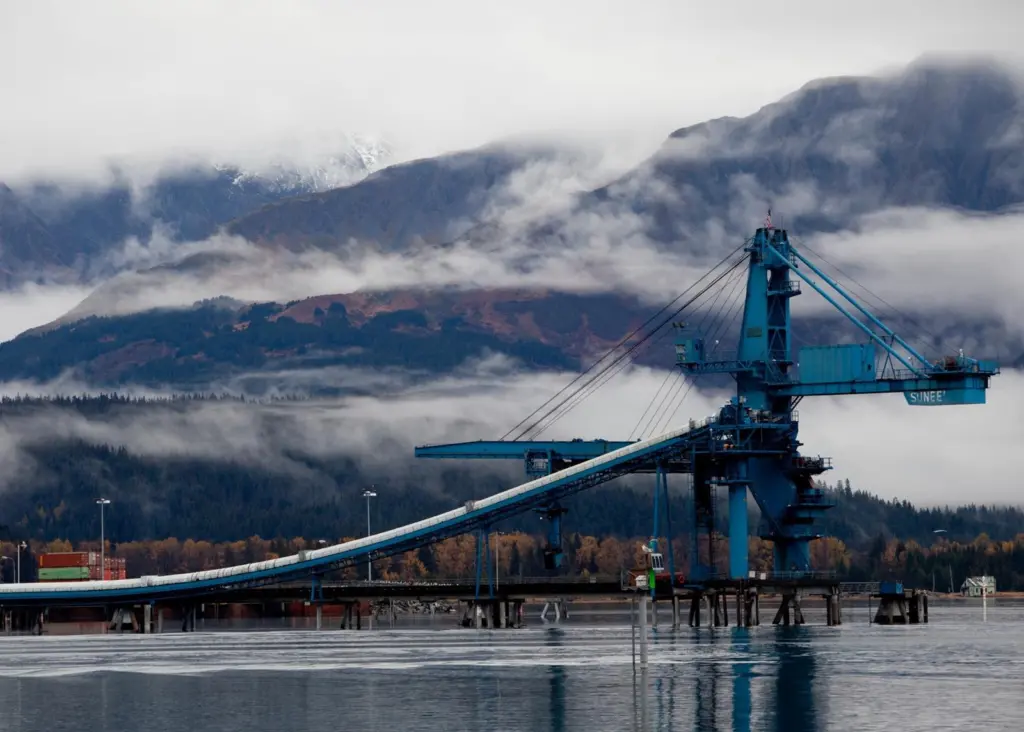
A good example of conveyor belt efficiency is the Port of Seward in Alaska, which completed a conveyor system upgrade for its coal handling operations. The port has installed the new EVO Conveyor Load Zone from Martin Engineering, resulting in an increase of throughput by an estimated 20%, and an increase in the average load rate for the entire ship loading process from 700 mt/h to 858 mt/h, while enhancing control of dust and fugitive particle emissions.
Mr Goldbeck says that a notable benefit of conveyor belts is that they can handle one or several types of material on the same belt. “Ship loaders can move along vessel, so the ship does not have to be moved once spotted.” In addition, Mr Goldbeck says that conveyor belts can be installed on self-unloading ships to move the material from the ship to a stock pile or land-based conveyors to transport the material on shore.
Three sides
Port operators looking to purchase a conveyor belt must consider three important factors: width, length and cost. With respect to the cost, however, the cheapest price isn’t always the answer. “The cost of the belt can be from a few dollars per foot, or several hundred dollars per foot,” says Mr Goldbeck. “In addition to the three parameters, several other factors must be considered when selecting the right belt for the application.
“PIW, Pounds per Inch Width, provides one with the strength of the belt. This is based on the length, width, material load, incline of the structure, and the parasitic drag of items such as rollers, belt cleaners, and skirt board length. More is not better, and the PIW should be selected to match the calculated value.
“In addition, the ability for the belt to form a trough, (troughabilty) to bend over the pulleys, (minimum bend radius), to transition at the head and tail pulley correctly, and the aspect ratio (ratio of the top cover thickness to the bottom cover) must be correct for the application. If the belt is not selected correctly for the application, the belt life will be greatly reduced from conditions such as cupping, junction joint failure, or belt camber.”
The design of the conveyor belt is crucial in order to keep unnecessary breakdowns and costs at bay. “When designing a new conveyor system, it is important to select conveyor belt components that will provide a clean conveyor belt over the life of the belt,” says Mr Goldbeck. “Fugitive material can be very expensive if proper containment methods are not considered during the design phase.”
Innovation abounds
A dual skirtboard sealing system from Martin Engineering is an innovation that prevents unnecessary spillage, lowering cleanup costs in the process. The Apron Seal Skirting is a dual sealing system, comprising a primary seal which is clamped to the steel skirtboard to keep lumps on the belt, and a secondary strip that captures any dust particles which pass under the primary seal.
A notable innovation from manufacturer Phoenix allows users to notice possible damage during use. Phoenoguard PX is a system that constantly monitors the condition of the conveyor belt. Problems such as cover notching or damaged steel cords are detected and in serious cases, dealt with automatically. The Phoenoguard device stops proceedings if it detects the threat of damage to the conveyor belt.
The safety factor is a vital consideration for both conveyor belt manufacturers and port operators. “The most important concern for belt conveyor manufacturers is to ensure they are safe for employees to operate,” says Mr Goldbeck. For example, fire can be a risk when using conveyor belts. Combustible materials such as coal, gas or dust are potential hazards, since the static electricity created by conveyor belts can ignite these materials in the air. The conveyed material must stay on the belt to prevent safety problems, fires and fugitive dust.
“If conveying multiple materials, cross contamination may be a problem,” says Mr Goldbeck. “Preventing carry back, load zone spillage, and dust emissions is essential to provide a clean, safe,and productive belt conveyor system. Selecting the correct rubber belt for the application is essential to prevent these problems.”
Safety first
With that in mind, port operators and managers must bear in mind the potential hazards of conveyor belts for operating personnel. “The safety aspect of belt conveyors is being looked at all around the world,” says Mr Goldbeck. “I usually recommend a Belt Conveyor Risk Assessment be performed to insure conveyor belts meet current safety requirements. However, safety requirements will vary from country to country, and company to company.” Mr Goldbeck adds that an in-depth safety audit should be performed by a knowledgeable inspector to ensure all-round safety.
Recent innovations in conveyor belt design have helped to manage such issues. Savatech is one example of a conveyor belt manufacturer to introduce heat-resistant conveyor belts, using strong quality rubber material to handle temperatures of up to 125, 150 and 210 degrees respectively.
Savatech has also produced a solution to deal with the potential problem of self-ignition. During bulk operation, sometimes the bulk materials or the belt can self-ignite. Savatech’s range of self-extinguishing rubber belts counters this problem, with four flame resistant variations available.
Belt manufacturers have also tackled the problem of oil damage. If a conveyor belt ferries minerals or vegetables, for example, these can give off oils, which then penetrate the belt rubber, leading to distortion and swelling. Special materials are used in the belt design in order to resist penetration of oils and eliminate the risk of damage. Savatech has designed three different types of oil resistant belt in order to combat the different levels of oil and grease aggression.
Breakthroughs in technology have also allowed for the conveyor belt to not only become more efficient, but also safer and environmentally friendly. With regards to the human side, Mr Goldbeck says that conveyor belt training is a priority for operators. “Employee training must be implemented and in the future, any employee that is required to work around these belt cleaners will require in-depth training on how to safely and effectively operate these continuously-evolving conveyor systems.
“Belt conveyors provide a low cost method to transport materials,” he says. “They will continue that task for a long time. New components are being developed every day to reduce the cost to operate these belt conveyors. The evolution of items such as belt construction, belt cleaning systems, load zone containment methods, tracking devices, and rolling component improvements will continue for the foreseeable future.”
Related Articles
 CONTAINER & CARGO HANDLING
 CONTAINER & CARGO HANDLING