![GreenPort[PortStrategy]](https://www.portstrategy.com/greenport/wp-content/uploads/sites/4/2026/09/GreenPortPortStrategy.svg)





CUSTOMER CAN GET IT WRONG
Alex Hughes weighs up the pros, cons and respective market niches of gantry and mobile harbour cranes and examines how each stack up against the continuous ship unloader.
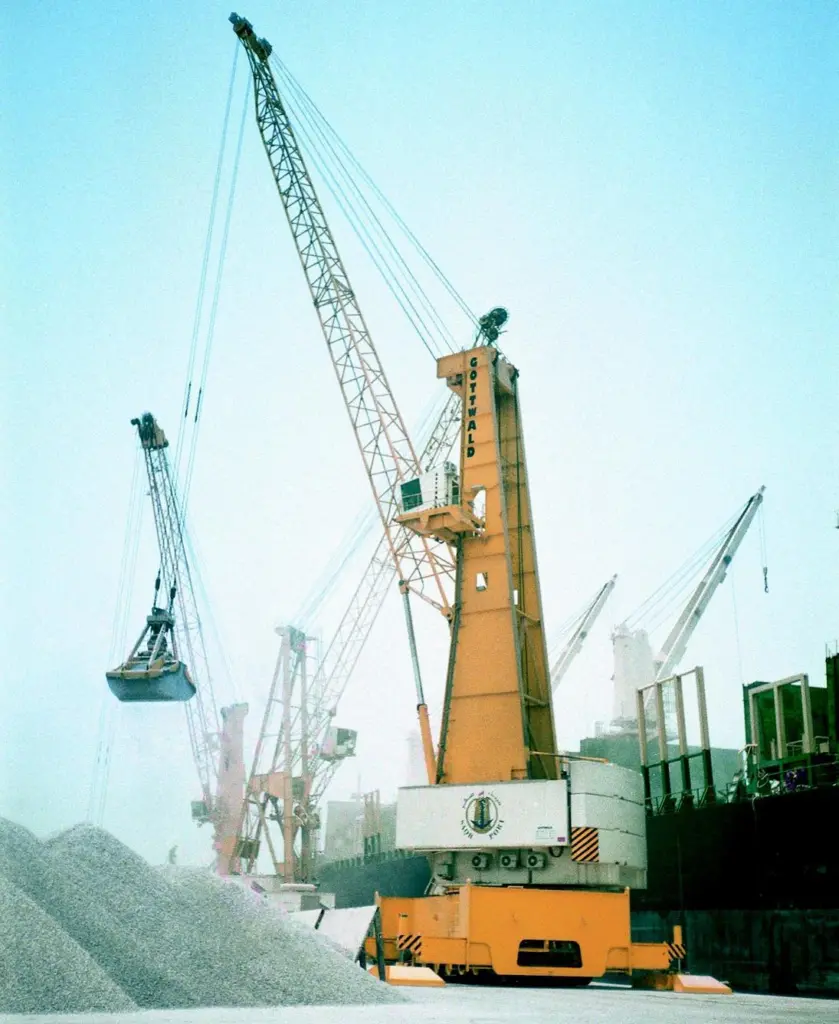
Hull Bulk Handling Limited (HBH), which operates from a 16ha terminal adjacent to the Queen Elizabeth Dock in the UK’s port of Hull, mostly handles vessels laden with coal or biomass imports. Other bulks, general and project cargo can be accommodated too thanks to the deployment of two high-speed fourcable luffing cranes, fitted with grabs, spreaders or even a hook.
Grab cranes were preferred over competing systems because of the need for this type of operational flexibility. For example, those deployed at Hull can handle sizes of coal up to 250mm, which would clog up a continuous ship unloader (CSU). Furthermore, CSUs and pneumatic unloaders would be unable to cope with coal consignments from the terminal’s main suppliers in the Baltic, since these are invariably contaminated with metal and extraneous material, which would cause them severe damage. However, all the crane drivers at HBH have to do is empty the grab into a hopper fitted with grizzly bars, which effectively filter out any large, unwanted material. The rest of the consignment then passes through to a magnet-equipped conveyor, which removes all ferrous metal. If the bulk being handled is simply too big for the conveyor system, then trucks can load straight from the hopper, while even larger items can be taken off the vessel and placed directly onto the quayside itself.
The cranes were sourced from a UK manufacturer, which had not previously built equipment for maritime bulk handling purposes. Dutch consultants Croese were therefore asked to provide the technical assistance required to guide the company through the necessary engineering processes.
HBH md Charles Holehouse notes that the decision to choose a domestic manufacturer had been prompted by the need to guarantee good after-sales support. “In retrospect, it was the wrong decision to go with an unproven manufacturer, ” he concedes. “Although the cranes themselves are well built, the electronics package used was too complex, with the result that it was difficult for an inexperienced driver to retain complete control during discharge operations.” To make matters worse during this difficult period, Holehouse claims that support from the manufacturer had been somewhat less than satisfactory.
In fact, the initial luffing gearbox setting for the jib had been too high, resulting in numerous electric motors burning out. This represented not simply an additional component cost to the stevedore, but also lost time during vessel discharge operations.
Therefore three years ago, a new cog was put into the gearbox to change the ratio and hence slow down the speed of the luff, allowing the crane to work more effectively.
In direct contrast, Holehouse cannot find enough praise for the grab manufacturer Verstegen. “Their products are absolutely brilliant, being hard wearing, low maintenance and extremely good value for money, despite not being the cheapest in the market place. Terminals need high levels of reliability and that is exactly what we have obtained from their grabs, ” he says.
On a 32,000dwt Handimax vessel, average hourly discharge rates of around 650 tons can be achieved across both cranes, which Holehouse speculates will probably last up to 25 years in front-line service. He nevertheless rejects any future second-hand purchases to reinforce the existing cranes pointing out that today’s terminal operators need to source the fastest, most reliable and proven equipment available just to remain competitive.
Kimmo Nyman, bulk handling director of the Finnish-based KCI Konecranes Group, is also dubious regarding the merits of the second-hand market, albeit for differing reasons. His company, despite building both CSUs and double-boom slewing cranes, specialises in producing gantry grab cranes for the bulk market. The majority are ordered by coal or iron ore handling terminals, but can also be used for fertilisers, animal feed, clinker, cement, limestone, bauxite and other ores.
Each unit is custom built, which can involve a crane with rail width of anything between 10 and 30 metres. Outreaches can vary from 30 to 55 metres, while requested backreaches can either be zero or up to 20 metres. In addition, some have to be adapted to work with one, two or even three short conveyors, so the feeder system beneath the hopper can be extremely simple or very complicated.
“Customers buying bulk grab gantries are therefore looking at a working horizon of around 20 years; those with short term contracts usually buy mobile harbour cranes (MHCs). This means that there is practically no second-hand market for gantries, while leasing is nearly impossible to set up because of the difficulty of assessing the residual value at the end of the leasing period, ” explains Nyman.
Indeed, annual global sales of gantry grab unloaders amount to little more than 20 units, of which three-quarters are sold to companies in either India or China. Recent barren years when no orders were placed for bulk gantries have resulted in many manufacturers dropping out of the market while most that remain are in serious financial difficulties. However, competition in the Far East also comes from companies producing CSUs whose own market is even more of a niche, amounting to little more than five units annually.
KCI Konecranes sees demand for its gantries coming from terminals needing to handle bulk flows of 1,000-3,000 tons per hour, way beyond hourly rates of 400-600 habitually handled by conventional slewing grab cranes or the limit of 1,000 tons achieved by a double boom slewing crane with a fixed hopper on the portal.
The company, cognisant of the need to improve reliability, has recently introduced its patented advanced grab drive (AGD), which cuts maintenance costs on its bulk handling gantries by 20% when compared to conventional rope trolley equipment, without adding to the overall price of the crane. This is because the new design allows savings to be made on the steel structure.
“In this market, while price remains an issue, customers tend to look at technical performance and testimonials before committing to a purchase. However, in China, which is becoming a key market, it is still pretty much of a case of ‘lowest price wins’, without too much appreciation of the overall lifetime costs of a crane, ” notes Nyman, who adds that stricter environmental considerations will also affect future sales with even more sophisticated filters coming to the fore.
Maintenance as part of the overall sales package is also becoming more fashionable, particularly in Europe, he stresses.
MOBILITY EQUALS FLEXIBILITY MHCs are turning up in ever greater numbers in the bulk handling industry, with fierce competition between the three leading manufacturers: Liebherr, Fantuzzi Reggiane and Gottwald Port Technology. The latter’s marketing manager, Peter Klein, believes there is even more potential for deployment of MHCs in the dry bulk sector, although this might mean manufacturers having to look at increasing the per-hour rate of such cranes if they want to gain market share in dedicated dry bulk handling facilities which currently deploy either CSUs or gantry grab cranes. Furthermore, with 60% of current output being taken up by European terminals, much scope still exists to place product in developing regions.
While Klein claims that his company’s biggest crane, the dieselelectric four-rope HNK 360EG, is capable of discharging around 1,500 tons per hour of bulk solids, it only marginally competes with gantry grab unloaders or CSUs, which he views as being designed and built for specific commodity flows. Nevertheless, for hourly movements of less than 1,500 tons, double luffing level cranes are also a threat.
“Where MHCs have a distinct advantage over CSUs and gantries is in terms of flexibility of location. MHCs are also versatile cranes in that they can be fitted with a range of different grabs to enable them to handle a wide variety of materials, while substituting the grab for a spreader makes it possible for a terminal to also work with containers. Various other lifting attachments can be fitted so that project cargo and a variety of breakbulk and general cargo items can be handled too, ” he stresses, adding that the flexibility and mobility that the MHC offers are probably slightly more important than either price or technical performance in securing a sale.
For stevedores working on finger piers or jetties, where space is limited, or where a conveyor or rail/road loading beneath the crane is required, it is also possible to substitute the rubber-tyred chassis on a Gottwald MHC and instead convert it into a portal crane, with Klein emphasising that 18 such conversions have been sold to date.
Nevertheless, it is the four-rope crane for mechanical grabs that Gottwald normally markets to what Klein describes as the “professional bulk handling market”, noting that such cranes are usually bought specifically for this purpose and thereby generally remain dedicated to this trade. Nevertheless, while the more generalpurpose two-rope variant is mostly (60%) used for container handling and general cargo (10%) purposes, fitted with motor grabs these cranes are deployed on dry bulk handling duties too.
As for maintenance, Klein says that this is always offered to customers and can even include lifetime coverage, encompassing upgrade of the diesel generator train, controls and external power supply, if so required. Cranes can also be supplied with grabs, although Klein stresses that Gottwald is not married to a particular supplier, but will seek the best product currently available.
Indeed, the operational success or failure of a bulk handling grab crane is pretty much dependent on the grab bucket attached to it.
German manufacturer Orts GmbH produces a complete range of bulkhandling grabs for operators using mechanical-rope, electro-hydraulic and diesel-hydraulic equipment in either orange-peel or two-clamshell designs.
“Bulk grabs are suitable for all types of dry bulk cargo. Of course, each type of material has its own physical characteristics, which could mean having to design a grab for specific products. However, in most cases, shipping and stevedoring companies need an “all-round” grab, which they can use to handle different types of cargo efficiently, ” explains sales director Sigvard Orts (junior), adding that scrap metal, pig iron and large stones also fall within the range of such equipment too.
In terms of productivity, Orts emphasises that this is dependent on three key factors: kinematics, the closing force of the knives and on the overall skill of the crane-driver. In fact, a 12m3 electro- or diesel-hydraulic grab could theoretically achieve average loading rates of around 250-300 tonnes per hour.
“The reliability of the grab is also extremely important when discussing productivity. It is pointless to buy a cheap grab, if it then breaks down during vessel handling, effectively prolonging the length of the port call. The grade of filling is also crucial; the better the grade of filling of the grab, the shorter the loading/discharge time, ” stresses Orts.
Challenged to define the exact role grabs play in the dry bulk industry, he points out that not all bulk materials can be handled with a vacuum, screw or belt unloader. Indeed, if the on board load becomes compressed, as can happen during heavy seas, belt or vacuum unloaders can struggle to cope.
“It is true that grabs do not have such a high discharge rate as alternative technologies, but they do have more universal applications and are certainly more flexible, not to mention robust. Furthermore, some shore-based terminals are just not equipped to handle large rates of unloaded bulk. Also, when compared to equipment on selfdischarging vessels, maintenance of shore-based grabs is significantly cheaper, ” explains Orts.
While other bulk discharge equipment manufacturers stress their ability to contain dust emissions, Orts underlines the fact that a well maintained grab will produce less spillage and that, in reality, most dust emissions are made when discharging dry bulk consignments into hoppers. In fact, Orts GmbH developed a 100% covered grab in the 1980s, specifically to address environmental concerns.
Quizzed as to whether purchases of grabs are driven by price or technology, Orts unhesitatingly replies that both are important.
“Technologically, the knives on our grabs offer a high closing force and have optimised kinematics. Add to this a high discharge rate and all round reliability with a reduced need for parts replacement and you have a very cost effective piece of equipment, especially when you consider the price over the whole life time of a grab, ” Orts points out, adding that a limited market also exists for second hand equipment too.
Neither leasing nor maintenance is commonly bundled into purchase agreements. Outright purchase is still the preferred acquisition method, while maintenance can be relatively easily undertaken by a competent mechanic, argues Orts, adding that in emergency cases the company is nevertheless prepared to despatch its own engineers worldwide.
As for the future, Orts notes that some grab manufacturers are trying to bring down the overall weight of their products enabling handling capacity on the crane to be increased. However, it is Orts’ belief that on mechanical rope grabs there are limits to how far this can go. Nevertheless, he does see potential improvements forthcoming in further reducing dust spillage.
Related Articles
 CONTAINER & CARGO HANDLING
 CONTAINER & CARGO HANDLING