![GreenPort[PortStrategy]](https://www.portstrategy.com/greenport/wp-content/uploads/sites/4/2026/09/GreenPortPortStrategy.svg)

Energy Utopia
Can ports benefit from Smart Grid concepts? Felicity Landon reports
Imagine the sun is shining and, somewhere near you, a whole bank of photovoltaic panels is generating masses of solar energy. But everyone’s outside having barbecues, demand for electricity is low, and some of that precious electricity may just have to be dumped.
Or imagine a breezy morning, and the wind turbines nearby are generating a mass of energy – but it’s a time of day when demand is well below peak. And finally, imagine half-time in a big televised football match, and thousands of households putting the kettle on at the same moment – when it’s not particularly sunny or breezy and a coal-fired power plant in the area is on partial shutdown for maintenance.
Multiply that across transport, industrial and commercial premises, and add in the growing move towards low-carbon power generation, and it’s clear that ensuring the right power in the right place at the right time is a delicate balancing act.
Enter the Smart Grid? Well, enter parts of it, anyway, as network owners and operators gather increasing amounts of data and introduce new levels of ‘intelligence’ to their operations. Based on one on-line video, the ultimate Smart Grid would see nice people driving their nice electric vehicles to and from work and plugging them in at predictable times in their perfect back yards, and a local power supply being perfectly tuned into the peaks and troughs of industrial and domestic demand.
“You can find many different definitions of what people believe a Smart Grid should be – but in essence, it is a general convergence of technologies that have come together with a set of present needs within the electrical network,” says Stephen Burdis, energy management solutions leader EMEA at GE Digital Energy.
“We prefer to look at it as a ‘grid modernisation journey’. All electric networks have some degree of intelligence already, and that comes from control platforms or devices out in the network which generate data. That ranges from the basic to the quite advanced. But the reality is that network owners and operators are facing new challenges that simply weren’t there 25 years ago.”
Outdated
Among the issues? First, many electrical networks were designed pre-Second World War and are clearly on borrowed time. Second, most networks were designed to operate in a specific way, i.e. power generated travels one way, to a consumer at the other end. With the creation of embedded generation such as wind and solar, new centres of generation need to feed into parts of a network never designed for that purpose.
“Consumers behave in a very different way to 25 years ago – we have consumers who are also generating, for example,” says Mr Burdis. “Then consider the move to electric vehicles, which will create a huge strain on networks, and policy issues that require utilities to offer and deliver more low-carbon solutions.”
The obvious answer might be to reinforce (or expand) networks to step up capacity but that’s very expensive, particularly in the urban context, he points out. So the solution must be using intelligent data from the network to manage constraints and capacity, make the most of power fed into the system and understand, for example, when ‘head room’ capacity can be taken up to meet demand.
“On the industrial level, there are many more ways now of monitoring networks and gathering data in order to create smart solutions,” says Mr Burdis.
Phil Dingle, Eaton’s utilities and networks segment manager, says: “The concept of a Smart Grid is the ability firstly at utility level and then coming down through all the consumers of electricity to see how we can best match what is available as our energy source, whether traditional power generation, wind or solar, at the point of use. If the sun is shining, you are going to get lots of PV energy; you want to make sure you are using it and not dumping it. If there are steady gusts in the North Sea, you need to be able to use that wind power in a smart way.”
Consumption curbs
Another important part of the whole concept is minimising consumption – through systems such as active lighting control, efficient boilers, and so on.
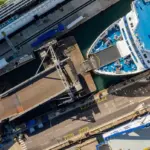
A big challenge for ports in this context is the growing demand for cold ironing, especially from the cruise sector. “If you have a cruise ship come in with 4,000 passengers and have that floating hotel running off the grid, that’s good for the local environment in terms of less emissions and noise – but in terms of a Smart Grid and smoothing energy flow, it is the complete opposite, putting a huge spike into energy consumption,” says Mr Dingle. “To put it into context, the energy consumption of a very large cruise ship is probably greater than one of the landmark buildings in London.”
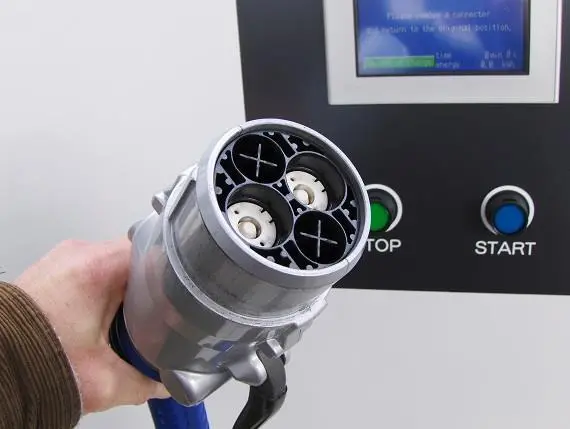
Powering terminal equipment and vehicles by electricity makes perfect sense and is more straightforward; they are never doing high mileage, fairly predictable in their demand, and never far from the point of plug-in.
“There is a lot that ports can do to make use of and adapt parts of the Smart Grid concept,” he says. “It will be the low fruit first; what am I doing in terms of PV panels on the roof, heat-efficient buildings, LED lighting, etc.? There is loads of technology available and people are using it to make life much more efficient and smart.”
Mr Dingle also highlights the issue of renewable energy being ‘thrown away’. While hydro electricity can be controlled by dam systems, for example, “there are definitely instances when it’s a windy day in the North Sea and we are throwing energy away because the infrastructure isn’t there to land and use it,” he says.
Storage solutions
As a result, there is a huge focus on energy storage possibilities. “There are plenty of projects looking at ways of energy storage, whether it’s large batteries or something similar. That would enable you to take store energy generated from solar or wind, and take it out when you need it.”
Stephen Burdis at GE describes energy storage as something of a ‘holy grail’ in Smart Grid terms. “Getting storage solutions to market on a useable and economic scale is still a challenge for the industry,” he says. “There are a lot of different storage technologies available; we have produced storage originally designed for transportation, scaled up to grid level connectivity. But at the moment, most projects across the UK, for example, have been looking at smaller community-led storage. What’s clear is that storage is a very important component in the Smart Grid jigsaw.”
Looking ahead, he says the big question is whether energy control ultimately becomes more centralised, with networks and assets managed in a more intelligent, efficient and product way, or whether we push more towards a decentralised model where consuming groups and communities – such as ports – might want to go along the ‘micro-grid’ route. “I think the jury is still out on that.”
Related Articles
 CONTAINER & CARGO HANDLING
 CONTAINER & CARGO HANDLING