![GreenPort[PortStrategy]](https://www.portstrategy.com/greenport/wp-content/uploads/sites/4/2026/09/GreenPortPortStrategy.svg)

Focusing on future fuels to target zero emissions
The Port of Antwerp-Bruges is working towards greener operations on multiple fronts to tackle the environmental, social and economic impacts of cruise operations, writes Michele Witthaus.
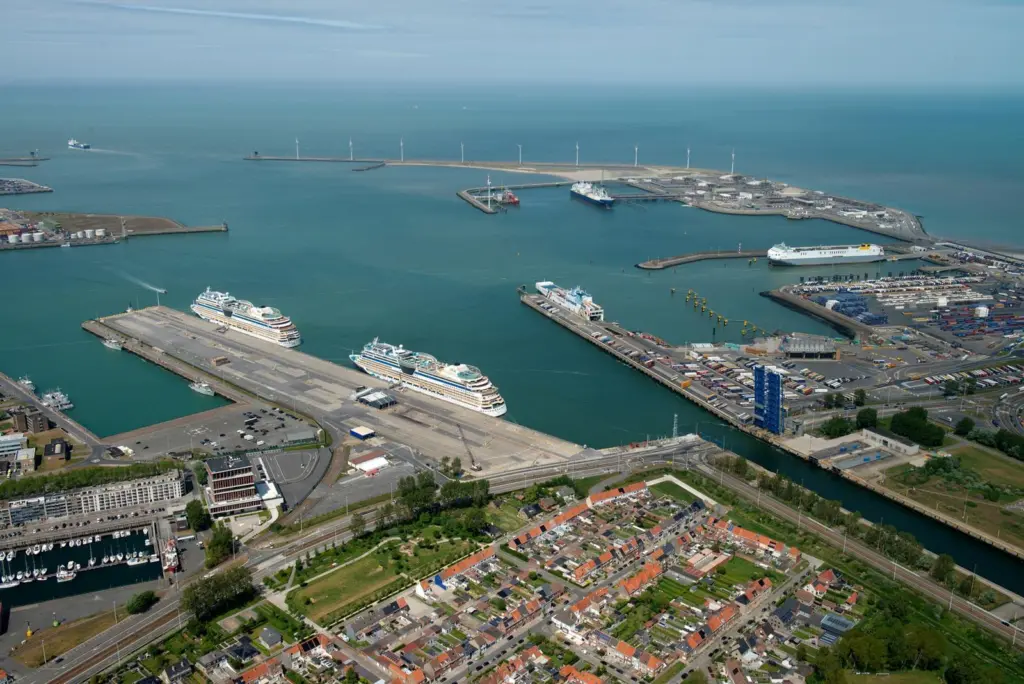
Located on the coast of Belgium between Northern France and the Netherlands, Zeebrugge is an established port of call in a multitude of Western and Northern European cruise itineraries and is of special interest to travellers wishing to explore the history and culture of Flanders and Brussels.
As well as longer multi-country cruises, the port attracts ships on mini-cruises from the UK. Zeebrugge’s cruise operations are managed by the Port of Antwerp-Bruges, which welcomes around 180 cruise ships and 400,000 passengers each year.
Taking all its emissions into account, from its cargo operations as well as the passenger shipping sector, the Port of Antwerp-Bruges has stated that it plans to reduce CO2 by 35% by 2025 compared with 2005 levels, with the reduction reaching 55% by 2030.
Energy transition
To advance its strategy of reducing ship-related emissions, the port plans to introduce onshore power supply (OPS) at the beginning of 2026.
“By 2028, the planned OPS connection will be reinforced to provide 16 MVA of power capacity,” says Piet Vandenkerkhove, Account Manager Cruises at Port of Antwerp-Bruges.
“We offer LNG and bio-LNG bunkering (ship-to-ship and truck-to-ship), which can already reduce CO2 emissions compared to conventional fuel oils.”
”Besides, we are also focusing on preparing our port for the multifuel future where multiple renewable fuels like methanol or hydrogen will be available and bunkered at our port (for the port as a whole, not only the cruise sector).”
To enable the cruise side of the business to achieve its targets in this context, the port is investing in plans to provide sustainable cruise operations going forward, with a strong focus on future-proof fuels.
“Our goal is to be ready to offer alternative fuels at scale in the future (hydrogen, methanol and e-LNG),” says Mr Vandenkerkhove. “Zero emissions at quay and on the terminal is the ambition. This also involves further electrification of all rolling stock on the terminal.”
Other emission-reducing moves include the planned introduction before the end of 2023 of a battery electric shuttle bus to bring cruise passengers from the gangway to the terminal building (and vice versa).
The port is also taking various actions to streamline cruise calls, with a particular emphasis on efficiency. “The introduction of new (wider) fenders will make calls more efficient,” says Mr Vandenkerkhove. “Up to now, loading and unloading of luggage, waste and stores was very difficult because of lack of space between the ship and the quay wall.”
Changes afoot?
Some established European cruise destinations experienced record high temperatures during the recent summer season, leading cruise lines to change their itineraries in the worst-affected areas.
This is driving opportunities for ports that can adapt to different patterns of calls, as Mr Vandenkerkhove explains. “We are witnessing a seasonal shift of deployment of cruise ships. The weekly winter calls (October through March) of AIDA Cruises and MSC Cruises ships are a good example.”
There are also indications that some cruises will move away from the warmer Southern Europe itineraries that have been in place for many years. “If the heating up of the Med area continues, new opportunities may arise from cruises operating further North during the summer months.”
Increasingly, the social impacts of mass tourism and ‘overtourism’ are concerning to cruise ports in or near high-traffic destinations. The Port of Antwerp-Bruges is working to reduce the pressure of tourism in the main destination of Bruges, says Mr Vandenkerkhove.
“We limit the number of simultaneous cruise calls to two ships per day. On a total of 180 calls per year, we only have about 25 days with two ships. We actively promote off-season cruise calls to obtain a better spread of tourists throughout the year.
“A well-considered berthing policy should keep cruise tourist flows within acceptable limits in order not to become a burden for the main destination. Opening up the touristic hinterland to destinations off the beaten track is a challenge but will be beneficial to a better spread of tourists.”
VIPs
Easy access to amenities is of particular value to an often-undervalued category of people spending time in port: Ships’ crew.
For the Port of Antwerp-Bruges, crew members are an important and valued visitor category.
“A ship’s crew can be an ambassador for a port,” says Mr Vandenkerkhove. “Every port should consider providing them with free or affordable services based on their needs, including wifi, a crew lounge, specialty food shops and transport arrangements.”
Globally, breaking news about the cruise business is more quickly and widely publicised than ever, thanks to the ubiquity of social media. In this context, Mr Vandenkerkhove says that good data management and communication is crucial.
“The importance of providing correct data to (mainly political) stakeholders cannot be over-stressed. Negative news spread by some is often picked up by mainstream media and reaches the general public easily, even though many assumptions are based on perception rather than facts.”
Communication with partners and stakeholders is a major focus for the port.
“Regular concertation with all actors involved in the landside aspects of cruises is a must,” says Mr Vandenkerkhove. “It is also a way of keeping them updated about a continuously changing industry. The port authority plays a crucial role in conveying the concerns between the land side and the cruise lines. Improvements and solutions are only durable if they are supported by the port, the inland destinations and the cruise lines.”
Growing green cruise operations at Antwerp City Port
Antwerp welcomes around eight hundred river cruises and thirty sea cruise ships annually. Antwerp City Port manages the cruise operations at the city’s Scheldt Quays and the new terminal at Het Steen.
Over the entire urban port area of Antwerp, there is maximum capacity for a total of 40 river cruise ships with an overall length of up to 135m and one sea cruise ship with a maximum length of 265m. At the latter berth, vessels are moored on a purpose-built floating pontoon with a connection to the main terminal building.
“River cruise ships can dock at various locations spread throughout the urban port area and the Scheldt Quays in accordance with the ‘City port plan 2020-2030’, the policy vision of the city as far as shipping is concerned,” says City Harbourmaster Werner Weijts. “Reconciling the various functions of urban areas is one of the key tasks in this regard: habitation, tourism, and economic activities.”
Alternative power
Sustainability is an important part of the plans for the port and onshore power supply is currently provided at Kattendijkdok, the operating base for river cruise ships in the port. The city of Antwerp has committed to additional locations for the rollout of shore power for river cruise ships, including the Scheldt quays, with full implementation due to take place before 2030.
In addition to offering alternative power sources to as many vessels as possible, the port is keen to attract ships that are cleaner by design. “The new ships are invariably equipped with stage V engines (new standards in Europe),” says Mr Weijts.
“The city can also boast that most of the river cruises that dock in Antwerp hold a gold or silver, Green Award certificate for inland shipping.”
Reconfiguration of facilities at the port in recent years has included the development of a new cruise terminal and visitor centre located at Antwerp’s oldest building, Het Steen.
The City’s Vice Mayor responsible for tourism, Koen Kennis says: “Our brand-new cruise terminal opened in 2020 and allows us to welcome vessels and passengers in the most comfortable, safe and durable ways possible.”
”All major attractions are located within walking distance from the terminal. By offering these advantages we are happy to see the large majority of passengers prefer to spend the day in Antwerp, rather than hop on a bus and visit other destinations.”
Going forward, Antwerp City Port will focus on attracting cruises in the premium and luxury end of the market.
The economic and social sustainability benefits that such ships bring to Antwerp and the higher number of people exploring the city during calls, are important factors in this strategy.
“The average number of passengers aboard a river cruise is one hundred and forty, while for a sea cruise ship it averages six hundred for Antwerp,” says Mr Weijts.
Related Articles
 CRUISE GREENPORT
 EUROPE GREENPORT
 EUROPE GREENPORT