![GreenPort[PortStrategy]](https://www.portstrategy.com/greenport/wp-content/uploads/sites/4/2026/09/GreenPortPortStrategy.svg)


Boosting efficiency between the quay and the stack
The final frontier for terminal efficiency lies between the quay and the container stacks. Automated guided vehicles (AGVs) can boost productivity and lower OPEX in this area so that the whole terminal will see the benefits, says Michel Lyrstrand, global sales director, Gaussin.
At terminals around the world, container vessels continue to increase in capacity, cargo volumes are growing steadily and turnaround times are becoming shorter. Container terminal productivity needs to keep pace with the demands of the rest of the supply chain.
A key area that is often overlooked in boosting terminal productivity is the area between the quay and the stacks. If we can improve efficiency and productivity here, the whole terminal will see the benefits.
The good news is that new automation technologies are available that combine high productivity with low operating costs and zero emissions. This article will outline how this can be done using existing AGV systems and new developments.
The blueprint
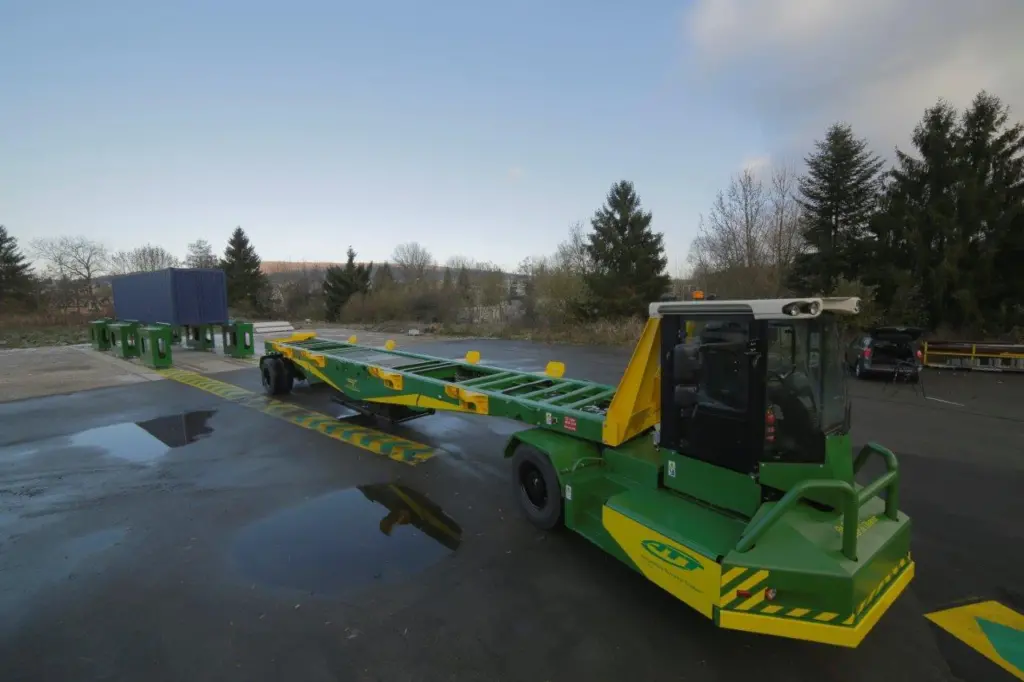
Gaussin’s Automotive Terminal Trailer (ATT) was originally developed for DP World in 2009 and was designed with a driver’s cabin and exchangeable power packs. Today, around 100 such vehicles are in operation worldwide. It is this design upon which Gaussin’s later ATT vehicles are based and the construction of the vehicle has been developed specifically to enhance operational efficiencies.
The delta-shaped construction of the trailer’s middle section has lowered the vehicle’s total weight by approximately 30% and so reduces the energy and fuel needed to power the vehicle. Most of the beams on the new design are made from steel plates that are bent in shape. This lowers production costs and simplifies painting procedures, which helps ensure a higher level of protection against rust.
The next step forward
The ATT Lift is a new vehicle that has been adapted from earlier models of Gaussin ATT. The Teluk Lamong terminal operated by Pelindo III in Surabaya, Indonesia, has purchased a fleet of 50 ATT Lift vehicles, which will be fully operational in early 2015.
All ATTs have a hydraulic suspension and by increasing the stroke of the hydraulic cylinders, the height of the ATT Lift’s chassis can be adjusted. In combination with similar steel racks or a docking station (as Gaussin calls it), the ATT Lift can load or unload containers by itself. To help drivers enter the docking station safely and securely, both the front and rear axles are steerable and the vehicle will drive in an automated mode into and out of the docking station.
Customers can choose between hydraulic or electric propulsion for the ATT Lift. Gaussin has developed a diesel/hybrid power pack and, later this year, will be launching an LNG/hybrid power pack. These electric vehicles have the same advantages as the hydraulic ones. However, electric propulsion requires less maintenance and the electric wiring makes assembly easier and therefore faster.
Using electricity rather than burning diesel fuel releases less CO2, NOx and harmful particulate matter into the atmosphere, which preserves air quality and the environment. A fully electric power pack was launched last year by Gaussin and CEA, the French research institute for nuclear and energy. The power pack can be comprised of up to three layers of batteries, each with a capacity of 80 kWh. With three layers of batteries, the average time between recharges is around 12 hours.
Each power pack takes 2.5 hours to recharge, regardless of how many battery layers the pack has. These Lithium-Ion batteries can be recharged around 2,500 times, equivalent to a lifespan of six to eight years. These power packs are completely sealed and equipped with an air conditioner to maintain their optimum temperature, which increases the batteries’ lifespan.
The next generation of green horizontal transport on the quay
The result of removing the cabin and driver from an ATT Lift is what Gaussin calls an Automated Intelligent Vehicle, or a Lift AIV. Like a Lift AGV, which was launched in 2007, the AIV Lift is able to load and unload containers by itself by means of docking stations.
The AIV Lift uses the suspension to adjust the vehicle height. Because of this lifting mechanism and its delta-shaped frame construction, the total weight of an AIV Lift is considerably lower than that of a Lift AGV, which uses a sax-lift on top of the vehicle that increases the vehicle’s height and weight.
The AIV Lift rotates both the front and rear axles ± 45°, while the Lift AGV has a turning radius of around nine metres. Because of this increased manoeuvrability, the AIV Lift is able to enter any transfer point under the QC, even when two QCs are placed side by side. With a QC back reach of approximately 28m, the terminal could easily have up to five transfer points per QC. Since the AIV Lift can reach every one of them, a small buffer has been established under the QC. This buffer is used for sequencing the containers, which allows us to remove the holding lanes previously needed by AGVs.
By removing the holding lanes, the distance between the stack and the quay wall can be reduced by approximately 28m (20%). Since 28m is equal to 4 teu in length and with 60 stacks (nine wide, five high), the stacking capacity can be increased by over 10,000 teu compared to a traditional AGV terminal. The lightweight Lift AIV has by itself already lower energy consumption and maintenance costs compared to conventional AGVs but in combination with the shorter travelling distances on the quay and the avoidance of an unnecessary stop and start in the holding buffer the AIV will reduce energy consumption significantly and will be the greenest horizontal transport solution available on the market.
Simulations made by consultants Moffatt & Nichol show (Figs 1 to 3) that quay crane (QC) performance increases dramatically when a buffer is implemented under the QC’s back reach. The target of 39 QC moves per hour was reached with 2.4 AIV Lift vehicles per QC. QC performance was shown to be increased when adding more vehicles into the system, until 95% of the theoretical maximum capacity of the landside crane operation was reached. This shows the terminal’s bottleneck in productivity is no longer the horizontal transportation, it’s the performance of the automated stacking crane (ASC).
Controlling the fleet
An AGV system is never better than the Fleet Management System (FMS) controlling it. In October 2014, Gaussin formed Port Automation Systems, a joint venture (JV) with French company BA Systemes. The company has over 40 years’ of experience building complete AGV systems, including both vehicles and control software.
BA Systemes has developed the BA-Box, which controls the speed and direction of automated vehicles. Every AIV is equipped with a BA-Box, which controls its speed, direction and also lifting. It’s also connected to the vehicles’ two transponder antennas and the two safety scanners.
The BA-Box receives orders from the FMS via the W-LAN connection. If any faults are detected on board or the battery needs to be recharged, a signal is sent from the BA-Box to the FMS, letting the operator know what’s happening. Operators can then take action and send the vehicle to the service station.
As the simulations by Moffat & Nichol show, by increasing the utilisation of AIV Lift vehicles, landside crane operations can be increased to maximum capacity. The bottleneck in terminal productivity can be moved from the quay to the stacks, forcing ASCs to keep up with terminal trailers, rather than vice versa. The horizontal transport will be used to the highest efficiency, with zero emissions, zero noise and electrical energy consumption reduced to some of the lowest levels ever performed.
Furthermore, other advances in technology are available that can even further lower operating costs. Capital expenditure can be reduced because fewer vehicles are needed to maintain high productivity.
There’s just one more hurdle to be overcome. In spite of the cost advantages, it’s always difficult for new technology to prove itself, especially in the conservative business of handling containers. Gaussin understands this and has invested in a demonstration site close to its headquarters in Héricourt, France. The large site is a complete working model of a modern container terminal. A number of Lift AIVs will be in fully automated operation, transporting containers from a docking station under an RTG, to a second RTG crane acting as a QC. The fleet of Lift AIVs will be controlled by Port Automation Systems’ FMS, which will receive orders from a TOS.
The site will also have a number of Lift ATTs transporting containers from the same docking station to a considerably narrower single-lane docking station, where a straddle carrier will pick up the container and load a truck.
The demo site will be ready by March 2015 and Gaussin is planning an open day in April. Gaussin’s Lift ATT will also be on show at the upcoming TOC Europe event in Rotterdam from 9 to 11 June 2015.
Related Articles
 ENERGY & TECHNOLOGY GREENPORT
 ALTERNATIVE FUELS GREENPORT
 ENERGY & TECHNOLOGY GREENPORT