![GreenPort[PortStrategy]](https://www.portstrategy.com/greenport/wp-content/uploads/sites/4/2026/09/GreenPortPortStrategy.svg)



Breaking boundaries in shore side power
Schneider Electric is well known for its energy management systems and its new ShoreBoX™ system aims to revolutionise the market thanks to its portability and modularity.

The ShoreBoX™ is the result of a heavy investment in R&D over the last few years. Back in 2012, Schneider Electric’s total sales of €24bn saw 4 to 5% being invested in research.
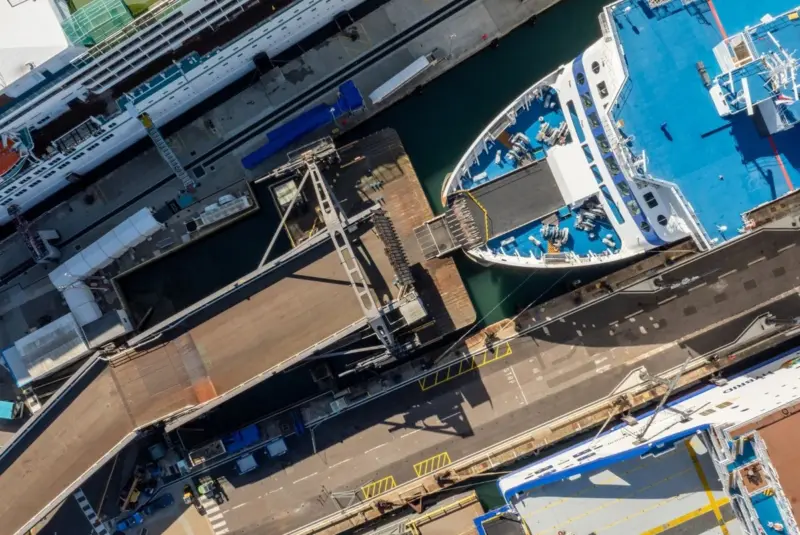
In harbour cities ship pollution is a major source of urban pollutant. Shore power ensures that ships can be plugged in to the grid at berth and switch off its own engines to cut emissions and reduce noise in the port environment.
And Schneider Electric’s ShoreBoX™ technology aims to take this concept and move it to the next level.
The current marketplace
The trouble is that there are plenty of issues to tackle before shore side power can be adopted on a much more global scale.
For example, although it’s quite clear what ports need to do to have this shore side power, some older ships may not have been built with the facility to attach to a shore connection.
Frequency conversion is also a key consideration here particularly as the US uses a 60Hz grid, while the EU uses a 50Hz grid. Most ships are 60Hz so a conversion process needs to be put in place in European ports by way of a static grid frequency conversion system.
But the European Directive on the Deployment of Alternative Fuel Infrastructures, which will affect all ports in Europe, is expected to be validated in April 2014, which should help with this.
If you look at the UK as an example, where private and trust ports are in competition with each other, one issue to consider is ports not having the capacity to install shore side power. For example, ports like the London Gateway have the infrastructure in place but they haven’t yet take the step to install the equipment.
Unless regulation is in place, it’s the same old chicken and egg story – ports are waiting for shipping demands and ships are waiting for port infrastructure to be in place before adopting and using new technology.
ShoreBoX™
Schneider Electric estimates that investing in ShoreBoX™ technology could see clients breaking even at the three year point (evidence based on a Schneider Electric project).
ShoreBoX™ is an all in one integrated solution. It’s adaptable to any port context and Schneider Electric says it’s easy to install and use. Best of all it’s mobile and modular – great for ports with limited space and enabling them to build it up, over time, depending on requirements.
Typical investment to equip a ferry berth (which requires 1 to 3 MVA of power) is between €500,000 up to €1m. A new cruise terminal investment will need significantly more power and cost will depend greatly on how much power the ship requires.
The ShoreBoX™ solution uses a Static Grid Frequency Conversion system. It can be installed and used for cruisers (12 to 15 MVA), containerships (1 to 8 MVA), tankers (2 to 9 MVA) and smaller commercial vessels such as tugs.
At one of its main R&D facilities in Grenoble, , the 3 MVA ShoreBoX™ prototype – which is approximately the size of a container in order to be shipped easily by road – has been tested thoroughly with a medium voltage supply of 6,6KV which simulates a real life port context.
For larger power requirements it’s modular so it can be used in parallel with other units. Traditional shore side systems were designed in line with the power of the ship, but this risked power being wasted if energy was found to be surplus to requirements.
ShoreBoX™ however can be sized to requirements – buy what you need and you can buy more later if required. This doesn’t waste power and is in itself a more green ethos.
Schneider Electric doesn’t just supply the shore side system. It has the capability to convert ships for shore power for between €200,000 and €500,000 when they’re in dry dock for maintenance. Newbuilds can have shore side power requirements factored in to the cost.
ShoreBoX™ has also been trialled in a real port environment in Morocco where two boxes have been installed for naval frigates.
And there are two ShoreBoX™ systems bound for Riga in May which will be used to power containerships.
Schneider Electric is also working on helping ports to develop biomass, solar and renewable energy options, which it says will ultimately allow ports to sell back surplus power generated back to the grid. So ShoreBoX™ is enabling the firm to expand its business in a number of areas.
Advantages
The ShoreBoX™ is quick to install – just two weeks is needed for commissioning and cabling. This is much quicker than other shore side power systems available on the market. Traditionally these systems have had to be designed then built then installed and then tested as separate processes. But the “plug n’ play” ShoreBoX™ is already pre-designed. This, combined with the use of the same products for each system cuts down the lead time of each order ensuring delivery is around eight to ten months.
Each ShoreBoX™ comes with a full maintenance and service contract, backed by Schneider Electric’s strong chain of global service centres.
Port owners can also monitor and control the performance of their ShoreBoX™ installations through Schneider Electric’s EMCS and EMIS systems. These systems can merge the data into the port’s operation management and control system allowing customers to get visibility of their energy profiles at terminal, port or multi-site level, predict energy consumption, negotiate better contracts with utilities, sell energy back to the grid and collect and report environmental KPIs.
For ports there is also the option to lease a ShoreBoX™ which ensures payback from year one.
The need for shore side power
Shore side power is already recognised as an important way forward to save costs and emissions for ports. There is a worldwide standard for shore power Standard EC/ISO/IEEE 80005-1 High-voltage Shore Connection (HVSC) is validated. This means for example that ships coming into the Port of LA can use the system when arriving in Denmark.
And the demand is there also. The Port of LA uses shore side power helped by the introduction of the new OGV Fuel Regulation and Northern American Emission Control Area (ECA) requirements in January. The California Air Resources Board (CARB) says that 80% of the power used by berthed ships will have to come from shore side electricity by 2020.
The company also has a strong relationship with Viking Line in Helsinki Finland.
Shore side power is available in 97 berths worldwide and so far, Schneider Electric provides just under half with shore side power systems.
But the retrofit side of the business is more of a work in progress. The company has already equipped one Stena Line ship in Gothenburg so there is a lot of scope left to develop that side of the business.
Michael Hawkings, segment manager marine UK, Schneider Electric, says: “Everyone wants to be first to be second. Shore side power is going to be driven commercially. We believe that market forces will be the driving force.”
And market forces such as the EU Directive which gives a two hour limit at berth for ships before switching to shore side power or low sulphur fuel could help drive demand.
Another is available infrastructure development funding under the TEN-T – Connecting Europe Facility (CEF). Money is available for both research into shore side power (50%) and deployment (20%).
Looking ahead, international standards are in place and the technology is there for the uptake so the industry looks positive. It is now just up to the ports and ships to decide who implements the shore connection first.
Related Articles
 ENERGY & TECHNOLOGY GREENPORT
 ALTERNATIVE FUELS GREENPORT
 ENERGY & TECHNOLOGY GREENPORT