![GreenPort[PortStrategy]](https://www.portstrategy.com/greenport/wp-content/uploads/sites/4/2026/09/GreenPortPortStrategy.svg)


Bulk cargo handling cleans up its act
Most dry bulk commodities are prone to spillage and dust pollution, posing environmental problems even for ports which handle comparatively low tonnages.
Ports which handle bulk materials – either incoming, outgoing or both – are confronted with critical ship-to shore transfer problems, which are far more complex than those involving ship loading or unloading of general cargo or containers. The dry bulk cargo also needs to be stored, if only temporarily, within the port zone. It also needs to be conveyed between the quayside and the storage location. A major environmental problem, common to all three of these operations and unique to dry bulk cargo handling, is that of material spillage and dust pollution. In recent years considerable advances have been made in environmentally acceptable methods of bulk handling in ports. At the same type the materials handling hardware, especially ship loading and discharge machinery, has become “greener” in terms of improved fuel-efficiency and reduced noise output.
Ship loading
Most dry bulk cargoes are dusty and therefore a potential source of wind-borne dust pollution. Powders such as cement, alumina and tapioca – all of which are commonly transported in large volumes in bulk form – can easily be blown by the wind a long distance from the immediate vicinity of loading or discharge. Commodities of larger lump size such as coal tend to include a high proportion of fines and most grains and pellets (animal feeds, sulphur prills, etc) also include dust particles. If large volumes of these or similar materials are allowed to freefall in open air conditions, even a distance of half a metre or less, the sudden rush of displaced air will give rise to air turbulence, causing dust particles to become airborne. Therefore dust nuisance can occur even during calm weather. This problem is particularly acute during ship or barge loading operations. For economic reasons vessels need to be turned round as quickly as possible and some modern ship loaders can easily achieve rates in excess of 10,000t/h. A ship loader itself is normally a fairly straightforward machine consisting essentially of a belt conveyor supported by a boom structure which is capable of traversing, slewing, luffing and telescoping to allow bulk cargo to be transferred from the quayside and dropped into the hold of the vessel. In order to minimise dust pollution it has become traditional to employ a fully contained telescoping loading chute attached to the end of the ship loading boom, extending down into the vessel’s hold so that it rests on top of the cargo. As the loading operation proceeds and the level of cargo rises in the hold, the outer bellows of the chute will compress thus ensuring that the base of the chute is constantly resting on the cargo where a skirt arrangement provides a dust-proof seal. A leading manufacturer of dust free retractable loading chutes is Cimbria Moduflex of Denmark. It has supplied this type of equipment to ports throughout the world, helping to protect and improve the general environment and working conditions while at the same time offering port operators a safe and efficient out loading system. To date the company has installed more than 10,000 such systems. Cimbria’s latest generation of chutes are of modular design, allowing each individual installation to be tailored to meet specific requirements. A further advantage of this approach is reduced lead time between placement of order and delivery (typically no more than two weeks) and, in the event of accidental damage or premature wear, it is only necessary to replace the affected section rather than the entire chute assembly. These systems can be supplied with or without integrated filter. Using an integrated filter means that the unit is fully self-contained, eliminating the unwanted complications and costs of connection via ductwork to a central filter bag station. Dust is aspirated to a filtration module mounted at the top of the chute. Forming an integral part of the installation, it comprises a filter cartridge together with induction fan. Dust is automatically extracted from the filters by compressed air and returned to the delivery stream. Both the flexible outer chutes and the internal guide cones can be supplied in a choice of materials to suit different conditions such as food-grade, high temperature, or abrasion protection. Another leading manufacturer of dust free ship loading chutes is Cleveland Cascades of the UK. The company points out that when material is allowed to free fall at an uncontrolled rate it accelerates owing to the forces of gravity and as the velocity increases dust particles within the material separate out and are ejected from the ensuing fast moving airstream. Ship loading in particular represents a major problem since the boom conveyor is often positioned 20m or more above the hold floor, resulting in high material terminal velocity. The Cascade solution overcomes the problem of uncontrolled material flow velocity by constraining the material to flow in a zigzag pathway provided by a vertical series of inclined cones which slow the speed of descent while at the same time eliminating generation of dust caused by particulate separation, degradation and segregation at source. This means there is no requirement for energy-intensive dust extraction systems and wear damage is significantly reduced. Even under extreme operating conditions, pollution levels of no more than 5g/m3 are guaranteed. Cleveland Cascades’ loading chutes have been installed worldwide and are said to be very easily integrated into both new and existing port facilities. A typical example was a chute recently supplied to a Saudi Arabian cement manufacturer where dust controlled ship loading was a prerequisite. The material handled is cement clinker. A Cleveland Cascades chute was supplied with a capacity to accommodate a flow rate of up to 1400t/h. It offers a maximum extended length of over 15m and has been fitted with a special ceramic lining material to prevent wear damage from handling millions of tons of this abrasive material. In similar applications airborne dust pollution levels of less than 2g/m3 have been easily achieved without the need for high maintenance extraction and filtration apparatus, thereby saving capital and ongoing service charges as well as energy costs associated with conventional loading chute systems. In almost all instances dust free loading chutes are supplied by specialist manufacturers and purchased as a separate item by the operator of a ship loader. However, Buhler Group of Switzerland, a leading manufacturer of both ship loaders and un loaders for grain and feed products, has in recent months introduced a new dust suppressor loading head of its own design for use with its ship loaders. This device regulates material throughput in such as manner, that the material velocity at the outlet of the discharge spout is low and consequently only minimal dust emission occurs. One of these systems has just been installed on a barge loader belonging to Lantmännen, Moss, Norway. Although dust free loading chutes are most frequently used for ship and barge loading applications, they are also frequently employed for loading trucks and railcars as well as for stockpiling both outdoors and inside horizontal storages and domes. Because conventional ship loaders involve movement of large volumes of cargo via a series of belt conveyor systems from the quayside to the discharge boom, there is a likelihood of material spillage occurring at the different belt transfer points. This problem has been avoided by Dos Santos International which, working in association with Cortex Resources, recently delivered a ship loader to Port Adelaide, Australia, which incorporates a Snake Sandwich high angle conveyor belt system which does not require transfer points. It has therefore eliminated spillage problems during ship loading of titanium ore.
Ship unloading
Discharging bulk cargo from vessels is a more complex task and raises a variety of environmental concerns which can include dust pollution, cargo spillage, high energy consumption and unacceptably high levels of noise. Normally the port or terminal operator needs to select a system which can achieve the required discharge capacity while at the same time incurring minimal environmental impact. Often in circumstances where various different cargoes need to be handled, a compromise decision is reached. Basically, there are three main categories of ship un loaders: pneumatic, continuous mechanical, and discontinuous mechanical. Pneumatic un loaders essentially operate like giant vacuum cleaners, extracting material from the ship’s hold by means of negative air pressure. They are only suitable for use with powdery cargoes or those of small-particle size. They offer the major environmental advantage of not causing dust pollution, but traditionally suffer from the drawback of high energy consumption and high noise output. They are therefore considered to be only “partly green”. Continuous mechanical un loaders are probably the most environmentally acceptable of the three available options. They normally cause only minimal levels of dust pollution and are more energy efficient than alternative systems. However, capital investment cost for this type of equipment is high and the technology is still fairly new, causing it to be treated with caution by those prospective buyers handling commodities other than coal, grain and cement. Discontinuous mechanical unloading (in other words, grab handling) is by far the most popular method of ship discharge and also the most prone to spillage and dust pollution. Its popularity resides in the fact that it is extremely versatile, allowing cargoes from heavy ores and rock through to fine powders to be handled by just one machine. All that is needed is a change of grab attachment which usually takes less than an hour. Grab discharge systems sub-divide into two types: slewing grab cranes that can be fixed, rail-mounted, rubber tyred, or mounted on a floating pontoon, and grab gantry un loaders. This latter category is normally purpose-built to handle no more than one or two commodities – usually coal and iron ore – and can achieve extremely high discharge capacities, often well in excess of 3000t/h. Traditional drawbacks are spillage, dust pollution and noise but if the un loader is at a remote location well away from residential properties – which is often the case with large marine coal and ore terminals – their environmental impact is less of a problem. Paradoxically, these negative features are partly compensated by the high discharge capacity of these machines which are capable of discharging a ship in a matter of hours rather than days – less time during which dust pollution and noise can cause a problem. For example, a grab gantry un loader with a nominal capacity of 2500t/h which was installed last year at the Spanish port of Tarragona, discharged its first 70,000t shipment of coal in just 28 hours, a task which would have taken nearer a week using smaller cranes. Slewing grab cranes, though usually achieving discharge rates well below 2000t/ h, are popular because of their high versatility. When not employed for grab handling of bulk cargo, they can be quickly rigged with traditional hook block or spreader for handling general cargo or containers. Apart from helping to ensure maximum use from the machines, this flexibility also helps ensure that they retain a high resale value. All the above-mentioned types of ship un loader are continuing to evolve. Progress is constantly being made to minimise the impact of their traditional “un green” characteristics: for example, noise pollution and high energy consumption of pneumatic un loaders and unacceptably high levels of spillage and dust pollution from grab-type un loaders.
A greener shade of pneumatic unloader
Vigan Engineering of Belgium, among the world’s leading manufacturers of pneumatic ship un loaders, has in recent months been in the forefront of developments to enhance the environmental credentials of this type of machine. The company’s sales director Alain de Visscher points out that increasing cost of energy has been a growing concern for port operators over recent years. Although at one time of less importance than capital equipment depreciation costs, investment in more energy-efficient plant is nowadays seen by many port managers as a key cost saving priority. Energy costs vary widely from country to country, with values as low as US$0.05/kW up to around US$0.20. Of course, the price also varies greatly according to the time of day and whether electrical energy is stable or subject to large fluctuations during hours in which the equipment is running, with frequent stop-starting causing amperage peaks. Nevertheless, an energy cost reduction of 5-10 cents per unloaded tonne can amount to a saving of thousands of dollars over a year. Pneumatic unloading equipment provides an interesting example. Indeed, thanks to latest technical developments, new state of the art un loaders consume around 50% less energy than similar machines manufactured 20-30 years ago. As part of a new engineering approach, Vigan has reduced the number of elbows along the suction pipe to make its machines more fuel-efficient. This has been achieved by installing the vacuum-producing turbo blower( s) into a main machinery room which is fully rotated on a slewing ring in such an arrangement that the suction pipes plus support boom rotate at the same time. The company has also increased the diameter of the suction pipes, with the effect that the product is conveyed more slowly. This reduces energy cost per tonne unloaded while at the same time reducing damage to the material being unloaded. In fact the material velocity at the entrance of the receiving hopper can be reduced to one quarter of its speed at the intake suction nozzle. Vigan states that speed variators (or frequency diverters) are one of the latest technical solutions being offered by electrical equipment manufacturers to reduce energy consumption. Their use allows performance, reliability and power consumption of the ship un loaders to be even further optimised. Major advantages include soft starting which avoids amperage peaks and there is better control of the turbo-blower speed when cleaning residual cargo from the bottom of the holds. This last remaining 10-15% of cargo necessitates a reduced discharge rate and the speed variator will regulate energy consumption accordingly.
Mobile harbour cranes: enhanced performance plus improved environmental credentials
Liebherr-Werk Nenzing, one of the world’s foremost manufacturers of mobile harbour cranes, reports that almost 90% of all such cranes that it has delivered so far in 2008 have been equipped with its in-house developed ECO-Control system. The cranes’ well proven hydraulic drive technology in conjunction with ECO-Control is said to achieve a reduction in diesel consumption by as much as 25%, without any decline in performance. Once the designated speed of the crane movement has been achieved, the Litronic crane control system automatically calculates the minimum required rpm for the diesel engine. A further advantage is the low rpm of the hydraulic system, resulting in longer service life for the hydraulic pumps and components. Furthermore, the lowered engine rpm has a direct impact on reduction of noise exposure. As already stated, one of the main drawbacks of grab handling is the unacceptable amount of spillage and dust pollution associated with this method of ship unloading, the problem being exacerbated when powdery cargo is handled in windy conditions. Grab manufacturers are continuing to evolve new designs of grab to alleviate this problem and Verstegen of the Netherlands in particular has achieved notable recent advances in this area. However, even grabs incorporating advanced dust and spillage prevention features will fail to perform well in the hands of an inexperienced crane operator and until recently the human element was usually the weak link in grab discharge operations. Nowadays advanced technology has greatly simplified the task of the crane operator. For example, Liebherr offers an optimised four-rope grab control as a standard feature on its mobile harbour cranes. During ship unloading, hoisting and lowering as well as closing and opening of the grab are driven simultaneously to achieve shortest load cycles. In addition features such as automatic lowering and hoisting guarantee the correct filling level of the grab for each cycle. Liebherr also offers the Cycoptronic grab anti-sway system which automatically compensates for all rotational swing – as well as transverse and longitudinal sway – of the load at maximum speed. The same advantages apply to the company’s “Teach In” feature, a semi-automatic system which pilots crane movements from the vessel hatch to the quay without any load sway.
If grab sway can be avoided and a correct opening and closing sequence is maintained with every discharge cycle, then dust emission and cargo spillage will be significantly reduced. One problem area is the quayside receiving hopper into which the grab discharges its load, often from a height of several metres. As with ship loading, this state of material free fall generates dust emissions. One widely adopted solution is to install negative- pressure air jets around the rim of the hopper which suck in the fugitive dust. Several manufacturers such as WAM and Roncuzzi, both from Italy, and E&F Services from the UK offer this type of system. Problems of grab sway cause spillage and dust pollution as well as limiting the rate at which cargo can be discharged. This problem has been largely eliminated with the advent of the latest generation of articulating boom grab handling machines, such as those made by Sennebogen, where the grabber attachment is connection via a flexible link directly to the boom head.
Bulk cargo storage & transfer
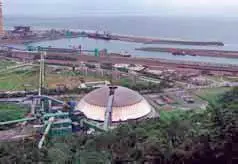
Dry bulk cargo which is awaiting shipment or which has just been discharged needs to be stored temporarily within the port area, normally within less than a kilometre of the quayside. In the past it has been standard practice to stockpile material which is not damaged by the weather (notably rain) in the open air, while perishable materials have been stored under cover. Commodities such as coal, iron ore, limestone and wood chips could be included in this first category, and cement, grain, alumina and animal feeds in the second. Coal and iron ore are usually kept in large stockpile areas capable of accommodating 500,000t or more which are traditionally located a long distance from residential housing and urban areas. However, windblown dust especially from open-air coal stockyards can be carried by wind over a considerable distance and in the face of tightening air-quality legislation this state of affairs is becoming increasingly unacceptable. A partial remedy is to erect some kind of wind protection barrier around the stockpile and another is to constantly spray the pile with water, to which can be added a chemical agent either to increase its wet ability or a surfactant designed to form a crust on the surface of the pile to prevent escape of dust. It is widely recognised that such measures provide less than perfect answers to the problem, apart from which chemicals added to water spay systems are expensive as well as environmentally undesirable. Furthermore – somewhat paradoxically – a coal stockpile which has been soaked by water sprinklers can in certain circumstances suffer from internal hot-spots, even to the extent of causing a risk of spontaneous combustion. Even as long ago as the early 1980s many Japanese ports, which because of that nation’s high population density are rarely located far from human habitation, began storing coal in giant silos to get round the problem of wind-blown dust pollution. Indeed they went a stage further by installing continuous mechanical ship un loaders to provide dust free ship-to-shore transfer of the coal from ocean-going bulk carriers, and the cargo was then transferred from the un loader to the silo by means of totally enclosed pipe conveyor systems (belt conveyors which maintain a cylindrical cross-section by having their outer edges overlapped at the top to enclose the conveyed material completely). In this way large tonnages of coal were imported in a 100% dust free manner. A further advantage of the pipe conveyors is that, apart from protecting the environment from dust pollution, they also protect the material being conveyed from contamination or rain damage. Because the return strand of the pipe conveyor is also kept closed, even over distances of a kilometre or more, there have been instances for example of imported coal moving from the quayside to silo storage, while simultaneously an export commodity is conveyed inside the return pipe conveyor strand in the opposite direction towards the quayside, thereby maximising use of the conveyor system while achieving huge energy savings. Other parts of the world, especially Europe, are now adopting the use of silos for covered storage of coal and a major player in this field is ESI Eurosilo of the Netherlands which has delivered many such installations throughout the world. Apart from the environmental advantage of storing the coal in a dust free manner, it can be discharged reliably and at precisely regulated rates of flow. Giant Eurosilo systems have also been delivered for storing potato starch, soya beans, potash, borax and ammonium sulphate. In preference to vertical silo storage, certain parts of the world including North America and the Far East, favour the use of dome storages for materials such as fertilisers, salt and limestone. Although domes are easier and quicker to erect, they are more wasteful of surface area. They are therefore less likely to be specified in port areas where space is at a premium.
Related Articles
 ENERGY & TECHNOLOGY GREENPORT
 ALTERNATIVE FUELS GREENPORT
 ENERGY & TECHNOLOGY GREENPORT