![GreenPort[PortStrategy]](https://www.portstrategy.com/greenport/wp-content/uploads/sites/4/2026/09/GreenPortPortStrategy.svg)

Electrifying the waterways
A Lithuanian ship designer and battery maker have struck up a partnership to electrify inland waterway transport.
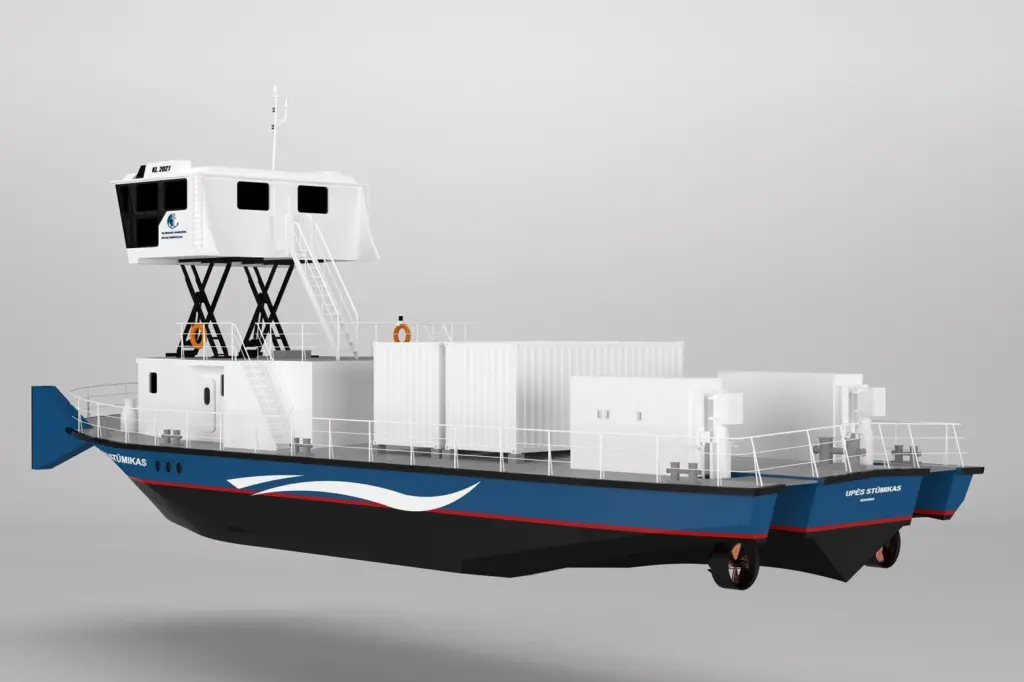
Western Baltic Engineering (WBE) is accelerating the development of its recently unveiled electric ‘pusher’ vessel with the signing of a new partnership with AYK Energy.
The agreement will see the companies collaborate on building the first electric pusher vessel, named the Electric Eel, for the Lithuanian Inland Waterways Authority before expanding to the wider EU market.
Eglė Mikalauskienė, head of sales & marketing, WBE said the partnership with AYK Energy will ”supercharge the company’s drive to roll out different models of the ground-breaking vessel for use on Europe’s inland waterways and other major markets like the United States.”
Growing market
The design partnership comes as the EU is ramping up pressure on member states to shift cargo from road to eco-friendly vessels on Europe’s extensive inland waterways network.
Presently road freight, accounts for 75% of inland cargo, while inland waterways account for just 6%t. EU studies indicate that inland waterway transport and short-sea shipping should increase by 25% by 2030 and by 50% by 2050.
This new partnership will focus on initially deploying the Aries + model 17.6 KW hour li-ion batteries with the potential to expand to its 23.3 KW hour Centarus & Aquarius ranges.
WBE’s Electric Eel design is pending class Approval in Principle with Bureau Veritas and can operate at a range of 300km before needing to stop.
The 26m long vessel is powered by three DNV approved AYK made batteries with a combined weight of 74 tonnes, two held in teu containers on deck which can be replaced via crane at harbour and one permanent battery below deck which can be charged at quayside.
The vessel has a pushing capacity of 2000 tonnes and a top speed of 22Km/h downstream at 85% engine load. The electric batteries create an engine power of 500 HP/400 KW compared to a diesel equivalent which has 1000 HP/800 KW.
Another innovation on board is the use of a wind turbine to generate 5KW of additional electricity for lighting, the galley and crew facilities.
Related Articles
 ENERGY & TECHNOLOGY GREENPORT
 ALTERNATIVE FUELS GREENPORT
 ENERGY & TECHNOLOGY GREENPORT