![GreenPort[PortStrategy]](https://www.portstrategy.com/greenport/wp-content/uploads/sites/4/2026/09/GreenPortPortStrategy.svg)


EXCLUSIVE: Embracing the market shift towards electrification
As the industry continues the race towards electrification, GreenPort talks to Liebherr Container Cranes about market demand for its products in its 25th year of business.
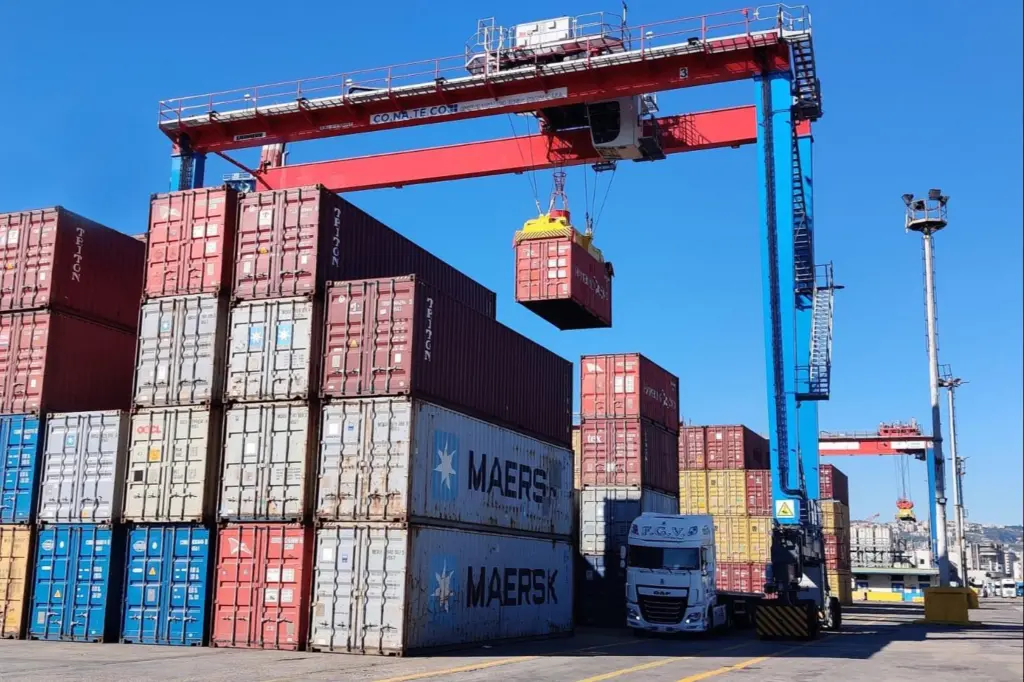
Liebherr continues to see strong demand for electric container cranes, driven by a continued strong demand for sustainable solutions across the board.
The company offers electric versions of all its cranes, but on the RTG front, the shift towards fully electric and hybrid solutions is accelerating.
“Terminals are prioritising energy efficiency, reduced operating costs and lower emissions. All our electric cranes allow our customers to capture energy when braking and hoist lowering, further reducing emissions and running costs,” Trevor O’Donoghue, Liebherr Container Cranes Ltd, tells GreenPort.
Taloured offering
Liebherr’s RTG range offers full electric RTG cranes with either a conductor bar or a cable reeling drum solution.
This offers customers the flexibility to choose based on their own particular operational requirements.
“In addition, our hybrid range of RTGs are perfectly suited to ports who want to take advantage of sustainability benefits, but for one reason or the other, a full electric solution is not for them, adds Mr O’Donoghue.
To facilitate cross-travel between stacks, Liebherr has deployed both ancillary gen-sets and the proprietary Liebherr LPO battery.
The LPO battery has a unique distinction of being portable and exchangeable between different RTG’s – an economical alternative considering the infrequent nature of cross-travelling in most terminals.
In addition, Liebherr has developed its own proprietary advanced crane simulation software featuring energy modelling. It provides precise predictions of fuel and electrical power consumption.
Built on experimentally validated energy models, the software helps terminals optimise energy use and reduce costs. However, it goes beyond energy analysis by offering a full economic assessment of different power system options, factoring in depreciation, productivity, power costs, inflation and maintenance.
Crucially, it can also assess a customer’s specific operational setup and recommend the optimum power solution, ensuring maximum efficiency, sustainability, and long-term savings.
“Our container cranes feature Liebherr Liduro drive systems,” says Mr O’Donoghue.
“These custom-built drive systems are designed specifically to operate with our cranes and include smart power management ensuring optimal performance.”
In addition, he points out that automation solutions from Liebherr further allow port operators to optimise the operation of their cranes, reducing energy consumption further and bringing predictability and reliability to operations.
Efficient eRTGs
In March 2024, Liebherr delivered four electric rubber tyre gantry cranes (eRTG) to Italian ports, marking its first RTG deliveries in the country.
One eRTG was supplied to Salerno Container Terminal (SCT), operated by the Gallozzi Group and three went to MSC subsidiary, Consorzio Napoletano Terminal Containers (Conateco) in Naples.
“Sustainability was central to these projects. Both SCT and Conateco, along with Liebherr, have comprehensive sustainability and corporate social responsibility policies,” says Mr O’Donoghue.
“All parties are committed to the United Nations Global Compact on Human Rights and are dedicated to fostering resilient, sustainable supply chains and accelerating the transition to a net-zero future.”
When it comes to the nitty-gritty of efficiency and sustainability figures, Mr O’Donoghue says that Liebherr’s eRTGs offer significant savings in fuel and maintenance costs.
Compared to traditional RTGs, Liebherr eRTGs reduce CO₂ emissions by up to 95% when operating on renewable electricity.
Liebherr container cranes provide compelling lifecycle emissions due to the highly optimised steel construction, power regeneration of up to 80% and a well-established track record in longevity due to stringent manufacturing practices and use of the highest quality raw materials and components.
Furthermore, Mr O’Donoghue points out, that its hybrid machines, depending on configuration can offer over 50% savings in emissions and energy consumption versus traditional variable speed generator machines.
Automated efficiency
In addition to electric options, automation solutions from Liebherr further allow port operators to optimise the operation of their cranes in addition to making them cleaner and more efficient.
Mr O’Donoghue says: “Remote-controlled and autonomous systems are at the forefront of port technology innovation, driving efficiency, safety, and sustainability across global terminals.”
At the CSX Carolina Connector Intermodal Terminal in North Carolina, Liebherr’s three fully automated RMG cranes operate without an onboard cabin.
These machines use Liebherr Remote Operator Stations (ROS) for supervised moves and exception handling.
In Australia, Liebherr’s cabinless STS crane at Patrick Terminals – Brisbane AutoStrad marks a significant leap forward.
This semi-automated crane integrates extensive automation with a ROS that allows operators to manage pick-and-place operations from an office environment.
Liebherr has also recently delivered remote-controlled RTGs and RMGs to APMT Rijeka in Croatia and there are also remote and automated STS and rubber‐tyred gantry (RTG) cranes destined for Duqm, Oman in the Middle East.
“Overall, the growing demand for remote-controlled and autonomous solutions reflects the industry’s focus on maximising efficiency, minimising downtime and achieving a more sustainable operational footprint,” says Mr O’Donoghue.
He says that Liebherr’s tailored approach to integrating advanced sensors, data analytics and automation expertise, helps ensure that each terminal receives a solution best suited to its specific operational setup.
25th anniversary
This year 2025 marks 25 years of the Liebherr RTG, a significant milestone in the company’s history.
At the beginning of the journey, early developments like automatic steering, destination control and stack profiling provided operators with enhanced precision and efficiency.
These tools have since evolved to meet the growing demands of the modern port, integrating seamlessly with automation and remote operation technologies.
Today, Liebherr offers full and semi-automatic solutions across the RTG range.
Its ongoing commitment to sustainability ensures that each new generation of RTG delivers significant reductions in emissions and energy consumption, contributing to a greener future for the port and terminal industry.
Mr O’Donoghue says that to celebrate its 25-year anniversary, Liebherr is reflecting on its past successes, highlighting the key technologies and innovations that have shaped its machines, but also looking ahead to future enhancements.
“Our focus remains on maximising productivity and sustainability while maintaining the performance and reliability that have defined Liebherr RTGs for a quarter of a century,” he says.
Liebherr’s eRTG arrives in Italy
One of the most recent markets to receive Liebherr’s eRTG is Italy.
In March 2024, Liebherr delivered four electric rubber tyre gantry cranes (eRTG) to two Italian ports, marking its first RTG deliveries in the country.
The eRTG supplied to Salerno Container Terminal (SCT) and operated by the Gallozzi Group, is among the largest Liebherr as ever produced and is capable of handling container stacks ten wide and six high.
All four cranes feature a hybrid powertrain, operating on both diesel and electricity via a cable reeling drum. This design enables emission-free container handling when connected to the grid and offers significant energy savings through onboard power regeneration.
Liebherr has long been a key supplier of RTGs to Italy via its longstanding agent Macport. Macport play a key role in the sales and service of Liebherr maritime cranes in Italy, Bulgaria, and Albania.
The eRTG for SCT is the latest Liebherr machine to be delivered to the terminal and joins four Liebherr Harbour Mobile cranes in container handling configuration and six Liebherr reachstackers already at the port.
Also in 2024, three eRTGs were delivered to Consorzio Napoletano Terminal Containers (Conateco) in Naples, an MSC subsidiary.
Conateco in Naples is at the beginning of its journey with Liebherr.
Its new Liebherr eRTGs are set to increase efficiency, streamline operations, improve cargo handling capacity and contribute to the economic growth of the local hinterland.
Related Articles
 ENERGY & TECHNOLOGY GREENPORT
 ALTERNATIVE FUELS GREENPORT
 ENERGY & TECHNOLOGY GREENPORT