![GreenPort[PortStrategy]](https://www.portstrategy.com/greenport/wp-content/uploads/sites/4/2026/09/GreenPortPortStrategy.svg)





Data drives development
As automated reefer monitoring systems rapidly take over from manual inspections within container terminals, the technology is moving away from purely monitoring temperatures and including a greater emphasis on analysing data.
This can be seen by an increased interest in using such systems for energy monitoring, allowing operators to use the data to reduce reefer energy usage. Julian Galvis, Identec Solutions VP Sales Marine & Ports, says: “That’s the future of our solution – it goes beyond the monitoring of temperature and humidity; we are past that as an industry. It is now more about the administration of the whole reefer process.”
A major trend has been to integrate reefer monitoring systems with other port platforms. This too has allowed data to be used more effectively. Donald A. Vinson, President and CEO, RTE notes: “Over the years, terminal operators have become much more sophisticated using technology and data. By comparison, reefer monitoring was typically a stand-alone system in the past. Today it is uncommon to find RTE systems not integrated with other platforms, especially Terminal Operating Systems (TOS). The data collected by our reefer monitoring system is integrated with other data to allow the user to make operational decisions. As a result, our GRASP system(s) have continued to add new features and integration methods.”
As reefer containers continue to increase in terminals, the investment in automated reefer monitoring solutions will continue to grow.
DATA ANALYSIS, DESIGN INNOVATION, ENERGY MONITORING, NEW ORDERS
Automated Reefer Management Systems (ARMS): ARMS has developed a system for automated power and reefer connections. It has identified the operational area management of the storage of reefers as needing improvement in terms of safety and operability. It points out that port personnel are still contributing to the area’s management both directly and manually. To solve these issues, ARMS has developed its ARMS plug, with the support of industry partners Identec Solutions, SCAME SPA, Crouzet SA and Nuova Icom. Used in the terminal or onboard ship, the solution automates the connection of refrigerated containers, and remotely manages electrical and data connections, continuously checking the status of reefers and detecting their electric consumption. Its mechatronic arms ARMS 1-2-1 and 1-2-n, currently in the industrialisation phase, allow the operating system of the terminal or ship, with which it interfaces, to remotely manage the connection and disconnection of electrical power and data lines on refrigerated containers. Its operating system also maintains a complete monitoring of the operating parameters and the state of reefer boxes using the integrated ReeferRunner system produced by its partner Identec Solutions.
Copeland: Copeland’s REFCON 6 is an automated terminal solution that covers the entire container terminal. Two-way communications between an operator and every reefer container can take place 24/7, and all data is securely logged for event history and documentation purposes. Data from local REFCON 6 systems is consolidated and stored by connectivity, software and service management programme ProAct Transport. Centralisation of data on a secure web server makes it possible for container terminals to establish automated remote management of all reefer containers, covering their entire stay at the terminal. Augmenting the REFCON 6 software, REFCON 6 portable modems and REFCON wireless hubs provide monitoring solutions for refrigerated containers at various sites, offering complete coverage. The REFCON portable modem can be directly plugged into the log retrieval port or connected using an extension cable, depending on the specific application. Once connected, all data is transmitted wirelessly to REFCON, where terminal staff can oversee data and alarms. Steven ter Beek, Sales Director, Copeland Europe, singles out data security as a major priority. The REFCON portable modem solution uses Bluetooth Low Energy (BLE) 5 as its wireless interface. “With its high-security standards, the use of this interface helps to protect data security,” he says. The REFCON portable modem is also equipped with built-in security keys for additional protection against external threats. By using BLE as the communication protocol, the REFCON Portable Modem eliminates the need for recharging and replacement at the end of the battery’s life.
Identec Solutions: Identec Solutions’ Reefer Runner is continuing to develop and expand in both its usage and capabilities. There are now almost 60 deployments of Reefer Runner worldwide, including eight of the world’s Top 10 global container operators. The remote monitoring and control system gives terminal operators real time visibility of every reefer container through its robust wireless technology. Once connected, all monitoring data and energy consumption is visible. It integrates directly with available TOS systems. Julian Galvis, VP Sales Marine & Ports, Identec Solutions, notes: “In addition to seeing more and more customers taking advantage of our system for invoicing and billing, they are using our system’s data to determine how much energy and costs associated with energy are being consumed. They can use that information to determine whether or not their tariffs are aligned with what the actual consumption is, and it gives them the option to switch to dynamic pricing rather than flat rates.” He says that this represents a “game-changer” for Reefer Runner’s customers. Reefer Runner teamed up for a trial with ABB in the Mediterranean in 2021, which allowed informed decisions to be made about reducing energy being used. For example, based on the information provided by Reefer Runner, peak shaving was able to be carried out during peak times for reefer energy usage, which allowed peak demand to be cut by 20 per cent and peak consumption by 25 per cent. Identec Solutions hopes to launch Reefer Runner Pro next year, which will include not only management and administration processes, but will help customers invoice for value added services such as repair and maintenance. “There will be more reliance on our system for not just for monitoring but for day-to-day management,” underlines JulianGalvis.
Elsewhere, Reefer Runner is expanding its offerings by moving to a 5G option for small terminals that want a subscription, cloud-based solution.
Recent up-take: Indentec Solutions is in the process of taking Reefer Runner live at the Terminal Investment Limited (TIL) terminal at the Port of Santos, Brazil’s largest container terminal facility, representing its first installation in the country. Reefer Runner became operational in December 2021 at Puerto Bolivar, Ecuador, as part of Yilport’s initiative to boost productivity. Last year Reefer Runner was installed for 770 reefer points at OPCSA in the port of Las Palmas, Gran Canaria, providing staff with more time for value-added services.
Lumel: Poland-headquartered Lumel developed its reefer monitoring system following a request from a customer responsible for reefers at a container terminal. The problems to be addressed included a lack of supervision over the parameters of container power supply, lack of information about power supply interruptions as well as lack of possibility to provide the goods receiver with documentation relating to continuous power supply to the container. Therefore Lumel, which manufactures industrial automation devices, developed a mobile measuring case for the container which is made of materials ensuring water and dust protection as well as low weight. It deploys a measuring circuit consisting of a power network analyser, current transformers and necessary protection devices. Built-in Wi-Fi and/or GSM modules guarantee wireless communication, providing remote access to the current and archived measurement results 24/7. Benefits include full control over the parameters of the container power supply; at any time, the administrator can connect to devices via Wi-Fi or GSM networks and an immediate text message is generated in case of any problems with the container power supply.
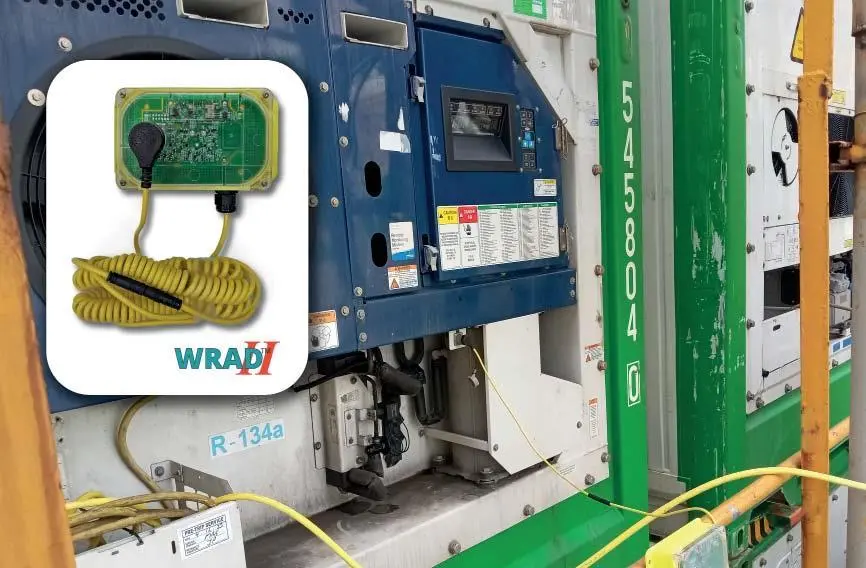
Refrigerated Transport Electronics (RTE): RTE has been in the reefer monitoring business for nearly four decades. It says that it introduced the first commercially available remote reefer monitoring solution in 1985 and the industry’s first wireless reefer monitoring system in 2011. Today, the company offers several monitoring solutions for vessels and terminals, including RF communications and reefer energy analysis. A driver for the development of RTE’s products is customer feedback and the company’s engineering team reportedly strives to develop unique solutions that “prioritise simplicity and functionality, tailoring them to meet the changing demands of our clients”. RTE’s latest product, the WRAD II wireless reefer monitoring device, is the second generation of its Wireless Reefer Acquisition Device. Equipped with Bluetooth wireless technology, RTE says it provides “fast and reliable low-energy connectivity crucial in a port environment”. The company has also included NFC capability to ensure efficient installation, setup, and diagnostic interaction for on-site personnel. RTE says: “Our goal is to get data to the user using various methods. An example is our added product features that provide empirical data and visually aided feedback to ascertain changing reefer conditions.” RTE’s site-based reefer monitoring solutions are currently used in over 80 terminals worldwide.
Related Articles
 EQUIPMENT