![GreenPort[PortStrategy]](https://www.portstrategy.com/greenport/wp-content/uploads/sites/4/2026/09/GreenPortPortStrategy.svg)
Bergen targets sustainable cruise
The Port of Bergen has established a strategy for reducing the environmental impact from cruiseships, writes Susan Parker
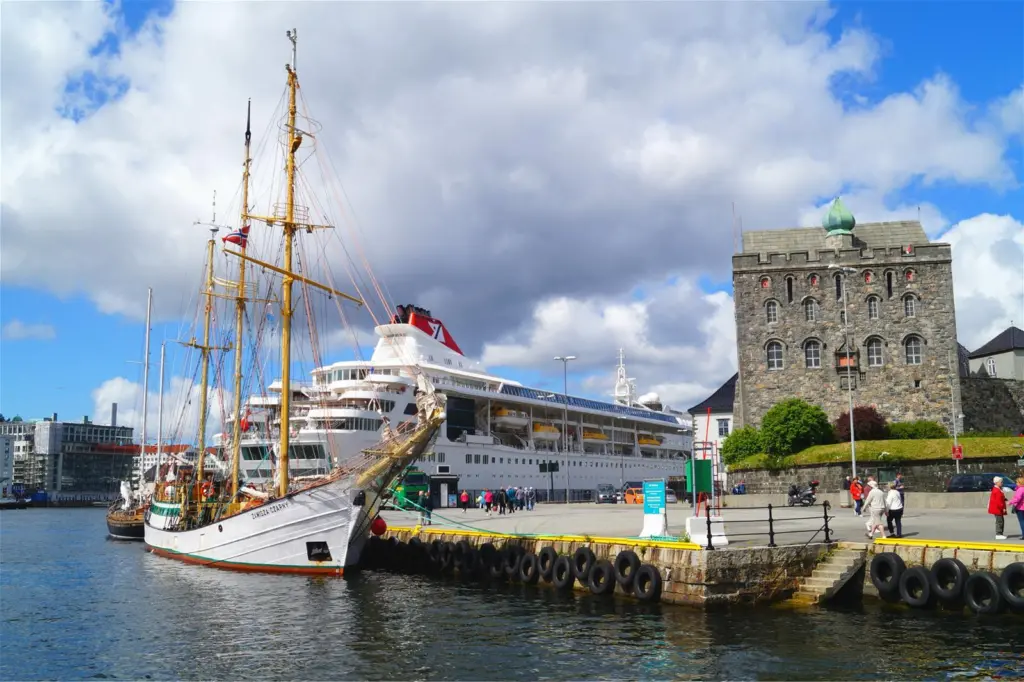
A combination of booking reservation criteria, infrastructure development and differentiated port dues enables the port to steer the development in a good direction, explains Even Husby, head of environment Port of Bergen. “It is important to establish a holistic approach to environmental management.”
He adds that all measures need to be aligned with the different stakeholders, which include shipowners, politicians and policy makers. The port has emphasised a process where shipowners are given due notice regarding changes. “Our goal is to respect the planned activities, stimulate to an improvement today and pave the way for a more sustainable approach further down the road.”
Multi-pronged approach
In terms of infrastructure Hurtigruten’s and P&O Cruises’ newbuilding Iona (19 calls were scheduled prior to the coronavirus pandemic) are due to bunker LNG this year. Both will be served by Gasnor Shell with the LNG being sourced at Kollsnes just outside Bergen.
There is also work underway to establish bunkering opportunities for hydrogen. Mr Husby says: “We are currently looking into a risk assessment. We assume it is a bit more challenging than LNG in terms of handling, given the higher energy density of hydrogen and the need for cooling of the liquid gas at -253˚C. Viking is planning a hydrogen ship. The county council is also planning for hydrogen-fuelled passenger boats. We need to look at how our port can adapt to the specific bunkering requirements for hydrogen.”
Different options are being considered but the assumption is that bunkering is not an option at, for example, the city centre quays. Acknowledging that it is in the early stages, he is pretty confident that: “We will most likely find solutions.”
A sewage reception facility which has been planned for a very long time is now under construction and due to be completed this year. Pipeline connections will be available at the three quays at Skolten and Bontelabo and for expedition ships at Festningskaien close to the city centre.The costs will be around NKr 8 million (€0.71 million) in total.
The port has invested NKr 140 million (€12.3 million) in an onshore power system (11kV/32mW/60hZ) which is due to be operational in May. This will be available at four quays with three parallel connections being possible. A power cable had to be fitted in the sea in order to connect the fourth quay at Jekteviken which is further away. Out of the 350 calls that were scheduled this year, 115 can theoretically be connected.
Mr Husby comments: “We think this is really good news. It shows that shipowners are making themselves ready, adapting to the requirements and the opportunities. We think it is a good indicator for what is happening which is positive. Hurtigruten are already plugging in and we have had requestsfrom several shipowners wanting to connect.”
Incentivisation
Beginning in May 2019, the port implemented a system for the environmental assessment of cruiseships called the Environmental Port Index (EPI), a joint venture with DNVGL and 11 other Norwegian cruise ports, extending to 16 this year. Husby comments: “Experience from running the system from May 2019 shows that an average cruiseship may reduce SOx emission with 10 kg/hour and CO2 emissions with 20% during a port stay.”
Upon departure each cruiseship delivers an environmental report to the EPI web system. Based on the report, the port receives a complete account of emissions (NOx, SOx, PM, CO2) plus an EPI score. The latter is an indicator of the ships environmental improvement while in port compared with a baseline. A high score means that the ship has done a good job reducing environmental impact. Typical measures include using better fuels, running the emission reduction systems in an optimal way and reducing energy consumption.
The port connects EPI to the local fees: “We would like to motivate the shipowners to operate in a green way. For example last year some of the shipowners with older ships are building new tanks on ships to carry LSF. Shipowners are getting used to the reporting. The feedback has been very good actually. The EPI means we are paying attention to what owners have been asking for a long time. In a way we are honouring what they are doing.”
While Mr Husby says that some years ago the public arguments were very much focused on the environmental impact of the ship, this has to a large extent disappeared now and will totally when the ships connect to shorepower. “What we are left with is the amount of passengers coming onshore.”
The City of Bergen has already asked the port to put into effect a limit on the number of calls and passengers a day to three and 8,000 respectively. Operationally the port is obliged to receive all ships calling. However it can limit the number of calls by only confirming future reservations when certain criteria are met. These include the environmental profile of ships (NOx, Tier I or shorepower interface) and not exceeding the maximum numbers as above. Mr Husby adds: “How to receive tourists in the best way at attractions is now being addressed.”
Finally he comments: “I think we have achieved a lot. We have managed to actually stop a lot of the negative discussion from politicians and local government. In the last five to six years I think we have moved from sitting in the back seat to driving the process. We now have the facts and relationships to deal with this in a good way. It has been a very beneficial process.”
Related Articles
 ENERGY & TECHNOLOGY GREENPORT
 ALTERNATIVE FUELS GREENPORT
 ALTERNATIVE FUELS GREENPORT