![GreenPort[PortStrategy]](https://www.portstrategy.com/greenport/wp-content/uploads/sites/4/2026/09/GreenPortPortStrategy.svg)
Electrification powers Kiel’s green future
The Port of Kiel is pushing ahead with port electrification, moving to cut port emissions by supplying shore power to ferries and cruise ships.
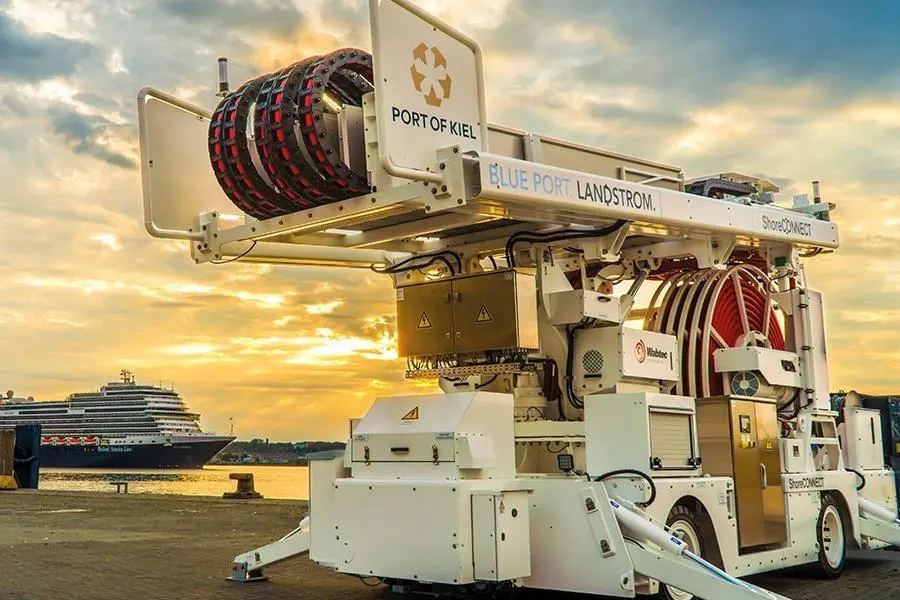
Kiel has now completed the final phase of construction on its extensive shore power infrastructure. With this new expansion, the port can now supply up to three cruise ships and four ferries with emission-free electricity at the same time.
”With this commissioning, we as a port are completing the development of our shore power infrastructure. Seven seagoing vessels can now be supplied with green shore power at the same time in the port of Kiel – including three cruise ships,” said Dr Dirk Claus, managing director at Seehafen Kiel GmbH & Co.
”We have invested €50 million in shore power alone in recent years and were already able to reduce ship emissions by 60% last year through shore power supply. By 2026, we will be supplying 80% of all ships with shore power.”
Long journey
Kiel began its journey in 2019 with daily shore power supply to Color Line ferries, later expanding to Stena Line ferries and cruise vessels such as AIDAsol.
By 2024, more than 270 cruise ship calls had been powered at berth, avoiding unnecessary fuel use and significantly reducing air pollutants.
The development of port infrastructure has been central to Kiel’s success. Following the first facility at Norwegenkai in 2019, larger combined systems were built at Ostseekai and Schwedenkai in 2021, capable of supplying both ferries and cruise ships with up to 16 MVA.
In September 2023, a further expansion at Ostuferhafen connected four berths, boosting capacity to serve one cruise ship and two ferries simultaneously.
Despite a temporary interruption during construction, the port anticipates delivering around 10 million kilowatt hours of shore power again this year, a figure consistent with 2023.
Port electrification plays a key role in Kiel’s goal to completely eliminate its CO₂ emissions by 2030.
Related Articles
 ENERGY & TECHNOLOGY GREENPORT
 ALTERNATIVE FUELS GREENPORT
 ALTERNATIVE FUELS GREENPORT