![GreenPort[PortStrategy]](https://www.portstrategy.com/greenport/wp-content/uploads/sites/4/2026/09/GreenPortPortStrategy.svg)
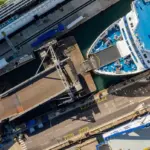
Environmental protection at Bremen Ports
A new publication from the ports of Bremen and Bremerhaven explains the ongoing environmental protection that is being undertaken
The ports of Bremen and Bremerhaven have a clearly defined environmental strategy and an extensive environmental work programme, both of which are explained in detail in a recently published book entitled ‘greenports Bremen/ Bremerhaven’.
The comprehensive report describes how environmental protection plays an increasingly important role in the port’s offices and workshops. With the support of many sectors: maritime logistics, terminal operators and shipping lines, the ports are not only changing over company fleets to low consumption vehicles, generating their own solar energy, efficiently disposing of waste, ensuring that workflows are as ecological as possible and adhering to International Maritime Organisation regulations, but also working within additional constraints set by the ports’ location.
Ecological standards
Whilst the city of Bremen is surrounded by a pronounced green belt, the area at the Weser estuary has brackish water habitats, as well as, sensitive salt meadows, mudflats and sandbanks that form part of the Wadden Sea National Park of Lower Saxony. Classification of these areas as flora-fauna habitats (FFH) by the European Union means that nature conservation and environment protection have to satisfy even more stringent criteria than before.
The National Park has set ecological standards for many years, so that many rare species of animals and plants already have protection. More recently large areas of the Weser have been declared an EU protective zone for anadromous fish. Moreover, further stretches of the river between Bremen and Bremerhaven have been declared special protection areas for birds and FFH sites.
If new water and port projects destroy or even affect protected habitats, equivalent natural areas have to be created. The Impact Mitigation Regulation in force in Germany is a recognised and successful procedure which has successfully been practised by port construction engineers and environmental planning specialists. Their brochure explains the unique and ingenious ways in which the ports of Bremen have offset the impact of port activities and development on nature.
Compensation and substitute areas
Modern day practice now dictates that if the environment loses out when port facilities are built, the natural habitat has to be restored elsewhere. Following the success of the substitute area created, Tegeler Plate, to compensate for the damage caused by the development of Container Terminal III, where engineers proved that the impact on the environment can be successfully balanced, a similar compensation project was implemented for the more recent construction of Container Terminal IV.
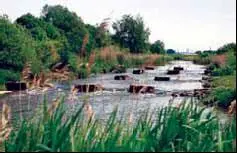
In 1997, Tegeler Plate, an area beside the Weser was chosen as the central substitute site for the huge Container Terminal III project in Bremerhaven. The environmental engineers created an extensive tidal area in the marsh, where the sea flows in and out of the tidal channels of this man-made ecological area. The 280-hectare site used to be intensively farmed, but the effects of the tides now allow natural and near-natural habitats to develop. The landscape is defined by reed beds, tidal channels and ponds. At higher levels, there are barren areas that are now used for extensive farming.
The compensation measures for the construction of the latest port expansion project, Container Terminal 4, posed a particularly difficult challenge for the planning engineers. Habitats and sanctuaries of international standing are being developed on Grosse Luneplate and along the Wursten coast and are protected by long-term agreements. The central substitute site for the new terminal is located on Luneplate. The environment planners used heavy-duty machinery to construct a 220-hectare tidal polder near the village of Dedesdorf in Lower Saxony. From 2010 onwards, water from the Weser will flow into the intricate system of tidal channels, creating new mudflats and reed beds which will provide a refuge for rare species. At low tide, most of the polder will dry out again. Bremenports have had a flood barrier built in the Weser dyke to ensure the necessary protection against high tides. A new tidal pumping station will control water intake and drainage, while a roughly three-and a-half metre high earth wall will serve as a boundary between the polder and the hinterland. The adjoining 290 hectares of grassland and ditches will provide a new refuge where rare species of birds can rest and breed.
There are valuable bird habitats in, and around Bremen and Bremerhaven, such as the tidal landscape of the Wadden Sea, or the vast grassland and ditch zones of the North German marsh. Innumerable migrant birds rest on these sites before setting off to breed or overwinter in other regions. The high-water resting sites are particularly important, as they provide a refuge at high tide for birds which search for food in the mudflat and shallow water zones of the southern North Sea. When planning the compensation measures for the impact caused by the major CT III and CT 4 terminal projects, the engineers had the chance to design new refuges for many species on Luneplate and along the Wursten coast. The reed beds, ditches and ponds that make up the wilderness of Tegeler Plate are dominated by extensive sedge growth and barren land, ditches, tidal pools and channels that are bordered by mudflats. More than 100 pairs of warblers – especially Eurasian reed warblers and sedge warblers – have found a new home here. Rare songbirds such as bluethroat and bearded tit have also been observed. The number of birds breeding in the reed beds has increased tenfold since this site was redesigned and there are now around 200 pairs.
As compensation for the impact on nature caused the construction of the new Kaiserschleuse lock, Bremenports has developed a substitute pool beside the Drepte, a tributary of the Weser. The 32- hectare site lies within the boundaries of Hagen local authority. Earth walls will be opened up and relocated along the banks of the Drepte to create a flood plain with wetland zones and a new shallow pool with highly diverse bank structures. The advantages of this pool are not only ecological. The Drepte site simultaneously enables compensation for several port construction projects, which substantially lowers the costs and takes the pressure off the port investment budget. Moreover, the fact that the substitute pool is already available means that the individual projects can be approved faster, saving time and therefore money.
Cattle country
The vegetation on extensively used grassland areas often consists of grasses and herbaceous plants that are unsuitable for high-yield cattle. Accordingly, the environment planning engineers at Bremenports opted for a tough breed that does not require high-quality grazing and that can remain outside all year round.
The cattle prevent woody plants from spreading on the site, because they eat these plants when the meadows do not provide enough green fodder in winter. In the Drepte flood plains, Bremenports has introduced Fjell cattle, an endangered domestic breed from Sweden. In this case, the animals come from Nordhorn zoo. Water buffalo have been kept on the sites inside the dyke on Luneplate since August 2005. These four-legged “landscape gardeners” have played a crucial role in converting former arable land into prime ecological grassland. Fourteen animals currently make up the herd and there are plans to introduce water buffaloes to neighbouring sites in future.
Another grazing project is in progress in the north of Tegeler Plate. A sand deposit site that was created when the Weser was deepened has been left to develop naturally. Here, the use of galloway cattle has proved successful, as the areas are gradually changing their structure and developing vegetation-free zones which are specifically welcomed. The galloways are helping to create valuable habitats for rare species of animals and plants.
Fish ladders and navigation
Many species of fish need slow-fl owing, shallow water with rich vegetation in which to spawn and rear their young. When the Weser was upgraded to provide a high capacity shipping route, embankments and sheet piling were installed in Bremen – a benefit for shipping, but not for fish.
In the 1990s, Bremen had the harbour basin of Überseehafen filled in. To compensate, the Werdersee Lake was linked up to the Lower Middle Weser. This improved the spawning opportunities for fish in the Weser. The weir at the Kleine Weser and the connection to Werdersee was modified to enable the fish to move upriver without any barriers.
Water from the Weser now flows into the Überseehafen at Bremerhaven through a free-flow canal. However, construction of the canal meant eliminating a shallow water zone at the bank, so that compensation was again necessary. Since then, Bremenports has operated the lock at the flood barrier in the Geeste, to enable fish to overcome this obstacle. Instead of ships, fish enter the lock chamber, lured by the current, and leave the lock again on the other side to continue their passage upriver.
Integrated management and maintenance plan for Luneplate
Port ecologists and nature conservationists now follow the legally prescribed objective of preserving the protected habitats and species on the Grosse Luneplate and the areas forming the Lower Weser European bird protection zone. Preservation is and will continue to be achieved by means of a so-called “ban on degradation” and by prescribing impact assessments for all plans and projects. A management and maintenance plan is also being developed for Luneplate in consultation with farmers, hunters, anglers and other users. In its capacity as Port Management Company, Bremenports is responsible for the upkeep and development of these extensive substitute sites. Tasks which fall within the responsibility of the environment authority are also integrated in the management and maintenance plan.
Bremenports is currently preparing a website about ‘greenports Bremen/Bremerhaven’ which will deal specifically with marine environment protection at the ports and business enterprises.
Related Articles
 ENERGY & TECHNOLOGY GREENPORT
 ALTERNATIVE FUELS GREENPORT
 ALTERNATIVE FUELS GREENPORT