![GreenPort[PortStrategy]](https://www.portstrategy.com/greenport/wp-content/uploads/sites/4/2026/09/GreenPortPortStrategy.svg)

EXCLUSIVE: Asyaport: The port that powers itself
For Asyaport, Turkey’s largest container port and the country’s only terminal to rank in Lloyd’s List’s global port index, onshore power is not merely an upgrade.
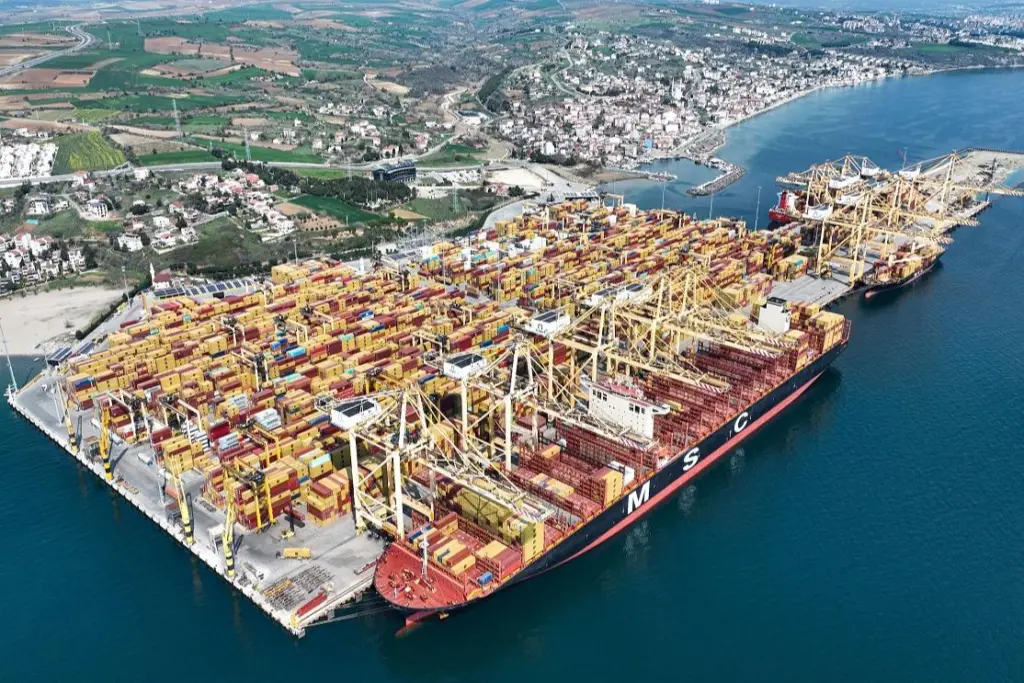
It is the cornerstone of a long-term strategy to eliminate emissions, electrify operations and catalyse systemic change across the wider maritime value chain.
“Asyaport’s sustainability vision is built upon the principles of operational excellence, carbon reduction and inclusive growth,” says Besim Dönmez, planning and technical services manager, Asyaport.
“Our main goal for 2030 is to achieve zero carbon emissions in our operations, maximise the share of renewable energy and integrate this transformation across our entire value chain.”
A strategic vision
When the MSC OSCAR, a 20,000 teu vessel, plugged into the grid at Asyaport in October 2024, the event marked far more than a technical achievement.
It signaled a decisive turning point in Turkey’s maritime decarbonisation journey and positioned the Tekirdağ-based terminal as one of Europe’s foremost early adopters of high-capacity shore power.
Part of Terminal Investment Limited (TiL), one of the world’s largest container terminal operators and majority-owned by MSC Mediterranean Shipping Company, Asyaport has aligned itself with the group’s wider sustainability ambitions.
These include decarbonisation, operational efficiency and the transformation of ports into hubs of green energy innovation. At Asyaport, that vision has become tangible through the commissioning of what is now one of Europe’s most advanced OPS systems.
“Shore power is not only an environmental investment; it is a social and operational one,” notes Mr Dönmez.
“Cleaner air, quieter surroundings and more efficient operations all contribute to a healthier, more sustainable future for our port and our people.”
As one of Europe’s earliest large-scale OPS deployments, Asyaport’s system has already supplied 4.7 million kWh of clean electricity to 88 ships since commissioning, avoiding 3,680 tonnes of CO₂ and eliminating the need for 1,150 tonnes of marine diesel.
With 8 MVA capacity enabling up to seven ships to plug in simultaneously, Asyaport is outpacing even many EU ports, at a time when only around 20% of required European shore power infrastructure is in place.
A holistic 2030 strategy
Asyaport’s leadership is driven by a structured sustainability roadmap looking toward 2030. Electrification is its backbone.
All STS and RTG cranes already operate fully on electricity, dramatically reducing fuel consumption.
The next phase includes the introduction of four electric terminal tractors by the end of 2025 and the port’s long-term goal is to transition every piece of terminal equipment to either electric or alternative-fuel models.
But this transition extends beyond hardware. The port’s strategy also embraces wider transformation pillars including digitalisation, operational capacity expansion, infrastructure modernisation, employee safety, community engagement and inclusive economic growth.
In this sense, the deployment of OPS is both a milestone and a signal, a demonstration that the port is committed to redesigning its operations around clean, renewable power from end to end.
An engine of decarbonisation
OPS on its own cannot decarbonise port operations unless the electricity supply is clean.
Asyaport recognised this early and has built one of Turkey’s most ambitious renewable energy portfolios among port operators.
It already operates more than 3,000 solar panels, generating around 6% of its electricity needs. But the ambition is far greater: The port aims to meet 100% of its annual energy demand, including OPS consumption, which totals approximately 30 million kWh, from onsite renewable sources by the end of 2025.
This includes plans for a 20-MVA wind turbine, which will allow the port to operate entirely on self-generated green power.
Once operational, Asyaport expects to become the only terminal in Turkey and potentially the world, to run exclusively on renewable energy generated within its own boundaries.
This energy could be fed back to the Turkish grid, that this is not the priority for the port. Its primary objective is to ensure that the port’s own energy consumption, including OPS supplied to vessels, is fully covered by renewable energy sources.
Future plans include exploring Battery Energy Storage Systems (BESS) to enable surplus electricity to be stored and eventually, exported.
This approach aligns closely with Turkey’s national electrification and renewable-energy strategy, which has accelerated significantly over the last decade.
Asyaport positions itself not only as a port operator, but as a contributor to this national transition, demonstrating how private-sector-led investment can accelerate progress even in challenging regulatory environments.
Preparing for the future
Shore power and electrification form the backbone of Asyaport’s current decarbonisation efforts, but the port is equally focused on its role in enabling future energy systems.
With global shipping accelerating its exploration of fuels such as LNG, methanol, ammonia, and hydrogen, ports are under pressure to prepare for a multi-fuel future.
Asyaport is already ahead of the curve. Its proximity to the BOTAŞ LNG Supply Facility, just 40 km away, offers a critical advantage and preliminary studies for both onshore and offshore LNG bunkering have already been completed.
Meanwhile, the port is monitoring hydrogen, methanol and ammonia technologies and participating in international research platforms such as the Valenciaport Foundation’s BlueBarge Project.
This multi-layered strategic engagement ensures Asyaport is not only prepared for technological shifts but is actively shaping them.
Overcoming obstacles
Transitioning a major port to full electrification and renewable energy is complex and Asyaport acknowledges the technical and administrative hurdles.
Yet the port also highlights a unique advantage: It was designed from inception with sustainability in mind.
“One of Asyaport’s greatest advantages is that it is a modern port, established in 2015,” explains Mr Dönmez.
“From the very beginning , the port was designed and built around a ‘green port’ concept with a robust, future-oriented infrastructure.”
Crucially, all major sustainability investments have been self-funded. Unlike many ports that rely heavily on EU or national funding mechanisms, Asyaport has chosen to develop its green systems – OPS, solar, wind and electrification, with internal resources alone.
Hundreds of vessel visits were analysed to ensure accurate OPS design parameters and the system was revised multiple times to align with IEC standards.
Asyaport’s advice to other ports is clear: Detailed planning, strong process management and unwavering commitment are vital.
“Energy transition is not only an environmental responsibility,” Mr Dönmez emphasises.
“It is also a strategic investment that enhances economic resilience and strengthens sectoral competitiveness.”
Social responsibility
Sustainability at Asyaport extends beyond energy and emissions.
The port’s 400-metre quay extension, due for completion in Q3 2026, will increase handling capacity to 4 million teu annually. This growth enables more efficient transshipment flows between the Mediterranean and Black Sea and strengthens Turkey’s competitiveness in global trade.
On the social front, Asyaport has emerged as a national leader in gender inclusion. More than 60 women now serve as crane operators, terminal tractor drivers and operational field staff.
“Women bring discipline, precision and focus to their work,” says Olkay Elçin, operations and maritime affairs manager at Asyaport.
“There’s no such thing as a man’s or a woman’s job in port operations – only dedication and skill.”
The port also engages in annual coastal clean-up programmes and recently saw the nearby Gündal Beach receive an “Excellent” water-quality rating, further evidence of its environmental stewardship.
A port role model
Asyaport says by combining electrification, renewable-energy deployment, forward-looking fuel strategy and social responsibility demonstrates how a modern port can become a catalyst for national and regional sustainability.
With its fully integrated energy-transition strategy, OPS system and plans for 100% renewable self-generation, the port now stands as a model not only for Turkey, but for port operators worldwide.
“Asyaport shows what’s possible when vision meets commitment,” says Mr Dönmez.
“We are proud to lead Turkey and Europe toward cleaner, smarter and more inclusive port operations.”
Related Articles
 ENERGY & TECHNOLOGY GREENPORT
 ALTERNATIVE FUELS GREENPORT
 ALTERNATIVE FUELS GREENPORT