![GreenPort[PortStrategy]](https://www.portstrategy.com/greenport/wp-content/uploads/sites/4/2026/09/GreenPortPortStrategy.svg)
EXCLUSIVE: Building on a sustainable tourism ethic
This time, Michele Witthaus talks to the Ports of Stockholm, about how the operator is leading the way in sustainable cruise initiatives.
With its location on the Baltic Sea, within easy reach of several other major northern European ports and just 20 minutes away from the 30,000 islands of the Stockholm Archipelago, Stockholm is a popular destination for cruise visitors.
Its three ports, located in the city centre, Kapellskär and Nynäshamn, together serve one of the largest cruise passenger hubs in the world.
With 136 cruise ships expected in the April-October 2025 season (41 of them turnaround calls), Ports of Stockholm is on a cruise growth trajectory that will also see expansion in the number of passengers that will arrive by ship (256,000, up from 196,000 last year).
Other signs of healthy expansion in the cruise business are bookings for maiden calls by vessels and by one cruise line, the Ritz-Carlton Collection.
Green reputation
Ports of Stockholm has a reputation for sustainable cruise tourism and is engaged in several strategies to ensure that the cruise side of its business meets environmental standards.
The operator’s environmental targets include reduced CO2 emissions and air emissions from maritime customers within the port areas.
This includes sustainable handling of solid and liquid waste from vessels across all Ports of Stockholm ports and reduced negative effects of noise levels from shipping customers and port operations.
Other goals include having no emissions of fossil CO2 from the ports’ forklift truck operations by 2025 and ensuring that Ports of Stockholm’s operations are entirely fossil-free by 2030.
Ports of Stockholm is also targeting more efficient energy use and wants to see a higher proportion of material recycling or reuse of waste in the ports’ own operations, along with the gradual phasing out of products containing harmful substances in port operations.
Terminal electrification
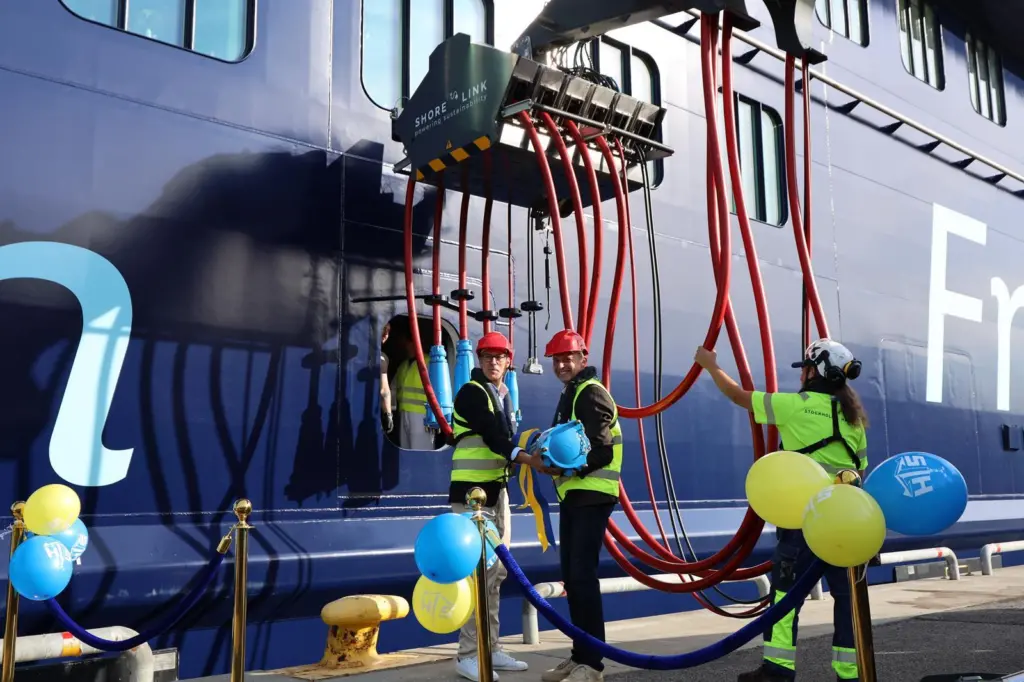
Providing onshore power supply (OPS) to ships while they are in its ports is a crucial part of the organisation’s sustainability aims as it cuts emissions from berthed ships. Accordingly, the development of OPS for visiting ships is currently a major focus for the cruise operations at Ports of Stockholm.
The first OPS facility for cruise ships was inaugurated in 2024. The inauguration in May 2025 of Sweden’s second OPS facility for international cruise ships means that Ports of Stockholm can now offer onshore power connection to approximately half of all cruise calls to the city in the centrally located Port of Stadsgården.
“Using green electricity (wind and waterpower) instead of using auxiliary engines (with fossil fuels) decreases the cruise ship emissions to air of greenhouse gases by approximately 6,000 tonnes per year,” explains Charlotta Solerud, environmental strategist, Ports of Stockholm.
“There is also a positive effect on other emissions to air (NOx, SOx and PM) and lower noise levels.”
At the launch of the OPS installation in May 2025, Jens Holm, chair of the board of Ports of Stockholm, said: “This is an important step in strengthening Stockholm’s position as a sustainable premium cruise destination, and is highly anticipated by the cruise lines.”
Viking Cruises’ vessel Jupiter was the first cruise ship to connect to the second OPS facility and many others are set to benefit from the facilities, which are part of a wider regional plan to enable ships to access onshore power.
The EU funding received by Ports of Stockholm will also see onshore power supply investment in the ports of Copenhagen/Malmö, Aarhus and Helsinki.
The installation represents the success of a longstanding aim at Ports of Stockholm to provide OPS for visiting vessels, says Stefan Scheja, marketing manager, Ports of Stockholm.
“The city of Stockholm has the ambition to be a sustainable cruise destination and the port has support from the city for its sustainability initiatives.”
He cites the most significant challenges that Ports of Stockholm faced in securing the new facilities as “the high investment cost for onshore power supply installations for cruise ships and seeking funding for that, as well as the difficulty (and long process) of power reinforcement to the port.”
“It is important in this aspect to have an active dialogue with the grid owner.”
Tackling these obstacles has paid off, with the OPS installations set to deliver return on investment for years to come.
Green incentives
Another important focus area for Ports of Stockholm is the existing facilities for reception of waste and wastewater from cruise ships.
Voluntary recycling of waste gives the ships a discount on the waste fee. This ‘nudge’ approach encourages sustainable behaviour on the part of cruise companies calling at the Ports of Stockholm. Four out of five cruise ships offload wastewater to the facilities of Ports of Stockholm.
There is also a policy of offering port fee discount incentives for cruise ships that have high environmental specifications and generate lower emissions to air, according to the Clean Shipping Index and Environmental Ship Index systems. In addition, Ports of Stockholm is looking into possibilities to decrease the carbon footprint of the cruise calls on land.
Working with other ports is crucial to the success of Stockholm’s green initiatives.
“The OPS installations, performed together with Aarhus, Copenhagen and Helsinki, provide a sustainable cruise route in the Baltic Sea region,” says Ms Solerud. “We plan to continue the work with expanding the onshore power supply for cruise ships in our ports.”
She adds: “Ports of Stockholm has for many years been a leader in related sustainability initiatives. This is well known by our stakeholders, and we are proud to be a part of and contribute to a responsible recycling chain related to fixed waste and sewage delivered from the cruise vessels.”
Future focus
Managing the flow of people is an aspect of growing importance as visitor numbers to Stockholm and the surrounding region rise.
“We have to be aware of social challenges, to avoid places or sites becoming too crowded in terms of having more tourists in the city, including the minor part coming from cruise tourists,” says Mr Scheja.
“Ports of Stockholm maintains a close dialogue with cruise companies and the shore-excursion companies working in the city to continue development and the offer of sustainable tours in the city. We encourage the use of the waterways between sights in the central part of Stockholm when possible.”
Beyond the existing projects it undertakes, such as the regional partnership outlined above for onshore power supply, Ports of Stockholm works closely with other ports in the Baltic Sea region on sustainability initiatives via the Cruise Baltic organisation.
“All member ports in the region, together with the cruise industry and cruise companies have signed the Sustainability Manifesto 2019, according to which we all agree on working to be the most sustainable cruise area in the world, related to economic, social and environmental criteria,” says Mr Scheja.
“Each year, Cruise Baltic summarises the initiatives the ports and destinations have taken the year before. Having a dialogue between ports to use the same kind of Environmental Index gives a strength to the region and it is easy for the cruise companies to adapt to.”
Related Articles
 ENERGY & TECHNOLOGY GREENPORT
 ALTERNATIVE FUELS GREENPORT
 ALTERNATIVE FUELS GREENPORT