




EXCLUSIVE: Green cruising at the edge of the grid
Michele Witthaus talks to Megan Turner, environment and sustainability manager and Peter Wright, head of cruise, Port of Dover about the challenges of running environmentally friendly cruise operations.
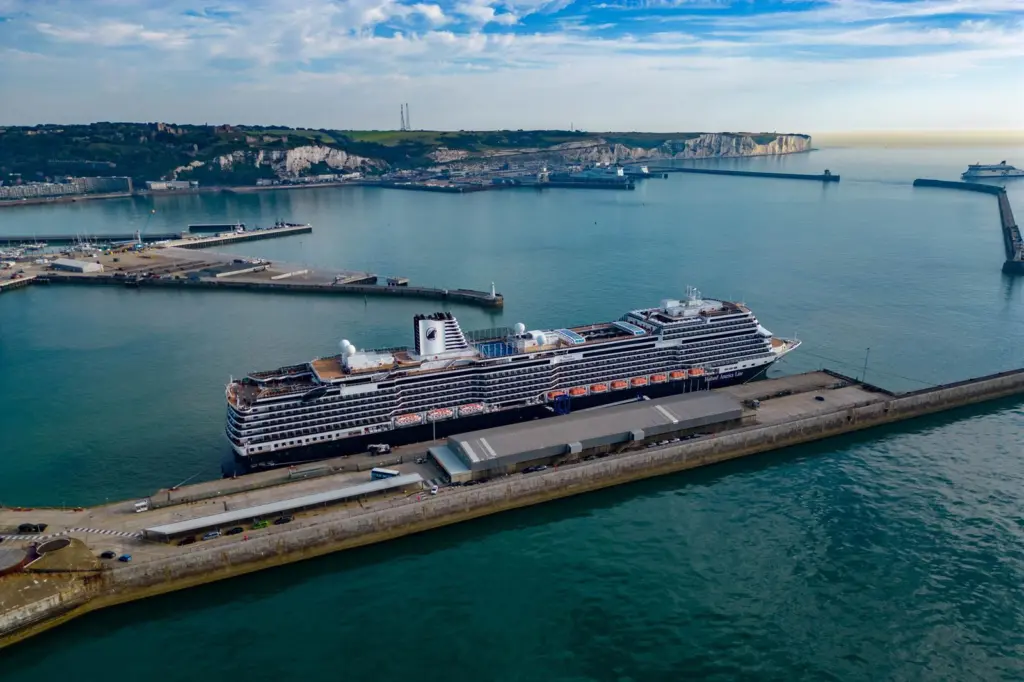
Situated on the English Channel alongside the region’s iconic white cliffs, the bustling Port of Dover is at the heart of one of Britain’s busiest sea ports with routes catering to hugely complex cargo flows and essential ferry services linking the UK to the continent.
Two dedicated cruise terminals and three berths serve the cruise passenger market at the port, with facilities to welcome up to three vessels simultaneously. Handling 100-120 ships a year, it is a popular seasonal port of call and turnaround facility for small and medium-sized ships of up to 320 metres carrying up to 3,000 guests during the April-to-September season.
“Half of the cruise business is as a port of call, because we’re very well located for London and the immediate southeast region of the UK,” says Peter Wright, head of cruise for the Port of Dover.
“Some of the brands that call cater exclusively for the British market, but we also see a lot of American passengers beginning and ending their cruise in Dover.”
Green benchmarking
The port has its own green benchmarking system for cruise ships, the Safety and Environment Award (SEA), which has been running for the last eight years to encourage better waste practices by ranking individual ships on their performance.
“It started out as a simple waste award, scoring ships on how they follow procedures to help increase recycling and how much they actually recycle,” explains Megan Turner, environment and sustainability manager at Port of Dover.
“In the last few years, we have expanded it so that ships also get scored on carbon emissions, safety and other aspects of performance. We’ve seen quite a lot of competition between the different cruise vessels because at the end of each season, their results show them how they compare to other vessels and we explain what they could do to improve. It’s been great at helping us increase the recycling that comes directly off the ship, by providing a bit of engagement to get them involved.”
She adds that some of the cruise food waste does have to go to deep burial landfill, but outside of that, the port works with cruise customers and the port’s waste contractor to improve segregation of waste.
“We also charge a lot more for general waste than we do for properly segregated recycling, which helps convince our cruise customers to recycle,” she says.
The results speak for themselves: For the last four years in a row, the port has been able to meet its target of 100% landfill avoidance for all waste from cruise, outside of waste that legally cannot be recycled.
Energy consumption
The Port of Dover is tackling energy consumption within the port area by switching vehicles to hydrogenated vegetable oil (HVO) instead of diesel where possible and this benefits the cruise visitors too.
“In 2022, we transitioned all our landside plant and machinery that support the operations that are crew terminal over to HVO and later that year we also transitioned all of our port tug and pilot vessels too,” says Ms Turner.
“It is more expensive than diesel, but it reduces carbon emissions by about 90% and it also reduces NOx, SOx and particulate matter emissions, which help the local air quality.”
She says that switching fuels has helped to achieve lower emissions while preventing the unnecessarily retirement of equipment before it had reached its end of life.
Another decision that has paid off for the port is its decision, back in 2016, to only purchase electricity from renewable sources for the entire port estate, including the cruise terminals.
“All of these measures have enabled us to bring our Scope One and Scope Two emissions from cruise down hugely,” comments Ms Turner.
She is proud to note that the port’s long-held goal of a net zero cruise terminal will finally be realised following the planned replacement of some remaining gas heating in the main terminal building, which is a listed structure.
“This makes it a little tricky for us to make changes at the terminal and we want to make sure that when we change out that heating system, we do it in a way that’s in keeping with the building.”
Port emissions
Tackling emissions from ships at berth in the port is a more complex challenge. Perhaps surprisingly for a cruise facility embedded in a large port that plays such a crucial business role in the UK economy, Dover cannot yet provide shore power to visiting ships because of the current inability of the local grid to meet the demand.
“Given the emissions that come from vessels when alongside in the port, shore power is a solution to help reduce these,” says Ms Turner.
“However, as we are on the coast, we are at the end of the grid, and there is currently no spare electrical capacity in the port or the local area. We are working on this with the National Grid and looking at other options to provide shore power as soon as we can.”
The Port of Dover shares information about shore power options with other ports that are also currently looking at installing provision for visiting cruise ships.
“The ports that know more about this share best practice and together with cruise line industry body CLIA, we try and identify areas where the industry and government can work better together on things like prioritisation of grid connectivity to enable permanent onshore power,” says Mr Wright.
Community engagement
Community engagement is a key element of the port’s special status in Dover.
Mr Wright comments: “The port is at the centre of the town and we’re a Trust Port, so we have no shareholders, only port users and wider stakeholders.
”That relationship is particularly important to us. The whole area of public realm along the promenade is controlled, owned and maintained by the port, for the benefit of the community. We also have our own police force, which provides support to the broader town too.”
He says that the port works very closely with the organisations that manage the local attractions and the tourism team at the District Council to ensure that it remains seen as a positive contributor to the local economy. For example, it arranges an environmentally friendly shuttle bus service to take cruise guests into the town to ensure that the town sees the benefit.
“Unlike some ports, which struggle to mitigate some of the challenges that large volumes of cruise guests bring to residents, we are lucky in that the community is very receptive.”
“It helps that the nature of our cruise business doesn’t introduce huge visitor numbers, even where we get three ships in, as one or two of the ships might be turning around, so the guests are not flooding the town centre. Even our biggest local attraction in the town and region, Dover Castle, is a vast site and could quite easily absorb thousands of guests at any one time.”
Many cruise visitors take the high-speed train from Dover into central London, a journey taking just over an hour. The port has had some quite advanced discussions with the operator around the opportunities to charter trains and it’s also talking with a couple of cruise lines about using such a service to ferry guests up to London for a short excursion, rather than taking them by coach. The train, says Mr Wright, is much more sustainable and provides a better guest experience.
Visitors looking for green local day trips can also enjoy the port’s two marine conservation zones, where seals, dolphins, rays, lobsters and even seahorses can be seen. Plus there is the nearby chalk downland, a biodiversity action plan habitat, at both the National Trust White Cliffs Site and the Ports Old Park Hill Nature Reserve, where the port is working with Kent Wildlife Trust to restore and protect the area’s unique fauna and flora.
Related Articles
 NEWS GREENPORT
 NEWS GREENPORT
 ENERGY & TECHNOLOGY GREENPORT