![GreenPort[PortStrategy]](https://www.portstrategy.com/greenport/wp-content/uploads/sites/4/2026/09/GreenPortPortStrategy.svg)

EXCLUSIVE: Ports key to Europe’s multifaceted ambitions
If all goes well, the EU’s new Port Strategy should give ports the tools they need to play their role in contributing to Europe’s multifaceted ambitions.
In my previous contribution to GreenPort, I discussed the Commission’s forthcoming EU Port Strategy which aims at being a comprehensive document looking at Europe’s ports in the context of both decarbonisation and the energy transition, competitiveness and resilience.
But let us now look a bit closer at these ambitions.
Existing policy
Firstly, there is the Green Deal ambition for Europe – the flagship project from the von der Leyen I Commission (2019-2024) – aiming for Europe to be net zero by 2050 and, no less importantly, the goal to move towards becoming zero pollution by the same date.
Secondly, there is the Fit for 55 package which was developed during the past years sets the policy framework for reaching these ambitions.
Of importance to ports, are among other things, the obligation to have onshore power in all TEN-T ports that exceed a number of cruise ferry and container calls per year, the obligation for ships to use OPS as from 2030, the inclusion of maritime in the EU-ETS system and a possible taxation of marine fuels.
More in general, the EU has also set new renewable energy targets, targets for production and import of hydrogen, targets with regards production of wind energy, etc. All relevant stakeholders, not at least ports, are getting ready to comply with all these requirements and are faced with the impacts of certain measures.
Next to the well-known challenges linked to complying with the AFIR Regulation, which sets the OPS requirements, it appears that a lack of grid capacity could become the major issue hampering the full use of OPS, when it is there.
The first year of EU-ETS maritime is as expected, showing first signs of carbon and business leakage to ports outside the EU. The important investments in extra capacity in the EU neighbouring ports announces further and more important moves to escape the ETS charge.
Clean Industrial Deal
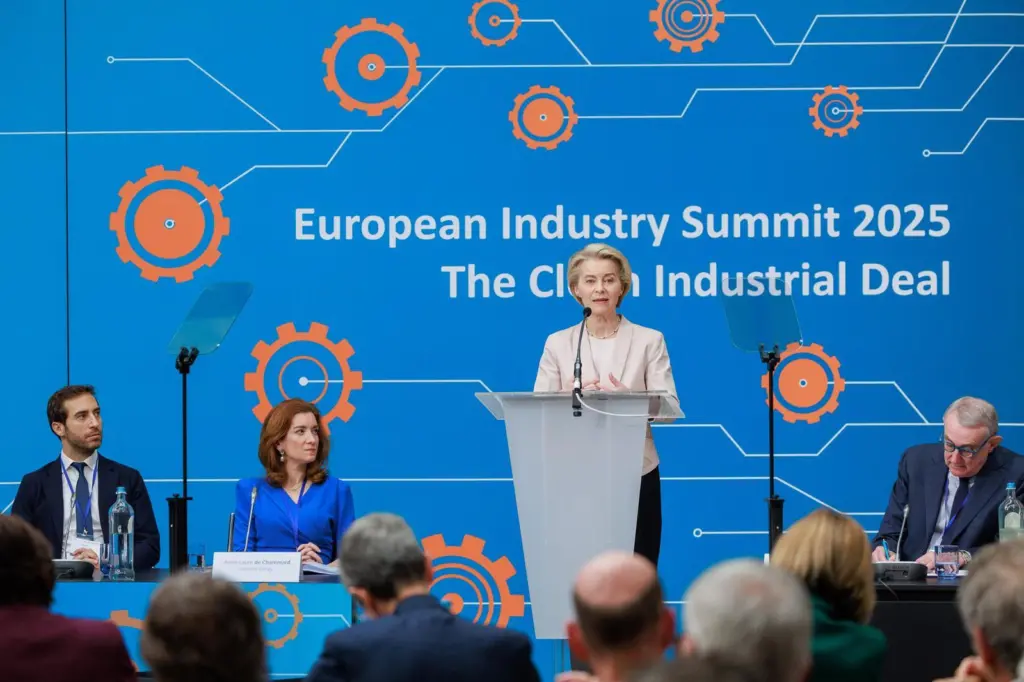
The flagship project of the new von der Leyen II Commission – which kicked off at the end of 2024 – is the Clean Industrial Deal, a project that aims at combining decarbonisation with competitiveness. The Clean Industrial Deal was published on 26 February. It aims at finding an answer to the double challenge of high energy prices and the fierce global competition. It intends to give European industries urgent support and outlines concrete actions to turn decarbonisation into a driver of growth for European industries and focuses on both the energy-intensive industries and the clean-tech sector.
Circularity is also being addressed since on top of its contribution to sustainability, it can help maximising the offer of limited resources and diminish Europe’s overdependence for certain materials. Also here, ports have a central role to play, be it as host of important industry clusters or main link with those clusters in its hinterland, as well as ideal location for circular economy and partners in the energy security and energy transition.
As part of its efforts to step up Europe’s competitiveness and create a more business friendly environment, the Commission is launching a series of “omnibus” packages, which aim at simplifying existing Regulations. A first package narrows the scope of sustainability reporting and due diligence obligations, two recently adopted legislative measures which installed a heavy load of reporting formalities. The new proposed scope exempt most of Europe’s ports from the mandatory reporting.
Other “omnibus packages” aim at diminishing administrative burden or easing the permitting. The length and complex permitting processes are a thorn in the eye of many port investors and delay – or even stop – energy transition or net-zero industry projects.
More measures needed
ESPO is supporting the Clean Industrial Deal ambitions. In our reaction to the Commission’s plan, we stress the importance of considering the supply chains needed when boosting clean industries, or stepping up circularity.
We emphasise the need for basic infrastructure in ports and investments in pipeline infrastructure to make it happen. We plead for fast track permitting for clean industry and decarbonisation projects and believe that ports should be seen as net-zero acceleration zones.
The production and handling of new energies in port areas, as well as developing carbon capture and storage projects or boosting circular economy will require a lot of extra space in ports.
While the Clean Industrial Deal ambitions are on the table, the concrete tools and measures to deliver are not yet there and time is running, since important investments are being delayed, certain companies are moving out well of established industry clusters in ports, reinforced by the import tariffs announced by the Trump administration.
And while Clean Industrial Deal is the new buzz word of this European Commission, the more than turbulent geopolitical context following the start of Trump’s Presidency is leading to a third priority of this Commission, on top of the two first ambitions: Strengthening military mobility and preparedness and increasing Europe’s resilience.
Also for this third priority, ports are in the middle, as enablers of military mobility for bringing troops and material to Europe’s hinterland as well as strategic pillars of Europe’s resilient supply chains and Europe’s economy and society.
Challenging times ahead
Even if the pandemic has tested the agility and resilience of ports when it comes to security of supply chains and business continuity, working together with military forces and defence authorities is for most of Europe’s ports a new field and new task.
To play their role in this context, the infrastructure in ports will need to adapt to the “weight” requirements of the military material, hinterland connectivity will need to be made more robust.
But next to the infrastructural adaptation, which again will come with need for space and capacity, ports will have to deal with a new stakeholders, the military – who works following other principles and has other priorities.
The “just in time” approach will sometimes need to make space for a “just in case” approach, effectiveness could in some ways become more important than efficiency, in other words buffering capacity and redundancy could become an asset.
It is clear that the challenging times we are going through raises the profile of Europe’s ports as strategic assets and partners in building a sustainable, net-zero, competitive and strong and resilient Europe. That can be a positive thing. But it is also evident that difficult choices will have to be made in terms of space and funding, since both are limited and both are in high demand for delivering on the energy transition and the geopolitical resilience.
We should finally also define gain the role of the port authority in light of these new roles, which come on top of the transitional role as multimodal transport hubs and nodes in the supply chain, not instead.
The new responsibilities that ports have, are mainly serving public interests and should be considered as such when policies is being developed and corresponding EU budgets are being allocated.
Let’s see if the forthcoming Port Strategy helps us with that.
Related Articles
 ENERGY & TECHNOLOGY GREENPORT
 ALTERNATIVE FUELS GREENPORT
 ALTERNATIVE FUELS GREENPORT