![GreenPort[PortStrategy]](https://www.portstrategy.com/greenport/wp-content/uploads/sites/4/2026/09/GreenPortPortStrategy.svg)



EXCLUSIVE: Ports of Jersey rejuvenation gets green light
Passenger operations at St Helier Harbour are set for a major sustainability boost as the waterfront area receives approval for the first phase of regeneration.
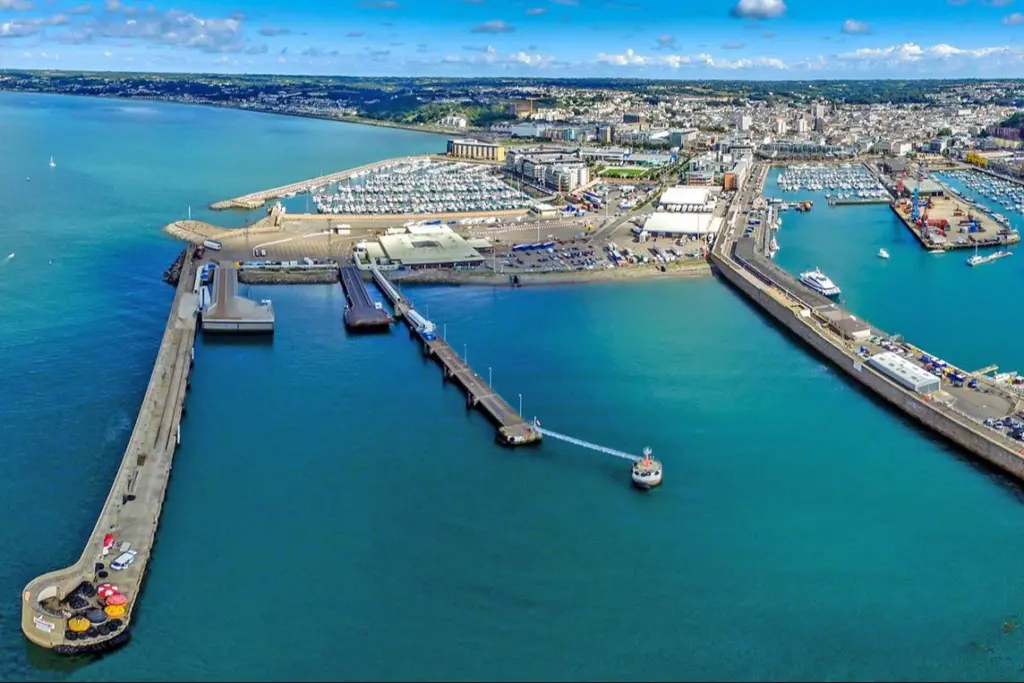
Just nine miles long and five miles wide, the Channel Island of Jersey welcomes many ferries and freight carriers as well as a small number of cruise ships to its capital of St Helier.
After two years of planning including a public consultation and funding bid, the Island’s Elizabeth Harbour Regeneration project will begin to take shape in late 2025, following the announcement in November 2024 by the Government of Jersey of planning consent for the first phase of works.
Infrastructure upgrades
The approval heralds the start of a long-term project, under the leadership of Ports of Jersey, to upgrade the lifeline port’s ageing infrastructure and bring improved facilities for both passenger and freight traffic.
The initial phase of implementation will renew the harbourside environment, with a strong focus on celebrating St Helier’s historic and cultural heritage.
The delivery of significantly improved user experience and facilities for both the local community and visitors is crucial to the redesign, which will see the Elizabeth Harbour area receive a new passenger terminal, customs and inspection facilities and freight distribution centre.
The new facilities will connect to St Helier via a network of landscaped routes.
Visually, the removal of high concrete walls that have separated the port estate from the town centre will also help restore the sense of connection between town and port, restoring views of the Jersey coastline and iconic Elizabeth Castle. A linear park will extend existing active travel routes for pedestrians and cyclists.
With the key sustainability objective of supporting the Ports of Jersey’s net zero goal for harbour operations by 2030, the project is focused on four of the United Nations Sustainable Development Goals (SDGs): SDG 7 (affordable and clean energy), SDG 8 (decent work and economic growth), SDG 13 (climate action) and SDG 17 (partnerships for the goals).
“The design demonstrates reduced embodied carbon against a 2019 baseline,” says Jamie Dollimore, deputy maritime director, Ports of Jersey.
“It does this by including and enabling the use of renewable energy to supplement the main energy supply for the harbour, including the new passenger terminal building.”
Energy focus
The amount of energy used in the construction process will be reduced in several ways, such as the use of modular, standardised components to enable future expansion. When in use, the buildings will benefit from passive design, including the use of low and zero-carbon technologies.
Some of the design elements will also play a role in maintaining a comfortable internal environment without much energy expenditure. These include vertical fins that will project from the façade to shade the building’s interior and solar-controlled, low-emissivity glazing, as well as mechanical façade openings that provide ventilation to reduce operational carbon.
Green roofs with integrated photovoltaic panels will link to a site energy network, ready for future connection to seawater-source heat pumps.
Futureproofing for low-carbon alternative fuels has been incorporated into the design through space allocation and the inclusion on initial infrastructure into the Master Plan.
“The reuse of materials and use of recycled materials has been incorporated to reduce embodied carbon within the design,” says Mr Dollimore.
“The design responds to the challenges of climate change to realise a climate resilient and adaptable harbour, by ensuring sustainable and ethical procurement practices for materials and also by addressing Jersey’s skills gap through apprenticeships and other initiatives throughout the redevelopment.”
Throughout the project, the focus is on minimising energy consumption, harnessing on-site renewable energy resources and integrating innovative, low-carbon and energy-efficient technologies, while providing a positive passenger experience, increased footfall and improved passenger flow.
Currently the port welcomes around 13 cruise ships a year, in addition to a much larger volume of ferry passengers.
“Due to the way that cruise ships operate in Jersey, the plans for the Elizabeth Terminal redevelopment will not significantly impact cruise operations,” says Mr Dollimore.
“Because of the depth and size of our harbour, they generally anchor out in the bay and run tenders to and from the Island. This will not be changing as part of the redevelopment.”
In line with Ports of Jersey’s Planet and People Plan, an employee-led initiative that has led to a range of different initiatives across the harbour area, the organisation works with its business partners, customers and supply chain to support sustainable tourism in Jersey.
“We also have a Memorandum of Understanding with the Region of Brittany to support effective cooperation on environmental protection and long-term sustainable development and operation,” adds Mr Dollimore.
Sustainable design
Ports of Jersey engaged global architecture firm Broadway Malyan working in partnership with local architecture practice Waddington as part of a consortium led by Mott Macdonald after a rigorous procurement process.
The company prepared a Statement of Sustainable Design and Construction as part of the planning process to ensure the scheme maximises sustainability opportunities wherever possible, says James Flynn, Senior Architect, Broadway Malyan.
“At the heart of the project was the embedding of sustainability in every aspect of the harbour while also creating a coherent sense of place,” says Mr Flynn.
“The design response for the new passenger terminal itself was to create a building that was as close to a net zero structure as possible using innovative passive design measures, improved building fabric and the introduction of various low and zero carbon technologies. The scheme also provides the potential for onshore power supply for vessels to align with the maritime industry’s decarbonisation aspirations.”
The design incorporates walking and cycling routes to encourage both visitors and islanders to make sustainable travel decisions. Imaginative reuse of materials in people-friendly spaces is another key aspect of the new facilities.
“When designing the new public realm around the terminal, we made the reduction of material sent to landfill a priority, by re-purposing existing precast concrete walls as retaining structures and creating landscape berms that will provide shelter from the wind and mounds that children will be able to use for informal play,” explains Mr Flynn.
The natural resources of the shorefront region feature prominently in the design, with marine-tolerant trees planted near the water’s edge and deciduous tree species in an arboretum towards the town. There will also be public art installations and sonic sculptures on a maritime theme, using old buoys and ships’ funnels to mark the way in a trail from the town through the site to a new observation pier.
“Fundamentally, the future success of this project is about people and creating an environment that provides the best possible experience for visitors arriving at the port by ferry and as a waterfront destination in its own right,” says Mr Flynn.
“The new masterplan embraces the character and spirit of the place with the use of high-quality maritime heritage assets articulating a series of new public spaces.”
This includes a new gateway garden leading to a waterside promenade along the marina edge, culminating in a new observation pier overlooking the bay and the nearby Elizabeth castle.
Mr Dollimore emphasises the importance to Ports of Jersey of the project’s goal of balancing the needs of people and commerce.
“The redevelopment is the catalyst for the wider St Helier Harbour Master Plan and is critical to maintaining the Island’s lifeline, with 98.6% of all goods entering Jersey through St Helier Harbour,” he says.
“The regeneration will safeguard the long-term viability of the harbour, serving both passengers and freight. It will improve customer experience and realise the area’s potential as a leisure, cultural and tourism destination.”
Related Articles
 ENERGY & TECHNOLOGY GREENPORT
 ALTERNATIVE FUELS GREENPORT
 ALTERNATIVE FUELS GREENPORT