![GreenPort[PortStrategy]](https://www.portstrategy.com/greenport/wp-content/uploads/sites/4/2026/09/GreenPortPortStrategy.svg)
GreenPort Conference Opens in Stockholm
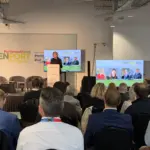
Ulla Hamilton, Deputy Mayor of the City of Stockholm and Chairman of the Ports of Stockholm opened the 5th GreenPort Conference which convened this morning in Stockholm…
“I would like highlight an important issue for the shipping industry as well as for the environment. The EU has for a long time put pressure on the UN maritime organisation, IMO, to take action concerning lowering emission levels of sulphur and nitrogen oxide. Also a special Emission Control Area (ECA) has previously been established including the Baltic Sea, North Sea and English Channel, where special emission restrictions apply. Present regulations in the ECA area stipulates a maximum sulphur content of 1.5 % in bunker fuel, whereas the international regulation stipulates a maximum of 4.5 %.
In April 2008 IMO’s Marine Environmental Protection Committee (MEPC) adopted new regulations of sulphur and nitrogen oxide emissions, later confirmed at the IMO meeting in October 2008. The beforehand position of member states, EC and other stakeholders, was a lowering of the ECA regulation from 1.5 % sulphur content to 0.5%. This is a hard and stringent regulation for the shipping industry but the involved parties even so agreed on it. At the meeting the level was suddenly lowered in the negotiations to 0.1 % to be implemented as soon as 2015 and without feasibility study. This is an environmental rule only appliable for the north of Europe and therefore not in line with harmonised regulations for the EU internal market.
I know that the Swedish Government have underlined that the EU-Commission has to act in order to investigate and secure the competitiveness of industry in Sweden, Finland, Poland, Lithuania, Estonia, Latvia, Germany, the Netherlands, Norway, Denmark, Belgium, and some parts of Great Britain and France due to the different rules for nothern and southern EU countries. There is also a clear risk that the regulations will lead to a modal backshift, where measures aimed at the maritime industries end up forcing freight on to the roads with higher CO2-emissions as a consequence.
I am concerned about the total effect on the environment if the regulation will be accepted as it is today. Different goals will effect the competitiveness of the shipping industry in Northern Europe. It is important to have tough targets for sulphur limits. But from a European internal market point of view – it is very important to have common regulations and common targets. Common environment goals are also important for the shipping industry and at the end – harbours.
GreenPort Conference 24-25 FEBRUARY 2010
Ladies and gentlemen!
As Deputy Mayor of Stockholm and also the chairman of the Ports of Stockholm I would like to welcome you to Stockholm. I am proud to say that Stockholm is widely recognised as one of the most beautiful capitals in the world.
Built on Lake Mälaren, Stockholm’s proximity to the open waters of the Baltic Sea and its well-preserved green areas contribute to this. The combination of medieval buildings alongside modern and exciting architecture also contributes to Stockholm’s beauty. The city’s remarkable city structure creates high profile opportunities for company investors – present and future, foreign as well as domestic.
Almost exactly a year ago, February 23 2009 Stockholm was – as the first city in Europe – awarded European Green Capital 2010 from the European Commission. The Award is given to a city that has a record of achieving high environmental standards, is committed to ambitious goals for further environmental improvement and sustainable development, and can act as a role model to inspire other cities and promote best practices in other European cities.
The motivation from the jury was that our city has a long history working to improve the environment, we can show that this work has given good results and we have ambitious goals for the future.
The Stockholm example also shows that we can combine the highest level of economic growth with the most ambisous sustainability policies.
Still Stockholm is facing the same challenge as many other cities: The city is growing and will continue to grow, and at the same time we aim to reduce our impact on the environment.
How can we combine a growing City with sustainability?
1. Our strategy is to build the city inwards – reusing brownfield areas while preserving precious green areas.
2. When building and planning our city or when retrofitting existing housing areas we need to integrate sustainable solutions that aims to reduce both the ecological footprint and the emission of carbon of our citizens. That means a well developed public transport system running on renewable fuels, district heating system based on renewable fuels, energy efficient buildings, clean cars and a smart system for taking care of waste.
Sweden’s largest city district, over the coming years, Stockholm Royal seaport, is to be developed in central Stockholm by reusing brownfield areas. The area, an old industrial area nabouring the harbour, will be developed while preserving precious green areas. This urban development contains plans for 10,000 new residences and 30,000 new workspaces and it is located next to the ”Nationalstadsparken”. The harbour in the area will be developed to a modern city harbour.
The challenge for Stockholm Royal Seaport, is to combine a growing city with the values that make Stockholm unique: the proximity to water and nature.
Sweden and Stockholm has a leading position in the transformation to a climate-adapted society. Our city is already a world leader in developing, marketing and implementing new energy and environmental solutions, and this position is to be managed and improved.
The ambition is clear: Stockholm Royal Seaport shall become a global showcase for sustainable urban development. Innovative environmental technologies and creative solutions are to be developed, used and displayed in a world-class environmental urban district.
Stockholm has reinforced its position as a leading port city and the hub of the Baltic region. Our natural waterways and strategic location, in the middle of the Baltic region, has meant that more shipping companies are locating new ferry lines and cruise routes to Stockholm.
The port and energy plants at Värtahamnen have continued to develop and has been integrated with the new urban development. The plans for expansion of the piers will result in new quay space and terminal buildings.
Through a systematic effort to reduce emissions, energy consumption, waste and noise, the Ports of Stockholm Group has been awarded the highest environmental classification among all the world’s ports.
I would like highlight an important issue for the shipping industry as well as for the environment. The EU has for a long time put pressure on the UN maritime organisation, IMO, to take action concerning lowering emission levels of sulphur and nitrogen oxide. Also a special Emission Control Area (ECA) has previously been established including the Baltic Sea, North Sea and English Channel, where special emission restrictions apply. Present regulations in the ECA area stipulates a maximum sulphur content of 1.5 % in bunker fuel, whereas the international regulation stipulates a maximum of 4.5 %.
In April 2008 IMO’s Marine Environmental Protection Committee (MEPC) adopted new regulations of sulphur and nitrogen oxide emissions, later confirmed at the IMO meeting in October 2008. The beforehand position of member states, EC and other stakeholders, was a lowering of the ECA regulation from 1.5 % sulphur content to 0.5%. This is a hard and stringent regulation for the shipping industry but the involved parties even so agreed on it. At the meeting the level was suddenly lowered in the negotiations to 0.1 % to be implemented as soon as 2015 and without feasibility study. This is an environmental rule only appliable for the north of Europe and therefore not in line with harmonised regulations for the EU internal market.
I know that the swedish government have underlined that the EU-Commission has to act in order to investigate and secure the competitiveness of industry in Sweden, Finland, Poland, Lithuania, Estonia, Latvia, Germany, the Netherlands, Norway, Denmark, Belgium, and some parts of Great Britain and France due to the different rules for nothern and southern EU countries. There is also a clear risk that the regulations will lead to a modal backshift, where measures aimed at the maritime industries end up forcing freight on to the roads with higher CO2-emissions as a consequence.
I am concerned about the total effect on the environment if the regulation will be accepted as it is today. Different goals will effect the competitiveness of the shipping industry in Northern Europe. It is important to have tough targets for sulphur limits. But from a European internal market point of view – it is very important to have common regulations and common targets. Common environment goals are also important for the shipping industry and at the end – harbours.
Related Articles
 ENERGY & TECHNOLOGY GREENPORT
 ALTERNATIVE FUELS GREENPORT
 ALTERNATIVE FUELS GREENPORT