![GreenPort[PortStrategy]](https://www.portstrategy.com/greenport/wp-content/uploads/sites/4/2026/09/GreenPortPortStrategy.svg)


GreenPort sustainability workshop gives insight into key issues
The 2022 Greenport Congress provided a platform for a sustainability workshop hosted by Jason Sprott (Sprott Planning & Environment – Australia) and Dr Chris Wooldridge from Cardiff University.
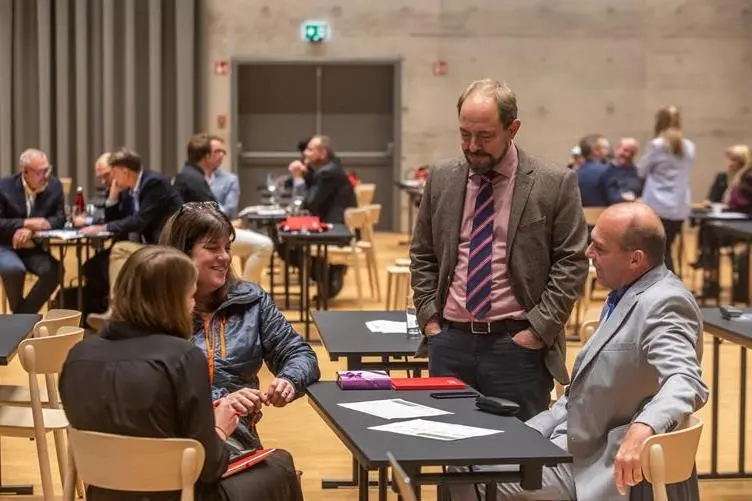
The very essence of Greenport is the exchange of knowledge and experience between practicing professionals and the workshop was specifically designed to encourage and facilitate input from the wealth of know-how and understanding brought to the event by delegates.
”We hope to continue to trend of micro-workshops at the next round of GreenPort Conferences – they encourage collaboration on ideas, policy and challenges facing the industry,” said Dr Wooldridge.
Identifying the issues
Commencing with strategic sustainability comments from Dr Antonis Michail, WPSP technical coordinator (IAPH), Heidi Neilson head of planning & environment (Port of Oslo) and Herman Journée Chairman (EcoSLC EcoPorts), the focused workshop included participants from Asia, Europe, the UK, Australia and North America.
The workshop focused on identifying the issues considered the ‘most important’ when developing sustainability strategies. Jason Sprott provided technical presentation on the benefits of using ‘Materiality Assessment’ – an industry accepted technique used by Sprott Planning & Environment team in their work with ports and terminals across Australia and New Zealand.
Participants were firstly asked to list what they thought were the most important issues to consider when developing sustainability strategies in the four categories of ‘People’, ‘Environment’, ‘Prosperity’ and ‘Partnerships’.
They then used a ‘pre-populated’ template across the four sustainability categories and were asked to rank each issue in a scale of importance from 1 (low) to 10 (high).
Port role-play
Participants worked in ‘stakeholder groups including: (Internal Groups) board members, executive, staff and (External Groups) community, conservation groups, financiers/banks, shipping lines and port tenants.
”When undertaking a materiality assessment, it is critical that both internal and external viewpoints are considered – this leads to a more informed process for Strategy Development,” said Mr Sprott.
”It was so pleasing to see the interaction and lively debate between workshop participants – each with their own valid viewpoint which is the essence of materiality assessments,” added Dr Wooldridge.
Results of the workshop are contained in the figure image above.
Figure One shows that whilst all issues scored at least five, the top issues included Safety (People), Climate Change (Prosperity), Energy/Fuel Transition (Environment) and Air Quality (Environment). Figure Two shows a comparison between internal and external stakeholder results.
”It was interesting to see the results of this workshop, which were indeed similar to what we’ve seen across other similar surveys across Australia and New Zealand,” said Mr Sprott.
“We find this graph provides powerful insights for an organisation when developing Sustainability Strategies – you can easily spot both similar viewpoints and those which are disparate – which is incredibly important information.”
Related Articles
 ENERGY & TECHNOLOGY GREENPORT
 ALTERNATIVE FUELS GREENPORT
 ALTERNATIVE FUELS GREENPORT