![GreenPort[PortStrategy]](https://www.portstrategy.com/greenport/wp-content/uploads/sites/4/2026/09/GreenPortPortStrategy.svg)
Helsinki: The pull between challenge and opportunity
The Port of Helsinki is attempting to find pragmatic answers to challenges many urban ports will understand – including the tension between costs and environmental strategies, writes Stevie Knight
As Helsinki has found out, development is no longer just about the available hectares or tonnage in and out the gate.
Alternative energy demonstration projects
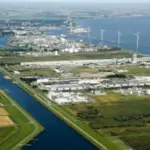
The environmental standards for the 240 hectare Vuosaari Harbour, which has taken over most of the heavy cargo handling, box and ro-ro from the city centre quays in the last five years, had to be stringent. Caught in controversy with claims that the adjacent Natura 2000 site would be “dramatically affected” the project had to prove that it was more than squeaky clean before getting the green light back in 2004.
Aino Rantanen, the port’s environmental manager admits this first bar was set high, but explains that operational phase “is not so different” from other European facilities. This said, she adds it has meant “keeping on top of air, water and sediment sampling plus bird and wildlife surveys as well as putting in place mitigation measures”.
Facing these requirements, the port decided to make a virtue out of a necessity and invited alternative energy demonstration projects. Predictably it’s been a harder road than the one mapped out in 2008. “It’s not necessarily cheap technology to put in place,” explains Helsinki’s development manager Ari Parviainen. The aligning of ‘ecobenefits’ with ‘cost savings’ has more to do with projected running costs than upfront investment, plus it follows on the heels of investment made just before Europe’s economic woes hit, which depressed tonnage right across the region.
So, while a 50kW demonstration hydrogen cell backup for a communications mast is in place and working fine, other demo projects are lagging a little, though many will be coming along in time including a hydrogen filling station that could prompt some on-quay hydrogen powered vehicles. It seems that since the automotive industry is ramping up for fuel cell car production so the technology may be low hanging fruit for handling equipment.
Aligning eco-measures with costs
But will these benefit port or stevedores economically as well as environmentally? Some, possibly. “It’s important to note we are offering ourselves up as a demo base as we have more than adequate power from the grid, but we know that much of this technology is useful where power arrangements may not be as stable,” says Ms Rantanen. In short, the demos aren’t actually part of Helsinki’s cost-benefit rationale – other places with more need might be faster to adopt the tech, but then again at least Helsinki will have proved the principle.
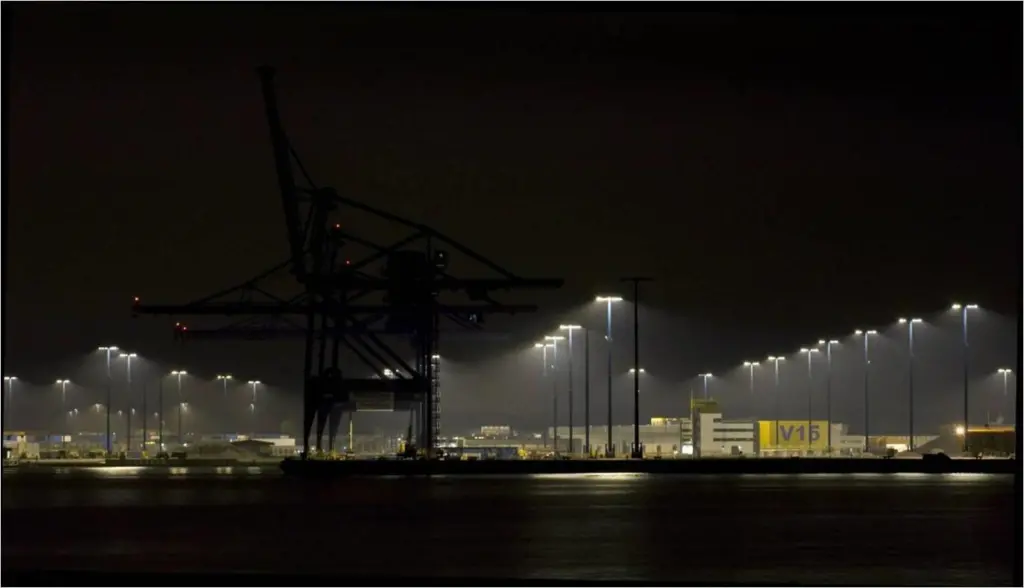
Having said this, there are some initiatives that have got everyone behind them as they align eco-measures with costs. Mr Parviainen says: “Although we had good, up to date lighting which minimised light pollution and focused the beams onto the ground, we decided to gain more control over it, so we divided it up into blocks, giving fine control over these different areas. This way we can actually turn off the lights when they are not needed.”
Ms Rantanen adds: “Actually, although the masts have five levels of lighting the top end is very, very bright, so we decided to turn them down to the ‘basic’ midrange level. We didn’t get any comments or feedback – so that’s where the levels have stayed.” Mr Parviainen points out that the stevedores have an interest as this basic level of lighting doesn’t add to their bill, unlike the brighter ones. “Right now it is sustainable; we’ve had no concerns raised,” he concludes “and it saves hundreds of thousands of Euros each year.”
Added to the other environmental measures the port, being Baltic facing, chose to invest in waste reception facilities, getting ahead of the game before anyone asked. “The first reception facilities were already done in mid-1990’s and now waste reception is possible on every quay,” says Ms Rantanen, so the stance that Helsinki has taken is ‘come on in for a refresh – we can handle it’. However, another challenge is the one linked to the Baltic’s emission legislation, the port is also now looking at a number of ships running SCRs or scrubbers; Ms Rantanen explains that the water or filter material from this is too toxic to simply go into the existing reception facilities but adds the port is already looking at different answers – and resolution to the issue isn’t so far off.
Outside Vuosaari, the port’s South and West harbours are still developing; the cruise and ferry-freight operations are still on the residential doorstep and this has helped the port’s resilience in the hard times besetting the Eurozone. However, this is coinciding with a big build project including room for 16,000 inhabitants and 6,000 work places. “It has meant a lot of talking with the various agencies but we think we have some answers,” says Ms Rantanen, adding that the planning and talking is still on-going.
A life near the port
The biggest issues are noise and road congestion. However, the area is not being blocked off, apart from the enclosed ISPS zone. Satu Lehtonen, Helsinki’s planning manager explains: “We don’t want to separate the harbour from the residential area but rather to work together and create an area which is welcoming for the passengers as well as residents. We also want to show that it is possible to work and live alongside an active port so the whole Jätkäsaari area will serve residents and the street network will be used by everyone.” It’s an interesting idea: the residential and business side of the project has had to find ways to integrate pedestrian areas, cycle paths and tram links, eased by some specific port-traffic roads.
Ramboll Finland has been closely involved in the Jätkäsaari development since 2000 with the planning and monitoring of decontamination measures (including an old landfill site) and strategies for the re-utilisation of polluted land plus the dredging of sediment from the seabed in preparation for the build-out phases.
Along with this, Ramboll is monitoring the construction impact, with measurements of water, noise and dust. However, one of the issues is actually the slow nature of the build: the Jätkäsaari project is being constructed in sections. So, despite the 2009 start, it’s not actually expected to be completed before 2025 and all these processes need to take place over a very protracted period.
Ferry traffic is gaining support too, from ship to shore – cold ironing – power. However, the scale of the project and its economic rationale has taken a great deal of weighing up: Ms Rantanen explains: “There’s still no standard for the industry and whatever you put in, most probably won’t fit the next ship, they are all so individual.” There’s a power issue too as the requirements come to around 10MW: “You can’t just drop this kind of thing in anywhere since the power draw is so huge,” she says: “I’ll admit that even though we had done the calculations and were certain that the city’s grid could handle it, I had my fingers crossed the first time we turned it on in case we blacked out an entire area.”
However, the economic case was won by a number of very specific factors. Firstly, the calls are very established, secondly the ferries are staying long enough to power down the engines. Thirdly, this pair of ferries had exactly the same technology at the other end of the route in Stockholm, so Helsinki could take advantage of a proven, worked out design: even so it has cost approximately €1.4m.
Despite the good standing of the present environmental measures, there’s another spanner about to be thrown into the works. “The environmental permits aren’t forever” says Ms Rantanen. “Although we work very hard at keeping on top of the necessary standards there’s a good chance that things will tighten up even further,” explaining that the port comes under the same legislation as the industrial power plants in Finland and all these operations are being subject to narrowing environmental strictures.
However, both Mr Parviainen and Ms Rantanen are willing to get around the table and carve a path through the issues: “It’s not all one sided; the port has a good standing with the community and wider economy, so we do have some negotiating power,” she says.
Related Articles
 ENERGY & TECHNOLOGY GREENPORT
 ALTERNATIVE FUELS GREENPORT
 ALTERNATIVE FUELS GREENPORT