![GreenPort[PortStrategy]](https://www.portstrategy.com/greenport/wp-content/uploads/sites/4/2026/09/GreenPortPortStrategy.svg)


High gas prices help drive CO2 emissions down
CO2 emissions from industry at the Port of Rotterdam were down by 4.2% in 2022, laregly due to high gas prices and reduced consumption.
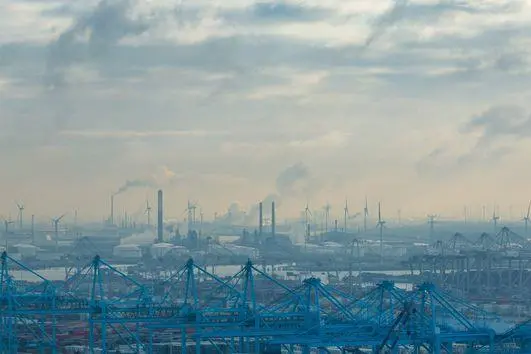
The decrease was mainly driven by the chemical sector and industrial gas producers which scaled back their production due to high natural gas prices. As a result, they emitted a total of 0.8 Mtonne (16%) less CO2 than in 2021.
The high gas prices also caused the three gas-fired power plants in the port area to reduce operating hours, while increasing those of the two coal-fired power plants. Coal-fired power plants were given room to do this by the government by lifting the 35% capacity limitation imposed after the war in Ukraine broke out.
Right direction
But altogether, coal and gas-fired power plants generated less electricity than in the previous year, as more and more electricity in the Netherlands is produced by wind turbines and solar panels.
In order to reduce the port’s CO2 emissions by 55% in 2030 compared to 1990, in line with the European and Dutch ambition, an annual CO2 reduction of 13.2 Mtonnes must be achieved at the port.
The port authority and its partners are working to achieve a reduction of 13.7 Mtonnes of CO2 emissions per year. To achieve this, it is working on projects including Carbon Capture and Storage (Porthos), electrification of industry and use of shore power for shipping.
It’s of the view that the production of biofuels in particular will lead to a substantial additional reduction in CO2 emissions outside the port.
The port authority said that altogether, with projects under preparation and implementation, the industry can achieve over 40% of the Netherlands’ CO2 reduction target by 2030.
But this figure does not include the import of hydrogen as an alternative for fossil energy, which is another alternative the port is firmly focused on.
Related Articles
 ENERGY & TECHNOLOGY GREENPORT
 ALTERNATIVE FUELS GREENPORT
 ALTERNATIVE FUELS GREENPORT