![GreenPort[PortStrategy]](https://www.portstrategy.com/greenport/wp-content/uploads/sites/4/2026/09/GreenPortPortStrategy.svg)


How Barcelona is reinventing its green cruise offering
Barcelona has long been one of Europe’s busiest cruise hubs, but now it’s embarking on a transformative journey to reshape its cruise infrastructure for a more sustainable future.
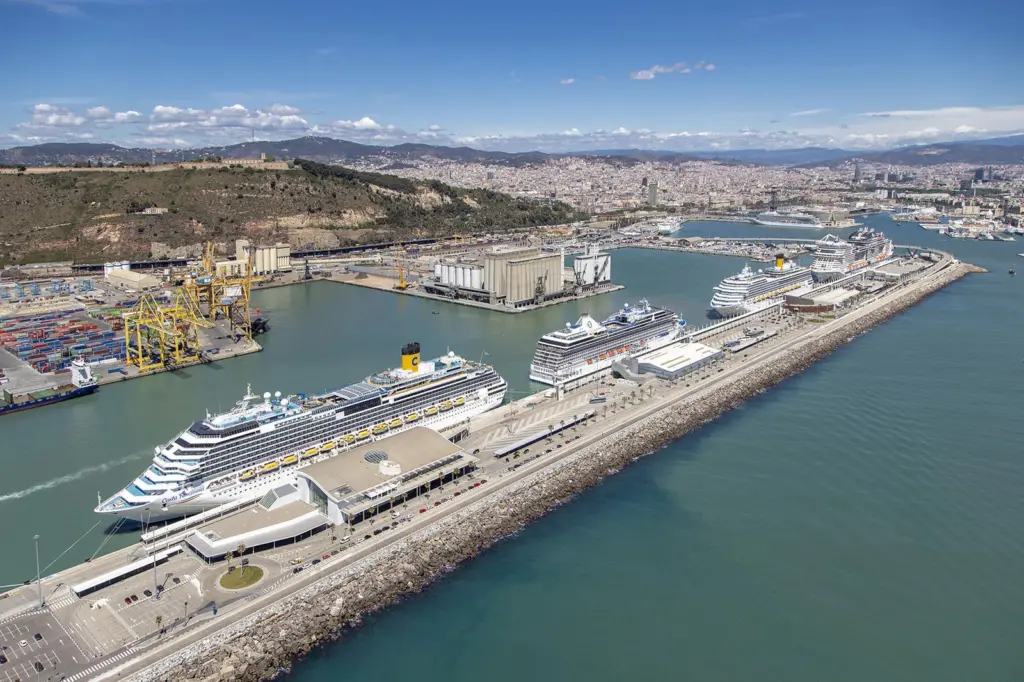
Backed by a landmark agreement between Barcelona City Council and the Port of Barcelona, the port is committing to fewer but larger and more efficient terminals, cutting-edge port electrification and comprehensive investments in sustainable fuels and green mobility.
This reinvention aims not only to future-proof the port against tightening environmental standards but also to make Barcelona a model for cruise sustainability in the Mediterranean and beyond.
The project is designed to enhance passenger experience while minimising environmental impact, creating a port that can grow in sophistication without growing in emissions.
Smarter infrastructure
At the heart of the new strategy is a decisive reorganisation of the Adossat Wharf.
The number of cruise terminals will be reduced from seven to five, with the oldest facilities, Terminals A, B and C, demolished. In their place, the port will build a single new public terminal on the site of Terminal C, designed to handle up to 7,000 passengers simultaneously.
This reorganisation is not about scaling back cruise traffic but rather about optimising port infrastructure for larger, more modern ships while reducing environmental impacts.
By 2030, this new public terminal, together with the four privately owned terminals (D, E, G and H), will offer some of the most advanced facilities in the global cruise industry.
José Alberto Carbonell, president of the Port of Barcelona, described the transformation as the culmination of a modernisation drive already underway.
“The signed protocol culminates the modernisation plan for the Adossat Wharf, which began a few years ago with the goal of upgrading port infrastructure and strengthening the competitiveness of the Port of Barcelona,” he says.
This new phase includes the demolition of three old terminals and the construction of a new state-of-the-art terminal; the rehabilitation of the wharf and the incorporation of OPS electrification systems, as well as improvements to access and mobility through the expansion of the Porta d’Europa bridge.
“These actions represent a public-private investment of 185 million euros, which adds to the investments made under the 2018 agreement and confirm the Port of Barcelona’s commitment to the sustainable development of cruise activity,” he adds.
The modernisation will also enable the port to prioritise home-port operations, which bring greater economic benefits to the city.
By improving terminal capacity and streamlining access, Barcelona aims to make its cruise infrastructure more resilient and adaptable to larger vessels, while ensuring that passenger flows are managed efficiently.
Electrification investment
Perhaps the most critical element in reducing port emissions is the large-scale rollout of shore power.
Ships running auxiliary engines while berthed contribute significantly to air pollution in port cities. Barcelona’s answer is an ambitious program to install onshore power supply (OPS) systems across its cruise terminals.
The first major project is already under construction at the MSC Terminal, in partnership with Danish engineering firm PowerCon. The €12.2 million investment will allow ships to plug into the electrical grid by 2027, drawing 100% renewable energy once a new substation comes online.
Ana Arévalo, head of the Port of Barcelona’s shorepower unit, highlighted 2027 as a turning point.
“The MSC terminal OPS is scheduled to come on stream in 2027, along with the substation that we will use to deliver 100% renewable electricity to all terminals,” she explains. “It will be a pivotal year for electrification of the Port of Barcelona wharves.”
Terminal G, operated by Royal Caribbean, is also preparing for OPS through a €12.6 million investment, with completion expected by the end of 2027.
Together, these projects form part of the €44 million Nexigen Plan, a sweeping port-wide electrification effort aimed at slashing emissions and positioning Barcelona as a pioneer of sustainable cruise operations.
Future-proofing refuelling
Beyond electrification, the Port of Barcelona is preparing for an era where sustainable fuels such as LNG, methanol and other synthetic fuels will play a vital role in powering next-generation vessels.
This adaptability will help to ensure that Barcelona can continue to accommodate the world’s largest and most advanced ships, many of which are already being designed with dual-fuel engines and systems capable of switching between traditional and sustainable fuels.
The port’s strategy aligns with the global cruise industry’s decarbonisation pathways and anticipates forthcoming international regulations on maritime emissions.
Its planned €50 million overhaul of a 610-metre-long section of Adossat wharf – where the older Terminals A and B are located – is central to this future-proofing.
By planning for both electrification and alternative fuels, Barcelona is sending a clear signal to the industry: The city is committed to being a leader in sustainable maritime transport, ready to welcome the next generation of environmentally conscious cruise ships.
Rethinking passenger mobility
Sustainability at the port also extends beyond the ships themselves. Barcelona’s agreement includes a far-reaching plan to transform passenger mobility between the port and the city.
One of the headline projects is the expansion of the Porta d’Europa bridge, which will be doubled in capacity and fitted with cycle and pedestrian paths through a €90 million investment.
A second key element is the creation of a new urban transport corridor that will link Plaça de les Drassanes with the Marina del Prat Vermell and the Zona Franca. This €10 million project is designed for public transport, taxis, minicabs, bicycles, and pedestrians, easing connections between the port and the wider city.
Finally, a new cruise mobility study will pave the way for a sustainable management plan. This will include a regular shuttle service to main public transport nodes, real-time monitoring of passenger flows and digital information systems at terminals to help distribute visitors more evenly across the city.
By 2029, when the new urban corridor is completed, cruise passenger flows will be integrated into Barcelona’s wider mobility network in a way that aims to reduce strain on local residents and enhance the visitor experience.
While the port’s infrastructure will be capable of serving larger vessels, the agreement with Barcelona City Council also introduces a cap on terminal numbers, marking the first real limit on cruise growth in Barcelona.
“For the first time in history, a limit is being placed on the growth of cruises in the city,” says Jaume Collboni, mayor of Barcelona.
He praises the port for its “effort in understanding and empathy” in recognising that “the growth of this activity cannot be infinite and needed to be reduced.”
Between 2018 and 2024, cruise passenger numbers grew by 20% under the previous agreement, which did not include limits.
The new framework represents a shift towards quality over quantity, with an emphasis on home-port cruises that bring more economic benefit and better align with Barcelona’s airport connectivity.
A model for sustainability
The Port of Barcelona’s €185 million public-private investment in new terminals, shore power and mobility – alongside the €265 million invested since 2018 – signals a long-term commitment to cruise sustainability.
It’s a great example of a coordinated approach between the port and the City Council helping to ensure that maritime tourism remains an economic driver while addressing concerns about emissions, congestion and community impact.
By embedding port electrification, sustainable mobility and readiness for sustainable fuels into its core strategy, Barcelona is creating one of the most advanced and responsible cruise offerings in the world.
With the Nexigen Plan already delivering OPS for ferries and container ships, and the cruise sector set to follow by 2027, Barcelona is setting a bold model for other global ports.
By integrating advanced terminal facilities with green mobility corridors and alternative fuel readiness, the port is working to ensure that both passengers and ships can operate with minimal environmental impact.
It is taking a holistic approach, combining infrastructure, energy and urban planning, that positions Barcelona as a benchmark for sustainable cruise destinations worldwide.
Timetable for Transformation (BOX OUT please Blakey)
The modernisation of Barcelona’s cruise infrastructure will unfold over the next five years:
2026: Closure of the Barcelona South terminal; demolition of the current Terminal C.
2027: Construction begins on the new public terminal; OPS at MSC Terminal enters service; work begins on doubling Porta d’Europa bridge.
2028: New Terminal C enters service; demolition of Terminals A and B; overhaul of the wharf section begins with OPS installation.
2029: Urban corridor opens.
2030: Terminal C fully operational with 7,000-passenger capacity.
Related Articles
 ENERGY & TECHNOLOGY GREENPORT
 ALTERNATIVE FUELS GREENPORT
 ALTERNATIVE FUELS GREENPORT