![GreenPort[PortStrategy]](https://www.portstrategy.com/greenport/wp-content/uploads/sites/4/2026/09/GreenPortPortStrategy.svg)


Portsmouth spearheads shore-based power
Portsmouth International Port is to spearhead the UK’s move to greener ports with the roll out of shore-based power at three of its busiest berths.
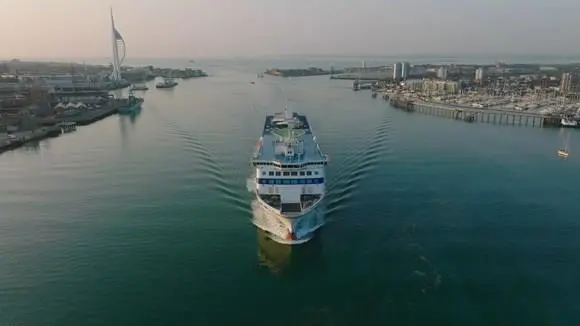
The SEA CHANGE project has received a £19.8 million award from the Zero Emissions Vessels and Infrastructure (ZEVI) competition and brings together the port with Brittany Ferries, the University of Portsmouth, MSE International, B4T, IOTICS and Swanbarton to design, build and operate the system.
“Once delivered this revolutionary multi-user, multi-berth shore power facility will be a UK first,” said Stephen Watkyns, technical director at Portsmouth International Port.
“We’ll be able to provide shore power for ships on thee of our berths,” he continued. “This project is another huge step forward for our ambitions to reach net carbon neutral by 2030 and eliminate emissions by 2050.”
Shore-based power will save more than 20,000 tonnes of CO2 emissions per year from 2027, says the south coast port, and help realise the potential of two new Brittany Ferries LNG-electric hybrids which will begin sailing from Portsmouth in 2025.
“Shore-side power in Portsmouth means we can be good neighbours to those who live and work around the city as soon as these vessels arrive in 2025,” said Christophe Mathieu, chief executive of Brittany Ferries.
“We are delighted that our forward-thinking partners have pushed to so hard to make this happen and are proud to contribute to wider emission-reduction goals.”
Funded by the UK government and delivered in partnership with Innovate UK, ZEVI is part of the UK Shipping Office for Reducing Emissions (UK SHORE), a new unit in the Department for Transport focused on scaling up clean maritime technologies. It has a current budget of £206 million, of which £80 million has been allocated by ZEVI to ten flagship R&D projects.
Related Articles
 ENERGY & TECHNOLOGY GREENPORT
 ALTERNATIVE FUELS GREENPORT
 ALTERNATIVE FUELS GREENPORT