![GreenPort[PortStrategy]](https://www.portstrategy.com/greenport/wp-content/uploads/sites/4/2026/09/GreenPortPortStrategy.svg)



Solar investment halves port power needs
PSA Zeebrugge has unveiled one of Belgium’s largest vertical solar power installations, close to 1,900 panels on warehouse facades to advance its port electrification aims.
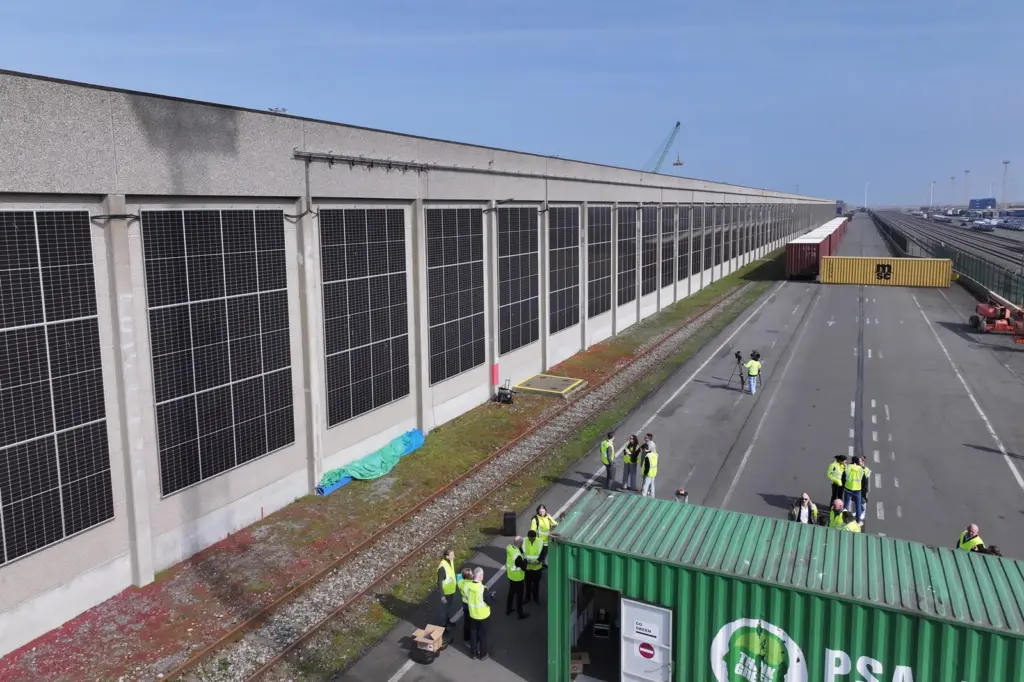
The operator said that it’s new panels, installed by Insaver, part of the Luminus Group, will generate 770 MWh annually and covering 50% of terminal electricity demand.
“While we already buy 100% renewable electricity, we are investing significantly to meet the Flemish government’s CO2 emission-reduction requirements, while contributing to PSA International’s broader ambition to achieve net zero carbon emissions from its own operations and energy use by 2050,” explained Francis De Ruytter, regional head sustainability PSA Europe, Mediterranean and the Americas.
“The Flemish government requires companies with an electricity consumption of more than 1 Gigawatt-hour per year to obtain part of that energy from solar panels. With this installation, we are meeting our photovoltaic obligations for the terminal in Zeebrugge, but also for our head office in Antwerp.”
Tailor-made solution
PSA said that the project addresses structural constraints that prevented traditional rooftop deployment while supporting regulatory compliance and long-term renewable energy targets.
The installation is expected to supply half of the terminal’s electricity consumption while reducing emissions by 101.43 tonnes of CO2 annually, equivalent to the output of 220 Belgian households.
Stijn Cuppens, CEO of Insaver, said: “By installing solar panels on its site, PSA doesn’t just reduce energy costs, it also contributes to the further decarbonisation of the electrical grid.”
“At Insaver, we believe in tailor-made solutions, tailored to the specific needs and challenges of each customer. Together with PSA, we have developed an innovative approach that perfectly matches the unique context of their terminal.”
PSA said it continues to expand its renewable energy strategy, exploring options to source 100% of the terminal’s electricity from local generation as part of broader port electrification efforts and decarbonisation objectives.
Related Articles
 ENERGY & TECHNOLOGY GREENPORT
 ALTERNATIVE FUELS GREENPORT
 ALTERNATIVE FUELS GREENPORT