![GreenPort[PortStrategy]](https://www.portstrategy.com/greenport/wp-content/uploads/sites/4/2026/09/GreenPortPortStrategy.svg)




Using smart grid technology to decarbonise
Portsmouth International Port’s (PiP) Port Energy Systems Optimisation (PESO) project has demonstrated how ports can use smart grid technology to decarbonise.
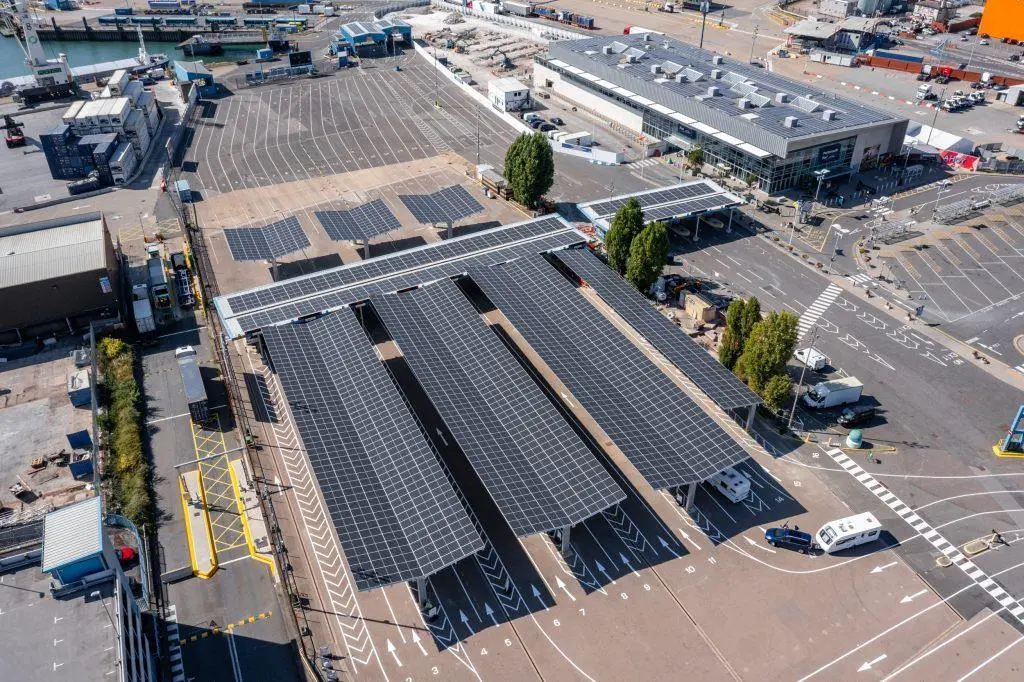
PiP, working with Swanbarton, ESC and MSE International, piloted the PESO smart energy system as part of a strategy to significantly decarbonise the port’s energy operations in a cost effective way.
“Our aim is to turn the port into a living laboratory of green technology. We were delighted to collaborate with partners on the PESO project, which has so much potential for the wider ports and shipping industry,” said Mike Sellers, port director at Portsmouth International Port.
“Combined with other sustainability initiatives, the findings from the PESO project will help us achieve our ambition of reaching net-carbon zero by 2030 and becoming one of the UK’s first zero emission ports by 2050.”
Energy management
The PESO technical capability has been demonstrated in a pilot system comprising a novel dual chemistry battery and a multi-level control system.
This control system includes an AI-based capability that learns from historic energy consumption profiles to ensure that the battery can deliver as much energy as possible when demand is high.
The technology has been extended further by engineering a predictive ‘digital twin’ model that can ensure the battery has storage capacity to fully utilise energy generated by on-site renewable generation or procured from the grid at times of low price.
This combined capability to minimise the cost of energy needed to supply vessels with energy and to drive the port’s own assets is a critical aspect of the PESO value proposition.
The project has shown that PESO technology can offer value to a wide range of ports. The prime ‘early adopter’ ports are likely to be in locations where vessels are obliged imminently to electrify in order to comply with policy developments in carbon emissions and air quality. Examples include passenger ferries and water taxis operating in cities where traditional fossil-fuelled combustion engines are not permitted.
PESO also has a critical role to play in minimising costly impacts on the local grid. It can do this by smoothing the power demand of the recharging sites and by prioritising as much power draw as possible at times of excess capacity in the grid (eg at night). The energy stored in PESO can then be made available to vessels when needed.
Although PESO has shown an exciting future for this technology in the ports and shipping sector, there are barriers to overcome if its potential is to be fully realised.
These include high cost of battery storage, the need to collaborate more widely along the value chain for maritime logistics and much needed policy developments on electricity pricing and public investment in the transmission and distribution networks.
The PESO consortium is actively working on a range of actions to advance the commercial deployment of PESO during 2023.
Related Articles
 ENERGY & TECHNOLOGY GREENPORT
 ALTERNATIVE FUELS GREENPORT
 ALTERNATIVE FUELS GREENPORT