![GreenPort[PortStrategy]](https://www.portstrategy.com/greenport/wp-content/uploads/sites/4/2026/09/GreenPortPortStrategy.svg)

A question of size
Is the threat of overcapacity being overstated in Northern Europe, asks Stevie Knight
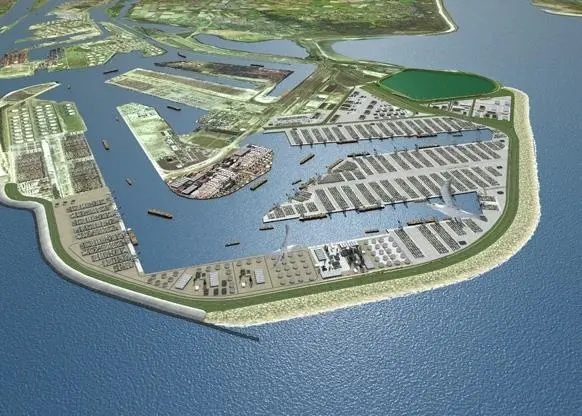
Despite the wavering nature of Northern Europe’s recovery, it’s being met more than half way by a blossoming of facilities that were edging forward waiting for the signs of an upturn.
This is despite the double whammy of the original downturn and the second bite of the ‘austerity measures’ following closely behind.
The truth is that projects like Maasvlakte II and Felixstowe’s Berth’s 8&9 were started years before the diverse pulls of the downturn and the Triple E class ships, but while the economic crunch wasn’t foreseen, it was obvious there was no particular physical constraint to ship sizes which have carried on going up – firstly in spite of the downturn, then because of it, and lately as an effect of the recovery.
Of course, along with this there is the ‘carbon’ card, and the hotly debated idea that bigger facilities are by their nature more eco-efficient as the big ships – and the logistics links – present a smaller overall carbon footprint. Together these seem to present a number of good, practical arguments for those northern European ports blessed with deep water to go for ‘hub’ status.
Paul Davey of Felixstowe outlines some of the arguments: “You need the critical mass to make coastal and rail services viable and attractive to shippers because frequency comes after volume. So, a deepwater hub is necessary to unlock the potential of both rail and coastal feeder links.” He adds: “The benefit for other, smaller ports is that we both get to handle the container – playing to the strengths of both.”
However, Richard Morton of Jura Associates points out that although some ports may be fine playing second fiddle, there are a number of big and flashy new facilities all heading to come online at once. There is Maasvlakte II in Rotterdam, Beverdonk in Antwerp, DP World’s project at London Gateway, and the Wilhelmshaven and Bremerhaven projects. “So in the short term, the Northern European area may well be looking at overcapacity. However, since a number of ports will have captive customers, I do see it working out eventually – but perhaps more toward the medium to long, rather than short term,” says Mr Morton.
Martin Poulsen of APM Terminals agrees that Northern Europe’s traditionally good growth has been interrupted by the downturn, and a lot of infrastructure was planned in better years.
He adds that if you just add up the most obvious figures, you would see overcapacity looming – but it’s not a simple equation. He explains: “If you only look at nominal capacity, then you would assume that there is too much coming on stream at the same time, especially given that quite a few ports still have room to spare. However, looking deeper, there are other dynamics to consider.
“Firstly, we all know vessels are getting bigger and bigger. Half of the strings in the region will soon have ULCCs on the routes, and this puts pressure, not just on draught, but on infrastructure, so if you factor these in, you get a different picture.”
He adds that with the bigger ships you have associated needs. “You have to look not just at berth depth, but channel navigation, and a higher rate of crane moves,” he says. Given this, he thinks “there will be winners and losers” in the region, with the haves and the have-nots growing further apart.
Still, given some of the rolling back of the economic dip, ports are looking again at their development programmes and eyeing their medium to long term prospects. Mr Morton points out it means trying to answer some very hard questions: the first being, “what is the industry going to look like ten or twenty years down the line?” followed very closely by “what kind of slice of this can we take?”
Mr Poulsen says: “Since most of the big ports from Hamburg to Zeebrugge cater roughly to the same hinterland market, it means they can be seen at present as somewhat interchangeable by the lines. So, differentiation is what is going to give any player the edge, and this is where connectivity gets to be a decisive factor.”
Therefore infrastructure and hinterland links are becoming increasingly important. Both Mr Morton and Mr Poulsen agree that there is a drive to move traffic to the waterways or on to rail, because there’s a general move toward getting traffic off the road, pushed by the carbon argument, fuel prices, and traffic congestion in general.
Given that draught is possibly the first issue, the ports that are better linked with railway or inland waterway crossovers stand to gain more. “In other words, there will be winners and losers,” says Mr Poulsen.
Although a little inland, Hamburg has four large container terminals and deep draft berths: this has helped it recently snare some southeast Asian traffic (through the ‘Grand Alliance’ of NYK Line, Hapag-Lloyd and OOCL), coming in directly from Vietnam rather than being transhipped.
However, Hamburg also saw early on that some of the best offerings it could make were the ones that joined the dots on the logistics map. Hamburg already possesses one of Northern Europe’s densest feeder and distribution networks, and to speed up the handling of feeder ships, HHLA and Eurogate invested in building up the Feeder Logistik Zentrale (FLZ). Following Unifeeder’s lead, it wasn’t long before Team Lines also decided to handle feeder services through the facility.
It’s proving a success in terms of market share as it has recently taken traffic from Rotterdam and now feeder ships will soon be calling at ports in Finland, Russia and Poland on a fixed schedule.
Mr Morton points to the two biggest divides that are pushing ports in the area to ask themselves some tough questions about their resources. “The most obvious is the draught issue, as the cascade effect means smaller ports will both have to realistically ask where their particular market is, and whether they relegate themselves to being a ‘feeder’ port and co-operate with a neighbour’s ambitions.”
“The other part of this is that the smaller ports will still have to be able to deal with the larger sizes of ships as they get displaced from the other services,” he says. So ‘relegation’ still means looking at what expansion or upgrades these ports do need to work effectively with others in the area.
The second divide is the resource issue. “Smaller ports don’t have the staffing resource for the amount of navel gazing needed to really evaluate their part in an uncertain future,” says Mr Morton. “No-one can stay still. But you don’t know what the future holds.”
However, in contrast to the ongoing competition between the bigger sea ports, inland ports are increasingly working together to enhance their role as hinterland hubs.
Isabelle Ryckbost of the European Federation of Inland Ports (EFIP) explains: “More and more seaports are being obliged to look beyond their own infrastructure and facilities, having to liaise with intermodal inland terminals in their hinterland.”
She adds that besides this, advanced co-operation between seaports and the inland ports not only offers a solution for the congestion inside port gates, but can also decongest the area around the seaport by bringing goods further into the hinterland – and the services offered range from simple nodal point interchanges for multimodal container flows, to providing everything from customs administration and warehousing to stuffing and unstuffing boxes.
There are also many kinds and levels of co-operation taking place, from simple MoU’s to ownership. “Duisberg, for example, is soon to sell off a large share, and both Rotterdam and Antwerp have already registered their interest,” says Ms Ryckbost. And since common issues along the river routes cross national boundaries, the Rheinports initiative brought together Weil am Rhein, Basel and Mulhouse, from Germany, Switzerland, and France.
Further, a recent feasibility study undertaken by the Port of Metz and the Port of Trier investigated setting up a joint box route along the Moselle to go into the maritime seaports. By joining forces, the inland ports found they could reach a potential 170,000 teu as well as gaining an important shift off the congested roads.
Ms Ryckbost adds: “By joining their forces the inland ports also want to become more attractive partners for the seaports.” But while these ports are “doing a little flirting to see what can work” she says that these are not exclusive relationships: “For example, Liège in Belgium is talking to both Rotterdam and Antwerp – it’s not monogamous…”
“Either way,” says Mr Morton, “even smaller ports with a history of competition won’t be able to continue to play off each other if they want to stay competitive: they will have to start to think along different lines, such as resource sharing.”
However, the biggest challenge for the seaports, says Mr Poulsen, is the industry interface between shipping lines and terminals. He points out that there are quite a few ways that both sides could better co-operate and ditch some of the inbuilt wastage, by, for example, planning together.
Mr Poulsen explains that capacity is built to scale the peak demand times, but there are a lot of off-peak lulls, and if there were better communications and particular, differentiated deals put on the table, then there would not have to be so much pressure on the hinterland links or port side infrastructure, and this could be reflected in better prices all round. And although he is cagey about it, it seems yes, there are the first stirrings of this kind of co-operation in the region, “but it’s very early days yet”.
Mr Poulsen concludes: “It’s something that would benefit both terminals and lines, but, historically there hasn’t really been the sort of co-operation you often find between suppliers and buyers in other sectors: so far it has been an almost adversarial relationship.
“We need to stop trying to pull the blanket from one side of the bed to another.”
Related Articles
 EUROPE
 ALTERNATIVE FUELS GREENPORT