![GreenPort[PortStrategy]](https://www.portstrategy.com/greenport/wp-content/uploads/sites/4/2026/09/GreenPortPortStrategy.svg)




AN IDEA WITH LEGS INCREASES PRODUCTIVITY
When ICTSI took over Baltic Container Terminal (BCT) Gdynia, it became clear that much of the equipment it took ownership of had been exceptionally well looked after. Jan Mors, BCTs executive vice-president comments: ” The function in the terminal was excellent. Technical and maintenance was good and equipment had at least five years more life than would normally be expected.”
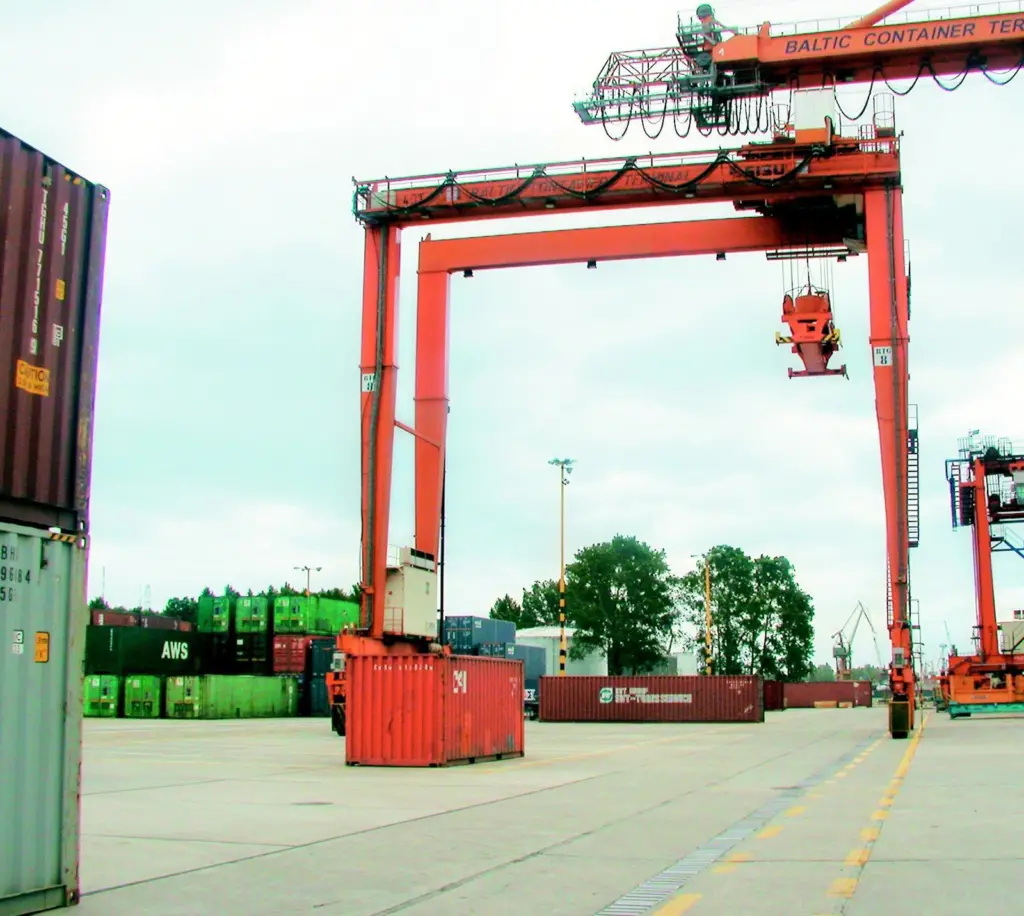
Because the container handling equipment was in good order but the terminal needed greater stacking capacity, BCT decided to consider increasing the height of its one-over-three RTGs to become one-over-five high. Negotiations with Kalmar began at the end of 2003 and an agreement was reached in February this year.
Kalmar agreed to prefabricate sets of six-metre long columns in its Tampere factory in Finland which were then shipped to Gdynia. Each RTG, between 11-18 years old, is partially dismantled using the backreach of one of BCT’s ship-to-shore cranes as the construction crane when its not needed for loading or discharging work. The columns are bolted at the top of the RTG’s four vertical beams and the top is bolted back onto the heightened unit.
Rewiring the RTG after the heightening procedure is a more complicated challenge and various safety initiatives have to be included. Each unit only needs to be out of service for a total of three weeks while the work is completed. Although Kalmar is overseeing the project, BCT’s own labour force is actually conducting the work, thus keeping costs down.
All of the one-over-three RTGs have a 9metre wheelbases which is sufficient to support a one-over-seven unit. However, extending to that height presents another range of issues, not least the need for a larger reel to accommodate the additional lengths of cable.
Increasing from one-over-three to oneover-five will provide BCT with a 67% capacity boost, depending how it is utilised. One-overfour stacking will gradually be introduced when some shuffling will become involved.
This is the first RTG heightening project for Kalmar but the fact that the structure is bolted together rather than welded makes it technically straightforward. Kone points out that its machines are also produced to be easily heightened at a later date, whereas many cheaper Chinese models are welded together, precluding them from later modification.
Kari Ronkainen, Kalmar’s manager ports and projects says: “Modification is an economic way to extend the life of an RTG.
The units are of factory quality and a warrantee is offered.”
Ronkainen declined to comment on the actual cost of the project, but he did say:
“The straddle carriers that we refurbished in St Petersburg cost 50% of the cost of new units but we did have to change everything except the frame and the engine.”
Although we could not pin Kalmar down to tell us the cost of heightening the RTGs, we do know that BCT paid a total of $12m for the following new equipment and the whole RTG modification project. You do the maths:
1 x Panamax STS crane (Kone) 4 x RTGs (Kalmar) 8 x prime movers (Kalmar) 11 x 40ft internal trailers (Buiscar).
Related Articles
 EUROPE
 ALTERNATIVE FUELS GREENPORT