![GreenPort[PortStrategy]](https://www.portstrategy.com/greenport/wp-content/uploads/sites/4/2026/09/GreenPortPortStrategy.svg)

An inward look
Northern Europes traditional ports are facing challenges from all angles, as Stevie Knight discovers
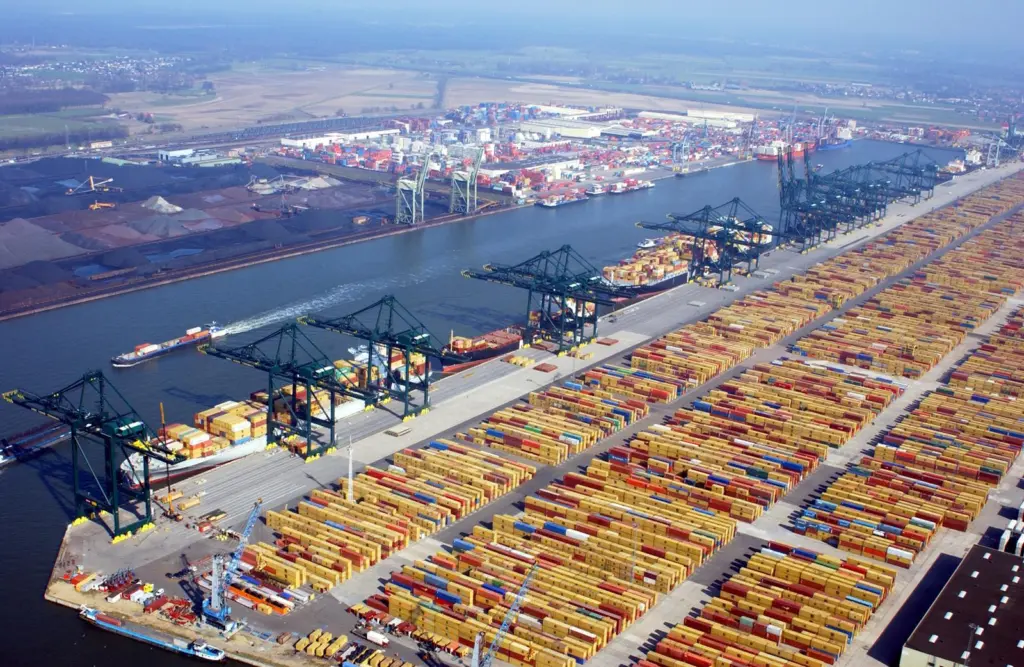
The fight for market share in Northern Europe is going to be impacted by more than the big capacity plans of JadeWeserPort (JWP) and Maasvlakte II.
Northern Europe is really quite a limited arena so it’s relatively vulnerable to market shifts, warns Ben Hackett of Hackett Associates.
Indeed, the downturn has already turned Northern Europe into something of a battleground with Hamburg only recently regaining its share from a price war, so JadeWeserPort and Maasvlakte II will certainly have an effect.
However, other elements are about to intrude. The strength of the German economy and growth in Central and Eastern Europe will help German ports, and Sönke Maatsch, co-editor of the Global Port Tracker from Hackett Associates and ISL, predicts: “By the end of the year, they may reach a market share of 40% again – just as before the crisis.” On the other hand, Antwerp, Zeebrugge and Le Havre will most probably continue to lose out.
Despite this, Mr Hackett adds that Baltic cargo, part of Hamburg’s lifeblood as well as a significant part of Northern European volumes generally, could be captured by JWP, which – despite its recent construction difficulties – will soon be trying hard to grab what it can in the transhipment market as it has deepwater but not so much in the way of hinterland links. Against this, waterway box traffic along the Elbe to Hamburg is expected to surge following the hotly debated dredging project which will deepen the route to 14.5m.
However, there’s another possibility on the horizon which could impact a number of operations including Bremen with its Eastern European ro-ro and automotive sectors links. If the Baltic ports – such as Ust Luga in Russia – get their depth and space sorted out enough to draw in direct calls, they could divert traffic away from its traditional Northern European transhipment base. Mr Hackett says that there’s been a warning shot from that quarter already, and that it’s probably just a matter of time before the Baltic starts pulling in its own cargo.
After all, there are some cargo paths that seem more natural than others and location, says Martin Poulsen of APM Terminals, will once again become a “significant consideration” as the fuel prices kick in along with European emission control legislation – something that may well increase the price of power as a large part of the market is forced into using distilled fuel (MGO) or other alternatives come 2015. “Steaming time out of ports will be more of an issue again,” he says. “While it does both rise and fall in the short term, over the longer term it is only going one way.”
Watery network
This again may well feed into the growing, pivotal role of the inland waterway ports and depots. There’s already a complex set of connections between places like Antwerp, Rotterdam and Duisburg, or Bremen and JWP, while Hamburg has its own set of links and very strong, mature relationships with freight and distribution companies that extends all the way from the other major ports and into the hinterland’s east and south.
“There are Dutch inland operations that run along the country’s German borders, Antwerp has a system of very successful inland depots and a number of ports have invested in the facility at Duisburg – including Antwerp which is running a direct rail service between the ports,” says Mr Hackett, adding that it’s no coincidence that both Antwerp and APM Terminals have been reaching along the supply chain, APM Terminals having a policy of embracing their clients’ clients.
“While you can’t underestimate the force of habit that keeps shippers sticking to solutions that they know and understand,” says Mr Poulsen, “two things will resolve the on-going under-utilisation of the inland waterways: legislation and fuel prices.” Further, he points out that the larger ships, and ensuing larger parcel sizes will put a strain on the road links around many Northern European ports – even if volumes only show slow growth: “Trucks are the least economical and most polluting solution so I predict a rise in volumes being transported by barge and rail.”
It’s borne out by the growth of Duisburg. Located where the Rhine and Ruhr rivers meet, it brings in goods from Amsterdam, Rotterdam and Antwerp and has only taken a decade to pick itself up from its role as a local steel and coal bulk port and transform, butterfly like, into a rapidly expanding container port and logistics hub.
Large companies including Kühne & Nagel, Hewlett-Packard and Danone have been won over: certainly the pull has been in part the investment in container quays and warehousing but the intermodal transfers that link water, road and rail together have generated as much interest.
Seine success
There are also developments on the Seine. While the Paris-Seine-Normandy ports last year saw a maritime tonnage fall by 4%, inland waterway traffic saw very healthy increases in both the more traditional bulk cargo – up by around 5% – and truly huge 18% growth in box traffic.
Almost in answer to Mr Poulsen’s point that there will be connectivity issues pushed by the larger parcel sizes on the bigger ships, the Paris-Seine-Normandy group is looking at something an ‘economy of scale’ all of its own.
Patrick Bret from the port of Rouen explains Northern France “has just too many ports”, while larger European facilities – like Antwerp – are actually strung out over quite a wide area.
So the idea is to tie these smaller French units together into a complex of around 130m tonnes under the name ‘Haropa’. “We are still far away from capacity like Antwerp or Rotterdam, but we can at least compete.” Further, although the port needs development, it has an entry point right into the Paris Basin.
The offering will run door to door and meet all the needs of the city and surrounding area. “Day one you have the goods delivered via the deep water of Le Havre – and by day three the goods are in the department stores,” he says.
There’s a number of sides to the programme, one being a joint venture between Terminaux de Normandie, SETO and TNMSC to give Le Havre 1,400 metres of quay while another is to improve access to the Port of Rouen from the sea through dredging the Seine channel, enabling a draught of 11.7 metres and giving a leg-up to the region’s vast agribulk industry with its nearby concentration of mills and storage sheds.
Paper trail
However, the boxes will also find a better reception. A point made by Richard Morton of Jura Consultants is that “there are physical bottlenecks, but actually, the barriers put up by stamping paper documents before things can move can be just as much of a hurdle”.
So the ports community system will mean onboard electronic data processing – saving time: the box gets on the barge with a Customs e-document which is processed while travelling overnight, finally being OK’d at its destination in Paris.
The challenge as Mr Bret sees it is winning French cargo back from Antwerp and Rotterdam: “We are big enough to compete but we are small enough that if we are approached by a customer, given 24 hours we can come up with a tailored, bespoke solution.”
He adds it’s not just inward, intra-European cargo that can benefit from this approach. “While containerships are central to Europe, in Africa and other emerging economies the box is not the only answer. These countries need to transport goods like second-hand buses, machinery and electrical appliances – often the items needed for infrastructure projects – in varying, not necessarily predictable loads. So, we have developed the BOCS system, which means all these different shapes and kinds of cargo get on the same vessel – and one that is suitable for the destination port in question. It’s all a question of flexibility.”
Related Articles
 EUROPE
 ALTERNATIVE FUELS GREENPORT