



Automated mooring for Baltic Sea port
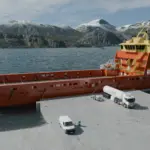
Trelleborg Marine and Infrastructure has supplied its rope-free automated mooring system to the international cruise ferry and domestic RoRo ferry terminals at the Port of Langnas in the Baltic Sea.

Part of Trelleborg’s SmartPort portfolio, AutoMoor uses vacuum technology to secure a vessel at berth in under a minute, continuously monitoring mooring loads and feeding real-time data to help operators efficiently manage port and terminal operations.
“Automating the mooring process is vital in optimising the vessel turnaround process and improving port safety, efficiency and sustainability,” said Richard Hepworth, president of Trelleborg Marine and Infrastructure.
“We’re delighted to be able to facilitate exactly that for the Port of Langnas, which services over 3,000 ship arrivals annually,” he added.
The AutoMoor T40 Twin Arm has two mooring arms that can operate together or independently to provide mooring of vessels with varying hull profiles. The arms can be pre-set to attach to vessel hulls at different heights to avoid obstacles on the hulls, enabling the port to accept a greater range of vessel types.
Trelleborg analysed the berth to determine where best to site the six T40 Twin Arm AutoMoor units, taking into account the available space on the hull of each vessel for the vacuum pads to attach.
“This will allow the mooring of as many as seven different RoPax vessels up to 223 metres in length and over 65,000 tonnes in weight, enroute between Sweden and Finland,” said Ronny Eriksson, chief executive at the Port of Langnas.
Trelleborg also supplied two of its AutoMoor T40 Twin Arm units to support the port’s domestic operations, successfully mooring the 108 metre Fjardvagen, a RoRo vessel that travels daily between Langnas and Naantali, mainland Finland.
Related Articles
 EUROPE
 ALTERNATIVE FUELS GREENPORT