![GreenPort[PortStrategy]](https://www.portstrategy.com/greenport/wp-content/uploads/sites/4/2026/09/GreenPortPortStrategy.svg)

Breaking hard ground
The barriers to entry are great, but Russia is still mightily attractive to investors. Stevie Knight explains
It’s the largest country in the world by area, with a growing economy and a constrained coastline which could make the terminals worth their weight in gold. But as it’s Russia, the gold is tempered a little by other considerations.
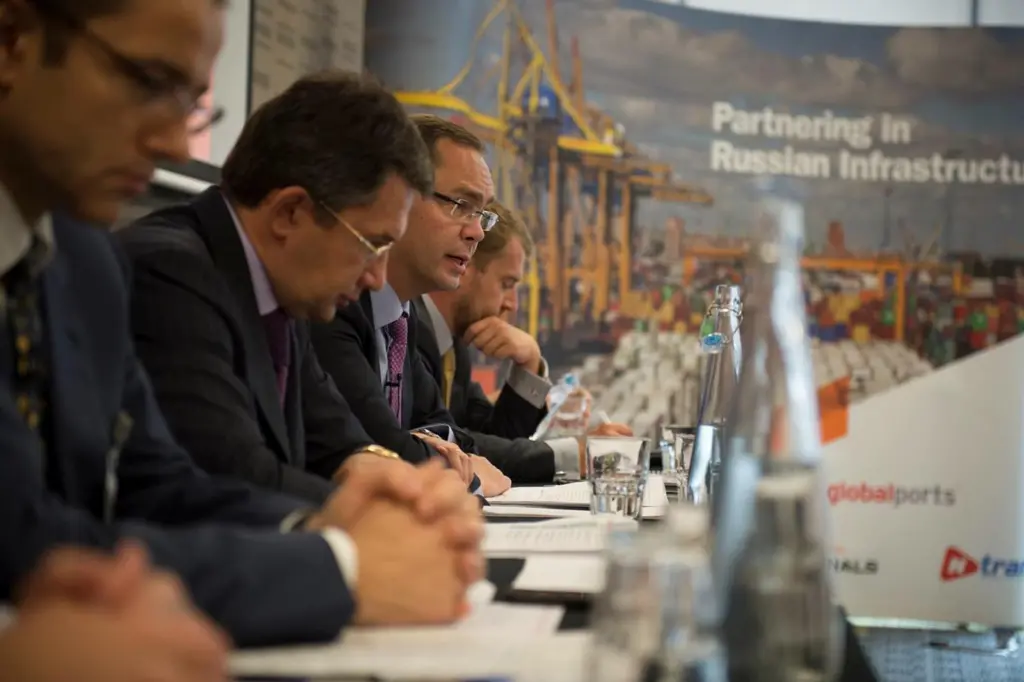
This is something that APM Terminals has obviously thought hard about, taking the unusual step of entering into a partnership with privately owned Transportation Investments Holdings Limited (known as TIHL or N-Trans) in the running of Global Ports, splitting N-Trans’ 75% share between them. Interestingly, the deal included reducing the companies’ block of voting by 15%.
The investment represents the largest foreign direct investment in Russia’s transport industry to date. Global Ports holds a 30% market share of the country’s overall container throughput operating two box terminals in St Petersburg and one in the Russian Far East, plus another two container terminals in Finland and one oil export terminal in Estonia.
Francois Delenclos of APM Terminals explains the venture is a major move adding that it’s not just the huge scale, it’s also the nature of the involvement, “as operators more often simply take control of new locations one by one rather than going into a regional partnership”. It’s bound to stretch the company’s culture a little as APM Terminals is more used to directing the changes themselves and remaining firmly in the driving seat. However, it will give it that all important entry into the Russian box market, a good place to be – barring a hitch with the oil prices that Russia depends on to fuel its economy.
Capacity crunch
The last two decades have seen lots of talk about the need to increase Russia’s Baltic capacity, but in terms of container ports, there is only St Petersburg and the new Ust Luga facility on Russia’s short coastline. And, as Holman Fenwick Willan’s Alistair Mackie explains, vessel size at St Petersburg is constrained by both lack of depth and ice, since it can only take ice-class ships in the winter despite the fleet of icebreakers keeping the channel open all year. Still, it’s one of the few ways directly into Russia and it remains an “interesting gateway” that will continue to gain momentum if things keep improving.
Because of this, around one-third of Russian imports arrive via Finland’s Hamina-Kotka and Helsinki facilities with the Baltic’s Riga, Tallin and Klaipeda adding to the competition: this costs St Petersburg nearly $1bn per year in lost revenue. So, along with energy bulk projects at Vysotsk, Primorsk and Vyborg there is also Saint Petersburg’s Bronka facility, the first phase of which aims at 1.45m teu and 260,000 ro-ro units.
However, although scheduled for 2015 there are doubts that it can reach the declared throughput because the sea and rail access need to be developed from scratch to correspond with the capacity; this requires around $3bn of public and private investment and might knock back the volumes.
Further, the European crisis has affected all the terminals in St Petersburg, results were expected to be higher, but the whole year has been dampened and the total throughput was only up 3.2% in total, explains Alexander Voronkov of Russia’s National Container Company: “So the competition between St Petersburg and the other Baltic terminals is becoming increasingly keen,” he says.
Ben Hackett of Hackett Associates points out that since deep water is something that is still lacking on Russia’s Baltic coast, Gdansk is the only real alternative. The Gdansk Container Terminal does well with its priority arrangement with Maersk, but this leads to another issue: even though there is space, other lines may feel they come in second place – unless of course they work up an investment deal.
Domestic attraction
However, there is more to Russia’s attempt to pull its own cargo through its ports. To start with, Ust Luga has just gained its first CMA CGM call, and further, an oil terminal has just started up at the port which aims to handle around 15% of the country’s oil exports plus an amount from Kazakhstan. The terminal will probably handle around 15m tonnes this year, around half of its full annual capacity. Since exports from the country amounted to 219m tonnes of crude last year, this is no small amount and makes Ust Luga’s oil terminal the country’s second largest.
Half owned by Gunvor, it looks like snaring business that was originally going through transit countries but the payback may not be as immediate as originally thought – last year a number of cracks appeared on the quay and repairs had to be hastily scheduled: so far only one out of the two berths is being used, the other is awaiting ground stabilisation measures. Despite this the developers are already in talks with potential investors to build a deep conversion refinery and natural gas processing complex to bring refined products to market.
Further south and facing the Black Sea, Ukraine port development is tied up around the implementation of the newly adopted sea law which aims to get things moving. Real estate property, berths and land plots within a sea port can now be owned by individuals and private companies with infrastructure leased out for up to 49 years. There will also be a new state-run body to oversee these procedures. However, so called ‘strategic’ port infrastructure will remain state owned – an important point to note.
It’s pretty unclear how successful the move to open the ports to private investment will be on the whole, says one source. He suspects these mostly look like being sold to existing local industrial or financial groups linked to the government or indeed to Russian interests, and adds that the Ukraine has “been less than smart” in attitudes that have ended up undermining attention from other, more competitive buyers for its assets. For example there was notable difficulty between Yuzhny’s TIS (Transinvestservice) and the local state-run port landlord.
Of the Russian interest in Ukrainian ports, he says: “They might, in the final analysis be the only ones ready and willing to take the risk of investing in the country; they have a certain amount of leverage in Ukraine and they know that they can carry out long term lobbying to help protect their purchases,” going on to say that they certainly won’t be paying “the fair market price” for something if there’s no competition.
Those who don’t follow the ups and downs of the relationship between the two countries might be surprised, but he adds that Russian politicians and businessmen are guided by economics and pragmatism, and they are “natural buyers” of whatever transport property comes up.
Battleground
Plus, Novorossiysk Commercial Sea Port might be trying to grab back some Russian cargo itself. NCSP, which operates both Novorossiysk and Primorsk Port, plans $200m in investments in the coming year as part of a $1.1bn spending plan. Recently, its oil side has caught the headlines with a corporate battle for shares, but its boxes are doing well too.
Notably, Novorossiysk’s three panamax-size terminals (run by NLE, NCSP and NUTEP) managed to total 634,968 teu in 2011, a huge jump of 48% over the previous year. Mr Hackett says that there are a good handful of positive points to the port: there’s a wide variety to the types of cargo on a number of key traffic lines running to and from the Med, the Far East and Asia, but interestingly, it also stands to gain from a rising interest in dry and liquid bulk containerisation. While it could do with fewer barriers to trade flow and could gain from more consolidation of cargo, barring another major economic wobble Novorossiysk is looking at solid growth says Mr Hackett.
Another big player about to make a grab for Russian cargo comes from the new deepwater port at Russia’s Taman.
Originally a greenfield, private operation, Taman came to the attention of President Vladimir Putin and with the state’s backing its now going full speed ahead.
With a projected capacity of 100m tonnes of bulk, 1.5m teu of boxes and costing around $5.4bn, Taman has a starring role in Russian plans: it’s one of the few ice-free ports, and so can ship all year round. Works are planned to start next year and finish, that is, completed as a whole, by 2018.
This is an interesting point by itself: the construction is being carried out as a single project in marked contrast to the other, more iterative developments in the region, but also noteworthy is the state’s willingness to clear up the Russian Railways (RZD) issues before the development puts a whole new strain on it, and together Tuapse, Novorossiysk and Taman stand to benefit soon from rail investment, including a bypass at Krasnodar, to the tune of $450m.
The government is now looking for private sector suitors to put in another $3.6bn. A number of investors announced interest with Glencore very recently gaining the grain terminal: however, Global Ports has also thrown its hat into the ring, which might give APMT the opening they want.
Ukrainian delays
All this looks like impacting Ukraine, says the industry source. “Although it won’t happen overnight it could mean Ukraine will eventually lose 60% to 70% of its present transit business and worst case scenario, it might end up by handling domestic cargo only; unfortunately the country’s own production won’t be strong enough to fill up the ports,” he concludes.
The main problem, he says, is that the Ukraine is really late getting started on the port reform track and now they are a “whole generation” behind the curve. “Terminal operators would have been interested in the Ukrainian ports a few years ago, but now they are more interested in Taman.”
Not everyone is of the same opinion. NCC’s Mr Voronkov says that he doesn’t expect a great contest to be sparked off by the new project, beyond that arising between Taman and Novorossiysk. Plus, although Mr Hackett points out that volumes are presently spread a little thinly across Ukraine, Odessa has a strategy to pull ahead of the pack, and it’s doing quite well handling 455,540 teu in 2011, over 155,000 in front of its competitors.
HPC Ukraina, an offshoot of HPC Hamburg, has put in a couple of ‘strategic’ investments with a Quarantine Mole project, 650m of new quay and three more ship to shore cranes. Odessa, says Mr Hackett, has done the sums and decided that despite macro-economic uncertainties, increasing the scale of terminal operations is worthwhile: in total you end up with a reduced unit price. Mr Hackett says on this basis it’s aiming to attract market share away from places like Constanta on price difference.
But no matter what the outcome of the Black Sea competition, routes into Russia can’t be considered easy.
Related Articles
 EUROPE
 ALTERNATIVE FUELS GREENPORT