![GreenPort[PortStrategy]](https://www.portstrategy.com/greenport/wp-content/uploads/sites/4/2026/09/GreenPortPortStrategy.svg)
GreenPort Congress in American first
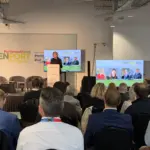
The first GreenPort Congress held in America opened on 16 May at the Baltimore Convention Center and focused on innovative techniques and technologies to reduce port emissions.
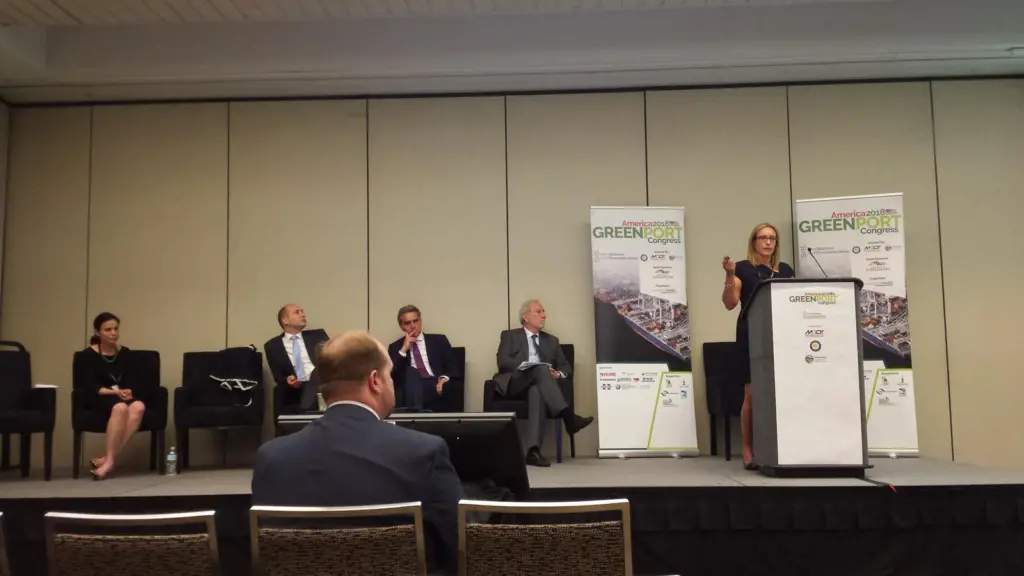
Celebrating Baltimore’s environmental record during its rise to the fourth fastest growing port in America, Boyd Rutherford, Lieutenant Governor of Maryland, said the port of Baltimore had enacted clean air standards twice as strong as those in the Paris Agreement.
Ben Grumbles, secretary of the Maryland department of the Environment, said: ‘We are showing the state and region – and leaders around the world – what progress can happen when we work together using federal funds and state funds.’
Keynote speaker Ray Fitzgerald, president and COO, Wallenius Wilhelmsen Solutions, said that funding green ports was a major challenge. ‘The global sulphur cap costs 40 to 60 billion dollars a year and industry cannot absorb that, so fundamental changes have to occur.’ Fitzgerald also called for more uniform regulation in the port sector. ‘We can’t micromanage idiosyncratic regulations by region,’ he said.
Jan Peelen, Netherlands attaché for infrastructure and water management, said that ‘chronic stresses on infrastructure combine into a cascading effect’ when major shocks such as climate change occur. Peelen said ports were often viewed as ‘a negative black box or a risk that has to be handled, but they can play a leading role in thinking about resilience.’ Leadership was also a topic for Robert Howe, MD, Bremen Ports, who said that as the fourth biggest harbour in Europe, Bremen seeks to advance its concept of ‘green ports as green gateways for green shipping and green logistics’.
Anne Choate, senior vice president of ICF International’s Sustainability Division, said that increasing resilience at a port has the effect of increasing resilience in the local and regional economy. She urged ports to ‘find champions who can sell concepts to management and staff on the ground. It’s important to find entry points in existing systems.’
‘Resilience is the new word for talking about climate change without mentioning climate change,’ noted Lena De Santis, managing scientist, Anchor QEA. She said that vulnerability assessments need to include infrastructure, habitat and community.
On the diverse challenges of building a sustainable logistics/supply chain, Mick Arnold, president of Arnold Packaging, said: ‘You can make packaging choices that will provide sustainability and profitability benefits. The world rewards people who are making smart choices.’ Captain Ahmed Khan, operations manager for Bahri Logistics, said that MARPOL compliance and a ‘spotless record of inspections’ were behind his company’s international growth. Brooks Royster, president of cold storage company MTC Logistics, said: ‘We recognised that energy is our second biggest expense and we now have over 100,000 sq ft of solar panels so that we can sell power back to the providers.’
Addressing community engagement challenges, Joseph Greco of Ports America Chesapeake LLC, said: ‘There is continuous pressure to move the economic activity of ports away from the population. We have taken up the challenge to become the most efficient port on the East Coast, with positive community relationships.’
Talib Horne, executive director of Bon Secours Community Works, said: ‘In supporting a port/community development program, it is best to let the community dictate which way the relationship should go.’ Community leader Francis Taylor said mutual respect was essential. ‘As long as you are reaching out from port to community and genuinely addressing issues with patience and concern, I think it’s a no-brainer that outreach can be successful.’ Destiny Watford, winner of the 2016 Goldman Environmental Prize for Grassroots Heroes, talked about her motivation for becoming a community activist for a Baltimore port community. ‘We weren’t at the table making decisions and we could not continue with that cycle,’ she said. Solomon Egbe, director of health, safety & environment at Ports America Chesapeake, said a proactive approach to mitigate community impacts was important. ‘We are way ahead of regulations; when we expand the port down the road it is going to create a significant impact on the environment, so we are jumping ahead of the curve in emissions reduction.’
Ken Adler of the Environmental Defense Fund said the EDF’s use of AIS systems to estimate air emissions from commercial ships in Houston had improved the accuracy of emissions reporting. ‘We did not think the existing data were accurate so we undertook to use AIS that the US Coastguard provides. AIS provides a susbstantially more accurate and robust way of measuring emissions.’ Dr Pepijn Veefkind of the Netherlands meteorological institute (KNMI) shared his organisation’s experience of emission monitoring from space. ‘A lot of ships are in remote locations. That is where satellites can play a very nice role,’ he said.
Innovative techniques and technologies were highlighted by various speakers. Michael Mengelt, Ramboll Finland, explained how dredge sediments can be reused as site filling materials, while Cristina Murphy of XCOOP (Rotterdam) considered the potential for in situ recycling of building materials.
Achieving near-zero emissions with clean smart truck technology was the topic for Parthav Desai of Volvo Group North America, while Amar Chhajed of Progress Rail talked about the Port of Tacoma’s switch to a Tier 4 switch engine, with significant emissions reduction. Dayne Delahoussaye of Neste North America offered solutions for carbon reduction through next-generation fuels.
Related Articles
 GREENPORT CONGRESS GREENPORT
 ENERGY & TECHNOLOGY GREENPORT
 GREENPORT CONGRESS GREENPORT