



Boom or bust?
Glyn Humphries, projects director at Adler and Allan, takes a brief look at why ports and harbours often underestimate what it takes to effectively deploy their Tier 1 boom during an oil spill.
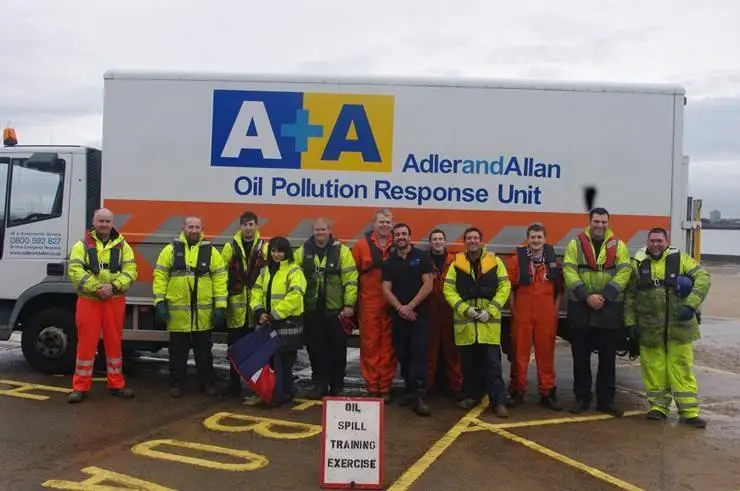
The framework for oil spill response is traditionally divided into three distinct segments called tiers. Tier 1 is what the port can do for itself, Tier 2 relies on outside help from an accredited contractor, such as Adler & Allan, and finally, Tier 3 is a major incident of national importance. Experience shows that for ports and harbours the response in the early stages of an oil spill can be critical in mitigating the effects of pollution and limiting the cost of the clean-up. However, for those ports that elect to strengthen their Tier 1 stockpile with more sophisticated booms other than sorbents, there are some pitfalls lying in wait.
When delivering accredited oil spill training on the subject of using booms, I often draw the audience’s attention at the beginning of the session to a slide produced by the Maritime and Coastguard Agency. They make the following observations about boom deployment:
- Technically complex
- Requires great expertise and manpower levels, something that’s often underestimated
- Significant health and safety implications
- In major spills there can be insufficient Resources
- Site prioritisation is essential
The language clearly isn’t optimistic, but why? Surely it can’t be that tricky? How can we ensure that we stand a good chance of succeeding with boom deployment?
Let’s consider what type of boom will be needed in different situations; there are three commonly available types of non-sorbent boom: fence boom, tube and skirt boom and shore sealing boom. Each type has strengths and weaknesses and before selecting a boom for a Tier 1 stockpile, it’s important to consider likely boom usage.
Fence booms: Up to half a meter in height, fence booms are typically manufactured in PVC so they are cheap to buy, requiring little routine maintenance. Launching and use in sheltered water is relatively simple, requiring no inflation equipment since the boom contains its own permanent buoyancy. This latter feature makes it bulky but fairly tough as it isn’t susceptible to punctures when used around piles, hulls etc.
The main weaknesses are the tendency for the fence boom to flatten on the water when exposed to wind. Because of its design, fence booms do not have good wave following characteristics or high reserve buoyancy so over-topping by waves or submergence under tension can occur. Each of these weaknesses means that in exposed situations a loss of containment can happen.
Inshore tube and skirt booms: Up to three quarters of a metre in height and typically manufactured in PVC or the more durable (and expensive) PU, inshore tube and skirt booms, have an air inflated tube to provide a good level of reserve buoyancy. Deployment is more demanding as inflators are needed. The air tube is also susceptible to damage so routine maintenance and careful handling are a must.
The tube is high frequency welded to an underwater skirt; the ratio of freeboard to skirt draft is approximately 1/3 to 2/3. At the bottom of the skirt there is a ballast member, such as a chain or steel cable, to hold the boom upright and accommodate the tension caused by the current.
While this type of boom has good wave following characteristics, won’t lie flat like fence boom and has a high resistance to submergence, do not ignore the implications of the tension build up when the boom is deployed across a current.
For example, if 200Ms of boom with a 0.6M skirt is intended to be deployed across the entrance to a harbour and directly across a 2 knot current, then the approximate tension load in Kilograms can be derived from the formula F = 26 x A x V x V. where A is the area of the skirt in metres squared and V is the current in knots. So, using our example the tension force generated is 26 x 0.6 x 200 x 2 x 2 = 12,480kg. This is why small vessels and deployment teams are often overpowered when deploying this type of boom into strong currents.
A further significant weakness that applies to all common booms is entrainment, whereby oil will be pulled under the boom and escape if the perpendicular current is greater than 1 knot.
To get over entrainment and the load generated by booms in a current, it is necessary to deploy the boom at an angle to the current. The chart below shows boom angle against current and it can easily be seen that at 2 knots a deployment angle of approximately 20 degrees is required. In order to cover our previous 200m quay to quay we will actually need to use 584 metres, which is a real handful and so a different strategy is needed.
Shore sealing boom: Commonly made form PE and, as its name suggests, is designed to work in the inter-tidal area, where the sea meets the shore and a seal is needed as the tide rises and falls.
Like the tube and skirt boom there is an air tube on top but here the similarity ends. The skirt is replaced by two water tubes that can sit down on the drying shore under the weight of the water inside them and then float up with neutral buoyancy as the tide floods.
The design works well on gently shoaling shorelines and forms a seal so oil cannot bypass the boom at the water’s edge. Large amounts of boom may be needed here, also, in addition to the inflator a water pump will be required to fill up the two water tubes. One significant drawback of this type of boom is its weight when the water tubes are filled – it cannot be moved on land without damage occurring. Another drawback is that it doesn’t have a cable or chain tension member to take the loads mentioned above, so great care has to be taken to isolate the tension load build up in the boom through the use of anchors etc.
Clearly, given all of the above factors, it pays to think carefullyabout your Tier 1 response ambitions. Start with a realistic risk assessment within your Contingency Plan and consider how best to mitigate those risks with a sensible booming plan. Most port operations today are lean and therefore the role of the organisation’s own staff in a response needs to be clearly thought through and appropriate training must be provided. Above all, recognise the importance of timely action in reducing the overall impact of a spill but be realistic and make sure that you can do what you say you can do by testing your capability in exercises.
Related Articles
 PRODUCTS & SERVICES GREENPORT
 ENERGY & TECHNOLOGY GREENPORT
 ENERGY & TECHNOLOGY GREENPORT