![GreenPort[PortStrategy]](https://www.portstrategy.com/greenport/wp-content/uploads/sites/4/2026/09/GreenPortPortStrategy.svg)


Decarbonisation with the helping hand of machines
Unprecedented challenges call for new solutions and that’s where artificial intelligence (AI) comes in, writes Grant Ingram, CEO for the UK and EMEA, Innovez One
Ports are experiencing one of the most fundamental transformations of a generation, as they strive to reduce their own emissions and support decarbonisation across broader supply chains.
The scale of the challenge could be matched by the growing potential of a new ally in the journey: artificial intelligence (AI). But is AI really ready for action in critical infrastructure like ports?
Changed world
AI is revolutionising the way we work, create and trade. Its fast-evolving capabilities are already transforming a wide range of economic sectors, including finance, e-commerce, healthcare and even agriculture. A world where AI is used to diagnose diseases, discover new drugs, detect fraud and recommend planting schedules for crops isn’t science-fiction anymore.
Meanwhile, AI has also embedded itself in our daily lives, powering translation tools, virtual assistants, and determining what appears on our streaming platforms and social media feeds. In fact, the global AI software market is expected to reach US$22.6 billion by 2025.
For the maritime sector, and ports in particular, the AI revolution comes at what is already a time of radical transformation. As the world responds to the climate crisis, shipping is facing growing pressure from regulators, investors and markets to decarbonise.
Inevitably, ports will be critical enablers and facilitators for that transition, through the provision of alternative fuels and onshore electricity, but also by helping visiting vessels reduce their greenhouse gas emissions in the critical “first and last mile” of their voyage at sea.
In short, ports will be the backbone of sustainable shipping. They must play new roles, while also continuing to improve commercially in an unpredictable market.
This is a complex endeavour, and one that requires action on multiple levels, from infrastructure decisions to re-thinking port operations. For many in our industry, this brings a fundamental question: could artificial intelligence support ports through the sustainability transition?
The answer is: it already does. Pioneer ports from Asia to Europe are using AI to boost their efficiency, decarbonise their activities, and facilitate emissions reductions for visiting ships and across supply chains more broadly. Here’s how.
Smarter operations
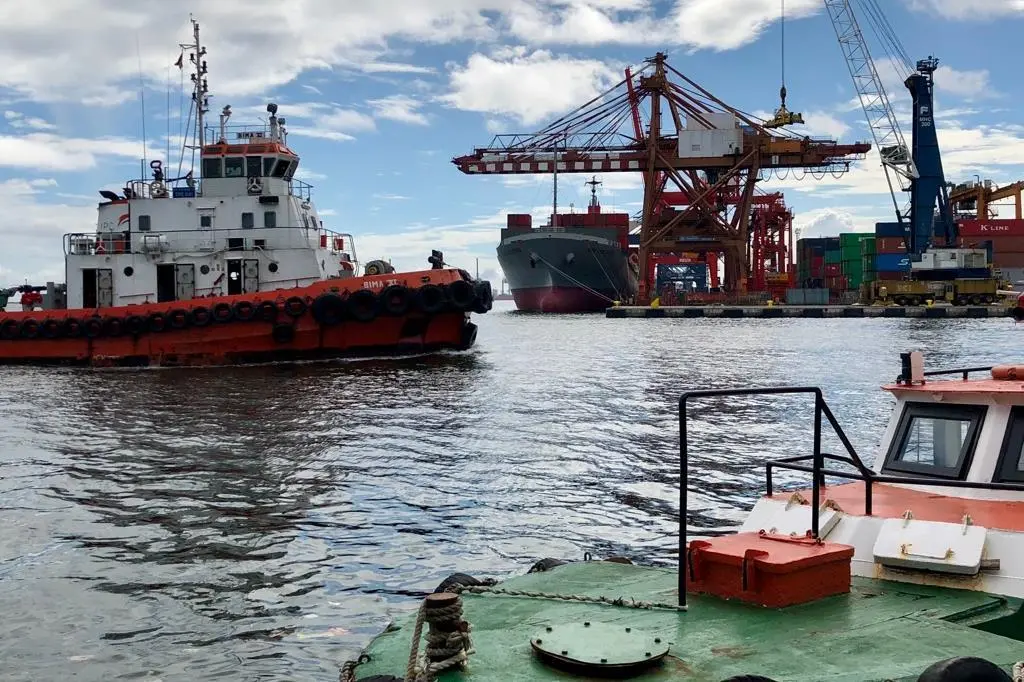
One area where artificial intelligence is already making a tangible impact today is by helping automate and optimise port, tug and pilotage operations. In particular, machine learning, a subset of AI which enables software to “learn” from data without being explicitly programmed, can improve the efficiency and reduce the carbon footprint of these operations. This is already delivering tangible results in ports from Portsmouth to Tanjung Pelepas and Singapore.
How does this work in practice? In a nutshell, our MarineM algorithm “learns” from a port’s past experience to predict the duration of each upcoming tug and pilotage job, based on which it assigns resources in the most efficient way possible.
In technical terms, we input data on different features of a ship’s visit, such as the vessel’s type, size, location, destination berth and the types of jobs required. This is fed to the model alongside port-specific parameters like tidal restrictions. We then use regression algorithms to get MarineM to predict the duration of each job.
As a second step, the algorithm uses the predicted duration of all jobs to deploy resources in the most efficient way possible.
Where spreadsheets and whiteboards fall short, algorithms powered by machine learning can solve complex puzzles and calculate optimal resource allocation – taking into account additional constraints such as the need to assign pilots to specific vessel types and sizes depending on their licence, the types and number of tugboats required for each job and the shuttles needed to take the pilots to the correct boarding grounds.
Tailored solutions
This optimised scheduling is crucial to ensure that all the moving pieces fall into place seamlessly to welcome ships exactly when they arrive – which has tangible impacts on idling times for visiting ships, congestion, and the port’s overall emissions.
For example, in Tanjung Priok, the 22nd busiest port in the world, MarineM has reduced the overall distance travelled during tug and pilot operations by 20% and continues to save US$155,000 in fuel costs annually. Implementing AI also slashed average waiting times for visiting ships, from 2.4 hours to around just 30 minutes. Not only did the port see tangible benefits in reduced port congestion, it was also fiscally smart as the pay back was a mere six months.
MarineM can start delivering accurate predictions quickly after its installation. Data on port movements collected in the first three months after the installation, together with historical data if available, is enough to give the algorithm a representative picture of the types of jobs and vessels it will encounter, as well as the ports’ typical operations.
Crucially, the algorithm learns constantly as new data comes in, meaning that it will continue to sharpen its accuracy with time. As a result, the scheduling solutions offered will be unique and tailored to each port, as the algorithm has been trained on their specific dataset and learnt about their particular operations and constraints. This is something that simply wouldn’t be possible without machine learning.
Untapped potential
Moving forward, we can imagine a future where the power of AI will be expanded to more areas of port operations. For instance, machine learning has the potential to help optimise berth management, to ensure that ships are allocated to the right berth at the right time.
Berth allocation is a complex puzzle with numerous constraints, such as the vessel size and type, tidal restrictions, the availability of cranes, and the need for offshore power. Algorithms powered by machine learning could learn from a ports’ data to solve these puzzles seamlessly.
The puzzle is likely to become even more complex moving forward, as vessels will be powered by different fuels and technologies, making their needs for port services more specific. Getting this equation right will be critical to a port’s performance, helping them be better prepared for the multi-fuel future ahead.
Another potential application of AI is the monitoring of port congestion. Algorithms could be trained to assess and predict levels of congestion from aerial images. This could help ports identify critical situations and take early action to ease congestion before it spirals.
Machine learning could also help predict actual vessel arrival times more accurately, supporting “just in time” initiatives that can significantly cut idling times for visiting vessels. Combined with congestion predictions, this could be used to advise ships to slow down and delay their arrivals, which would help reduce congestion and potentially their emissions – supporting smarter and more sustainable shipping.
Reliable results
With artificial intelligence, there are truly “horses for courses”. Using machine learning is a means, not an end, and different algorithms and techniques will be more appropriate depending on the problem to solve.
This was highlighted by the recent debates around the launch of ChatGPT, a chatbot that uses deep learning to simulate human conversation. While the chatbot has impressed with its ability to answer questions, write songs, emails and poems, it also proved fallible, with some blatant factual or logical mistakes.
This experience has emphasised a fundamental point when using AI in maritime: With ports and shipping operations, there is no room for error. As opposed to conversation algorithms, we can’t experiment with ports’ safety and efficiency. Algorithms must be developed accordingly, and this is why training methods for MarineM are totally different to that powering chatbots.
With port operations, we can be objective, and we teach MarineM what a good answer looks like using clear parameters and a carefully curated dataset. This supervised learning helps guarantee that the system will not come up with unrealistic or off-track solutions.
No port is too small
Different ports will also benefit from AI differently.
The more complex a port in terms of number of visits or types of activities, the more direct benefits it is likely to get from machine learning. However, smaller ports too can benefit from automated data capture, reporting and billing processes. Moreover, having a more accurate estimation of vessels’ ETAs would help all ports plan and allocate resources efficiently, whatever their size.
In decades to come, AI will increasingly be used on the ship side to optimise voyages and make vessels more autonomous. Enhanced integration, to ensure that port and vessel systems can communicate seamlessly, will be essential to harness the full potential of AI and deliver even more efficiencies, both at sea and during port stays.
Related Articles
 ENERGY & TECHNOLOGY GREENPORT
 ENERGY & TECHNOLOGY GREENPORT
 PRODUCTS & SERVICES GREENPORT