![GreenPort[PortStrategy]](https://www.portstrategy.com/greenport/wp-content/uploads/sites/4/2026/09/GreenPortPortStrategy.svg)
Electric hydrofoils propel port decarbonisation
As global ports race to meet climate goals and future-proof their operations, a new generation of marine technology is taking centre stage: The electric hydrofoil patrol vessel.
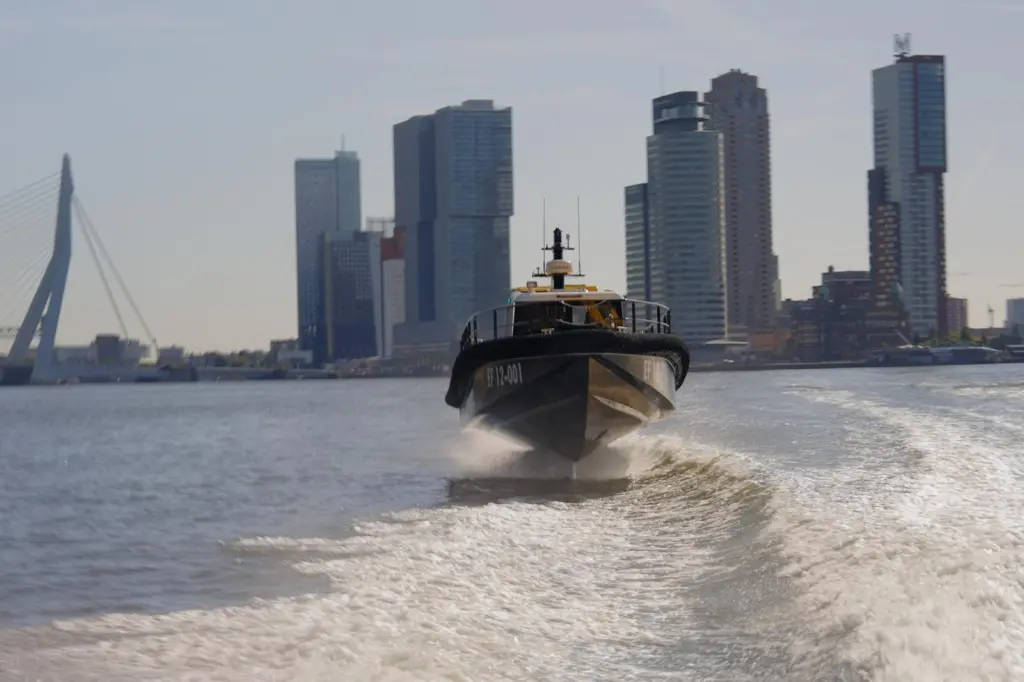
These advanced electric vessels, powered by hydrofoiling e-propulsion, are rapidly proving to be game-changers in the quest for port decarbonisation.
From the Port of Tyne in the UK to the bustling docks of Rotterdam and the sun-drenched harbours of Abu Dhabi, major port authorities are embracing the Artemis EF-12, a hydrofoiling electric patrol vessel developed by Artemis Technologies, which offers high-speed, zero-emission operations while significantly reducing energy usage and maintenance costs.
“Adding the EF-12 Pilot to the port’s fleet is a significant milestone not just for the Port of Tyne, but for the maritime sector as a whole,” said Matt Beeton, CEO at the Port of Tyne.
“We’re not only improving standards of safety and efficiency but also delivering a more sustainable operation in support of the (UK) Government’s Maritime 2050 strategy.”
Lifting standards
At the heart of the EF-12 vessel is the patented eFoiler technology by Artemis Technologies, which lifts the vessel’s hull above the water, dramatically reducing drag and slashing energy consumption by up to 85%. This results in quiet, smooth rides and near-zero wave impact, ideal for sensitive marine environments and congested harbour spaces.
Dr Iain Percy OBE, CEO of Artemis Technologies, describes it as a convergence of performance and sustainability.
“We are committed to developing high-performance, zero-emission solutions, and this partnership is a testament to what’s possible when industry leaders share a vision for transformation,” he says.
The Artemis EF-12 Pilot, scheduled for delivery to the Port of Tyne later this year, will enable a net-zero pilotage service, an unprecedented development in the UK maritime sector.
As ports worldwide transition away from fossil fuels, electric vessels like the EF-12 are emerging as viable, ready-to-deploy solutions.
The zero operational emissions of these vessels allow ports to directly reduce their environmental impact while also enabling customers to access carbon credit opportunities, a feature already being leveraged by AD Ports Group through its Noatum Maritime division.
The Gulf’s electrification
In Abu Dhabi, AD Ports Group has embraced the electric patrol vessel as a cornerstone of its maritime decarbonisation strategy.
Noatum Maritime, part of AD Ports’ Maritime & Shipping Cluster, has introduced its first all-electric hydrofoiling pilot boat, becoming the first in the region to do so.
“By offering fully electric alternatives, we are supporting our customers’ sustainability goals and potentially enabling them to leverage carbon credits,” says Captain Ammar Mubarak Al Shaiba, CEO of the maritime & shipping cluster at AD Ports Group.
With the Artemis EF-12 Pilot at its disposal, Noatum Maritime said it has significantly boosted its operational efficiency while reinforcing its commitment to environmental stewardship.
The vessel’s reduced energy consumption not only cuts emissions but also leads to meaningful savings in fuel and maintenance, critical factors for any port operator seeking long-term sustainability.
This regional first signifies a broader shift in how Middle Eastern ports are addressing climate mandates while remaining globally competitive. Through electrification, AD Ports is creating a future-ready port fleet, proving that innovation and environmental responsibility can go hand-in-hand.
Testing the water
Meanwhile, the Port of Rotterdam Authority, Europe’s largest seaport, is testing the waters of electrification with its new Artemis EF-12 Workboat, named RPA Zero.
Deployed as part of a comprehensive pilot scheme running until late 2025, the electric port vessel is being evaluated for its performance, reliability and environmental benefits across harbour patrol and enforcement operations.
As the port begins replacing its aging fleet over the next 12 years, sustainability is a top priority.
“We aim to be the smartest port, increasingly using modern tools in our enforcement and monitoring tasks,” says Herman Verweij, manager of maritime and environmental safety at the Harbour Master’s Division.
“We also want to be the most sustainable port.”
Rapid response capabilities are critical for Rotterdam’s harbour operations and the Artemis EF-12’s hydrofoiling design delivers speed and stability even in rough waters.
“Consider the minimal impact of wave action and the exceptional stability,” Mr Verweij adds.
“We are therefore enthusiastic about exploring whether and how electric hydrofoils can complement our range of deployable resources.”
Through this pilot, the port is not only testing vessel performance, but also evaluating the practicalities of electric charging infrastructure and asset deployment across varying operational conditions.
Decarbonisation goals
What ties these three major ports together is a shared recognition that port patrol and pilot services are an ideal starting point for fleet electrification.
These vessels operate continuously in port waters, making them high-frequency, low-range users, perfectly suited to battery-electric systems.
The Artemis EF-12’s ability to reduce drag and energy use while eliminating tailpipe emissions supports these sustainability objectives while addressing port-specific challenges like safety, noise pollution and maintenance downtime.
“Collaboration with the Port of Rotterdam Authority is an exciting opportunity to demonstrate how our Artemis EF-12 Workboat can contribute to decarbonising port operations,” says Dr Percy.
“We are glad to be supporting the most integral port in all of Europe with its efforts to achieve the ambitious sustainability goals it has set, whilst maintaining the highest of safety and efficiency standards.”
Global delivery
With the success of its current deployments, Artemis Technologies is already expanding its presence across Europe.
The Artemis EF-12 Pilot boat is part of a range of 100% electric foiling vessels designed for commercial use and various applications. Other vessels from Artemis Technologies include the Artemis EF-12 Workboat, Artemis EF-24 Passenger, a 150-passenger ferry and a luxury water taxi, the Artemis EF-12 Escape.
Artemis has signed a clutch of new contracts for its electric hydrofoiling pilot boats.
In August 2024, pilot services provider Brabo Partners signed a deal to bring an Artemis EF-12 Pilot boat into its fleet in the Port of Antwerp-Bruges, scheduled for delivery in late summer 2025.
The company has also secured a contract to supply the Swedish Maritime Administration (SMA) with a fully electric Artemis EF-12 pilot boat, which will be the first 100% electric pilot boat to operate in Nordic waters.
These developments signal a growing demand for electric port vessels across varying climates and use cases, reaffirming the EF-12’s versatility and global relevance in the shift toward port decarbonisation.
A zero-emission future
Electric hydrofoil patrol vessels are not just sustainable, there’s no doubt they are practical, scalable and increasingly essential for modern port operations.
As ports from Tyne to Rotterdam to Abu Dhabi demonstrate, these vessels are delivering on the promise of a more efficient, safer and cleaner maritime future.
The benefits are manifold: Immediate emissions reduction, reduced fuel and maintenance costs, enhanced safety and speed and alignment with both local and global sustainability mandates.
By targeting pilotage and port patrol tasks, ports can make impactful environmental gains without compromising operational readiness.
Whether supporting the UK Government’s Maritime 2050 strategy, enabling customers to access carbon credits, or transforming how Europe’s busiest ports respond to incidents on water, it’s clear the electric port vessel has arrived – no longer as just a concept, but as a working, game-changing solution.
And as Artemis Technologies scales-up delivery across key international ports, a cleaner, smarter future for maritime operations is no longer on the horizon, it’s already on the water.
Related Articles
 ENERGY & TECHNOLOGY GREENPORT
 ENERGY & TECHNOLOGY GREENPORT
 PRODUCTS & SERVICES GREENPORT