![GreenPort[PortStrategy]](https://www.portstrategy.com/greenport/wp-content/uploads/sites/4/2026/09/GreenPortPortStrategy.svg)


EXCLUSIVE: Better metocean monitoring for better business
In this article GreenPort talks to Dr Scott Beatty, CEO, MarineLabs, who gives us the lowdown on how ports, large or small, can save time, money and efficiency, if they get their monitoring systems right.
“What we’re noticing in in ports around the world is that there are metocean solutions that are provided by perhaps municipalities or governments nearby the port, but they’re not necessarily dedicated to the ports operations themselves,” Dr Scott Beatty, CEO of MarineLabs, tells GreenPort in our latest Portside Perspective podcast.
“And what happens is there can be outages or there can be issues with those systems, but the port is only one of many stakeholders that are using that data. And so that data can have inefficiencies and it’s not really tailored to the port.”
“The same exists for weather forecasting models. In some cases, national governments are providing weather forecasting models, but their resolution around port regions can be quite poor, which means that the accuracy and the reliability of the forecast models is low.”
Mr Beatty explains that from a ports’ perspective, it is better for ports to have their own data.
What MarineLabs offers is a tailored real time and predictive weather data solution for ports and terminal operators.
This allows operators to keep things moving even closer to operational thresholds, for example, where a forecast model from an external party or a government might say 25 to 30 knots, but the actuals turn out to be 17 to 19 knots.
This could mean the difference between a vessel calling and not. It gives more accuracy in terms of data being translated into improved productivity within the port.
The other side of this, as Dr Beatty explains, is uncovering something that the other forecasts aren’t seeing in terms of safety critical environments. “Then we’re actually reducing the chance of accidents as well,” he says.
Complete solution
MarineLabs runs a complete technology stack that provides real-time weather predictive technology and forecasting for both the port and its stakeholders.
For port operators, MarineLabs can handle the entire process from deployment and maintenance of the equipment all the way through to the software so that the port can just receive the data.
“This makes accessibility very easy, but it also means that we can provide an extremely high uptime and highly reliable solution which is tailored directly to the port,” says Dr Beatty.
“We’re deploying this right where the port needs it, where their pinch points are, where the potential for incidents can happen.”
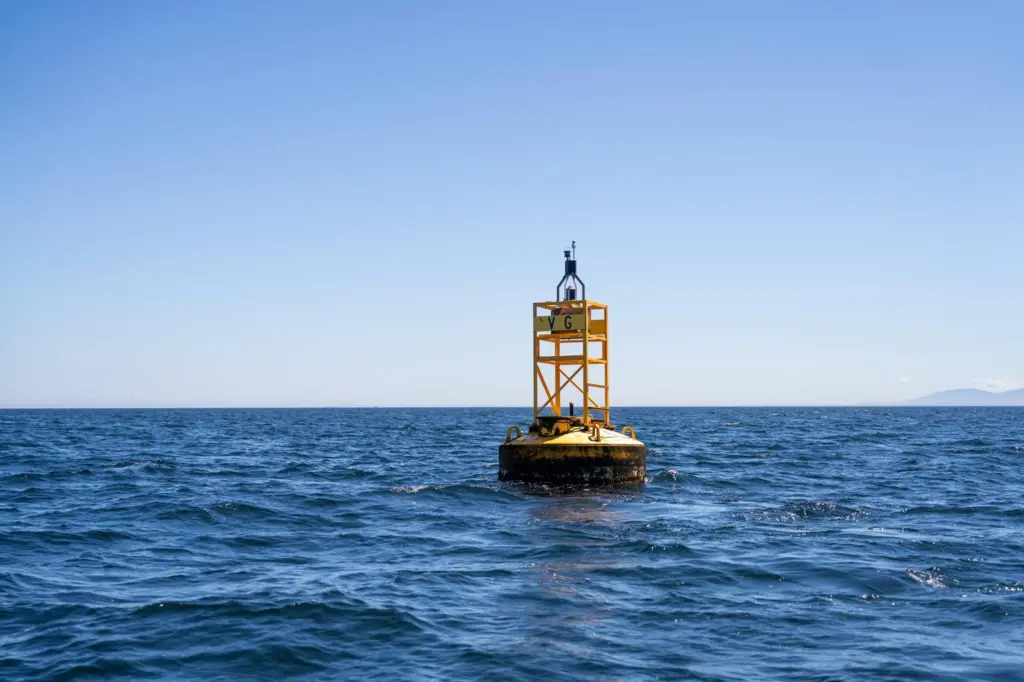
MarineLabs’ rapidly deployable, self-contained, solar powered sensor nodes bolt onto any navigational aid in the approach to the port, turning buoys into real-time data stations.
It’s already sucessfully deployed these stations in Canada and the company is doing a lot of expansion in the US as well.
“And the benefits really are that that you have this real time data exactly in the entrance of the port, you have a tailored solution and forecasting that is exactly where you’re operating. You also have a cluster of these units, which means that if something if there is an issue with one of the units, you have four or five others that are also transmitting data at the same time, so you have redundancy.”
“It’s a highly reliable, tailored solution to receive weather data for ports. Ports are too busy to be metocean experts, they just they need reliable data,” says Dr Beatty.
In some cases, there’s bunkering operations that have upper limits on certain parameters such as wave period or wave height. So MarineLabs can provide notifications directly to the operators when those thresholds are reached.
It makes the process more transparent, especially if an operation needs to be shut down. The stakeholders in the port all know where the data is coming from and they know that it’s accurate.
Large and small
MarineLabs works with all sizes of ports, from small harbours, all the way up to medium and large ports and its so far completed projects in Morocco, Tangier Med and Rotterdam, but also for smaller ports in North America.
Of course, smaller ports have a common challenge when it comes to weather and operational conditions and even if there are vessels that are small to medium sized, they still have weather sensitivities.
Obviously ports are all very different, but there’s a lot of uniqueness to each one, with weather as a commonality. For seaports, inland or river ports, there are certain challenges, for example, wind funnelling. Wind funnelling can really change the way a vessel pilot might bring a ship in to port, so better intelligence helps.
”Sensors can provide forecasting right where it’s needed. The issue may not be out in the entrance. That may be something that doesn’t have much weather sensitivity, but the sensitivity might be more near the terminals. That’s also an area where MarineLabs can apply our technology,” says Mr Beatty.
In order to design terminals to be resilient for the next 30, 40, fifty years of weather events, there needs to be some study of wind and wave conditions. In a lot of cases, that requires coastal engineering firms to take a look at what the the metocean statistics are for the last decade, and oftentimes, these engineers are applying coastal modelling.
”They’re applying desktop studies that create beautiful pictures of what the weather effects were at a port over the last tn years, perhaps hindcasting it. But these desktop studies are not that accurate if they don’t have validation data within their domains,” says Dr Beatty.
“The benefits of the MarineLabs system is that it collects tailored data that feeds into the validation of a coastal model. This can be used to model the wind and wave requirements of new infrastructure and new terminals, or new breakwaters. The build out process of the infrastructure therefore becomes a lot more efficient.”
“If there’s a lack of certainty in something, usually that means we’re more conservative during build out. But with good data the fear of overbuilding is reduced.”
Real-time results
MarineLabs has been working with the Port of Prince Rupert in Canada tackling cold temperatures and very heavy weather for newbuild LNG and LPG terminals, which are sensitive to weather effects.
MarineLabs has five sensor nodes deployed from the terminal area all the way out the entrance, which is tens of kilometres away, out to the pilot boarding station, which is quite exposed.
Before the MarineLabs installation, the most local weather data or weather buoy data came from a unit that was too far away. The other issue was that the buoy would go down and there was only one tender that could fix it because it was in such a remote location. So it could be down for months.
What’s resulted from the MarineLabs installation is additional productivity whereby the port now receives ships that would not have previously been able to call. But now they come in to anchor because of the accuracy of the data.
The added benefit is that pilots can access this data for the boarding station and the approach and they’re making use of it because they can now determine if it’s safe to board a vessel. In a lot of cases boarding a vessel is a very dangerous operation – for example, climbing a rope ladder up onto a ship in three metre waves with and 35 to 40 knots of wind. Any bit of weather intelligence can help pilots in their jobs and so they’re highly reliant on this new data.
”So, there’s multiple stakeholders within the port that are using the same data and it’s coming in handy in multiple ways,” says Dr Beatty.
“In addition, when it comes to new infrastructure, the port has now collected four years of data which it can make use of in the engineering process for determining the wind and wave loads that will be on a new terminal.”
Environmental opportunities
Dr Beatty points out that it often feels that port operations and environmental parameters are distant topics and yet port operators are getting tasked with trying to reduce carbon all the time.
“I think first off, a more efficient port is going to be a lower carbon port. So, if our data reduces call time and time in the unloading and loading process, that means that there is a reduced number of engine hours and reduced carbon,” says Dr Beatty.
He points out that data is also fundamental to just in time arrival or when a vessel needs to be rerouted because of weather.
Also, there’s less likelihood that there will be a marine accident which incurs a spill.
Port and shipping emissions figures often revolves around using AIS data from the ships and adding a weather component to that. Applying weather data to these calculations will bring in more accuracy.
“I think overall we’ve come to a juncture where there’s a major opportunity with bringing in technology like ours,” says Dr Beatty.
“It’s also easier than folks think to integrate this technology and the benefits can be achieved very quickly. What we’re offering is an optimisation of port operations, an increased coastal intelligence that will improve the safety of the port, improved environmental performance of the port and ultimately enhancing the efficiency of flow of goods. This means more productive ports hitting better cargo volumes.”
There is also the opportunity to streamline decision making for vessel traffic, reducing all kinds of incidents and logistical challenges.
“This isn’t a futuristic thing. There’s an opportunity with these technologies to have tailor made weather solutions right now at your port,” Dr Beatty concludes.
Listen to the Portside Perspective podcast
Related Articles
 ENERGY & TECHNOLOGY GREENPORT
 ENERGY & TECHNOLOGY GREENPORT
 PRODUCTS & SERVICES GREENPORT