![GreenPort[PortStrategy]](https://www.portstrategy.com/greenport/wp-content/uploads/sites/4/2026/09/GreenPortPortStrategy.svg)

EXCLUSIVE: Bridging the gap with temporary shore power
Garry Taylor, sales manager, Finning Power Rental, explains how given that some ports face years of delays to connect to the grid, temporary and hybrid shore power systems offer a practical, lower-emission solution that enables action now.
Shore power has increasingly been in the spotlight, given the EU requirement for container and passenger vessels to plug into onshore power at major ports from 2030.
In September, as part of its UK SHORE programme, the UK Government announced a GB£448 million investment to reduce emissions from UK shipping. This is on top of existing plans to extend the UK Emissions Trading Scheme (ETS) to domestic shipping from 1 July 2026.
However, many ports, especially smaller facilities, still face years of delays to connect to the grid. As a result, temporary and hybrid systems offer a practical, lower-emission solution that enables action now, not in the next decade.
A mixed picture of progress
Across the UK and Ireland, some high-profile ports have made headway. At Southampton, uptake of shore power has increased significantly since 2024, following connection of its cruise terminal system.
Dublin Port has received €73.8 million funding from the EU’s CEF Transport programme, to increase capacity and add an onshore power supply (OPS) under its MP2 project, while Belfast’s new offshore-wind hub plans include provision for shore-side charging infrastructure.
Elsewhere, many ports are still at the planning or feasibility stage. A December 2024 DNV study found that grid upgrades at major UK ports could take up to ten years and cost more than GB£16 million per site.
Even in Europe, where OPS will be mandatory for most vessels by 2030, only around a fifth of required connections are installed or contracted, according to a July 2025 study by DNV. The study shows that, “Of the 31 ports studied, only four have installed or contracted more than half of the connections required by 2030.”
The result is a growing gap between policy and implementation, particularly for ports handling mixed traffic or seasonal cruise calls. For these operators, temporary power offers a fast, scalable alternative that can cut emissions at berth without locking them into one long-term infrastructure plan.
Regulations driving change
From 2030, container and passenger vessels calling at major EU ports will be required to plug into onshore power instead of running their auxiliary engines. As such, operators must prepare for ships that will need to connect when they berth.
As well as any grid upgrades, an OPS setup means providing the correct voltage and frequency, typically 6.6 kV or 11 kV for larger vessels and 400-690 V for smaller craft, along with the necessary cable-management systems, safety interlocks and electrical controls to ensure that power can be delivered safely.
Although the UK doesn’t currently mandate OPS in the same way, from 1 July 2026, the UK Emissions Trading Scheme (ETS) will expand to cover ship emissions produced on domestic shipping voyages, for ships of 5,000 GT or more on UK-port to UK-port voyages. This includes emissions in-berth and while moored.
The system will fall under the same trading framework as aviation and energy, meaning that for every tonne of CO2 released at berth, operators will have to surrender their ETS Allowances and face penalties if they go over this amount.
Shore-side temporary power can also help vessel operators get ahead of tightening International Maritime Organization (IMO) emissions standards. The problem is that the IMO’s most stringent Tier III limits on nitrogen oxides only apply to newer vessels operating in designated Emission Control Areas.
However, most ships calling at UK ports still fall under the older Tier II limits because of the vessels’ age. This allows much higher emissions, up to 14.4 g/kWh of nitrogen oxides and this tier does not set a direct limit on particulate matter.
This is made worse by the fact that many ships run their auxiliary engines at low load when docked. Not only is this incredibly inefficient, it also increases fuel burn and accelerates wear due to incomplete combustion.
By contrast, EU Stage V generators are designed for variable loads. These generator sets fall under the UK’s Non-Road Mobile Machinery emissions regulations, which have much lower limits of 0.67 g/kWh of NOₓ and just 0.035 g/kWh of particulate matter. By connecting to these gensets while docked, vessels can immediately switch off their auxiliary engines and drastically reduce their shoreside emissions.
Ease of deployment
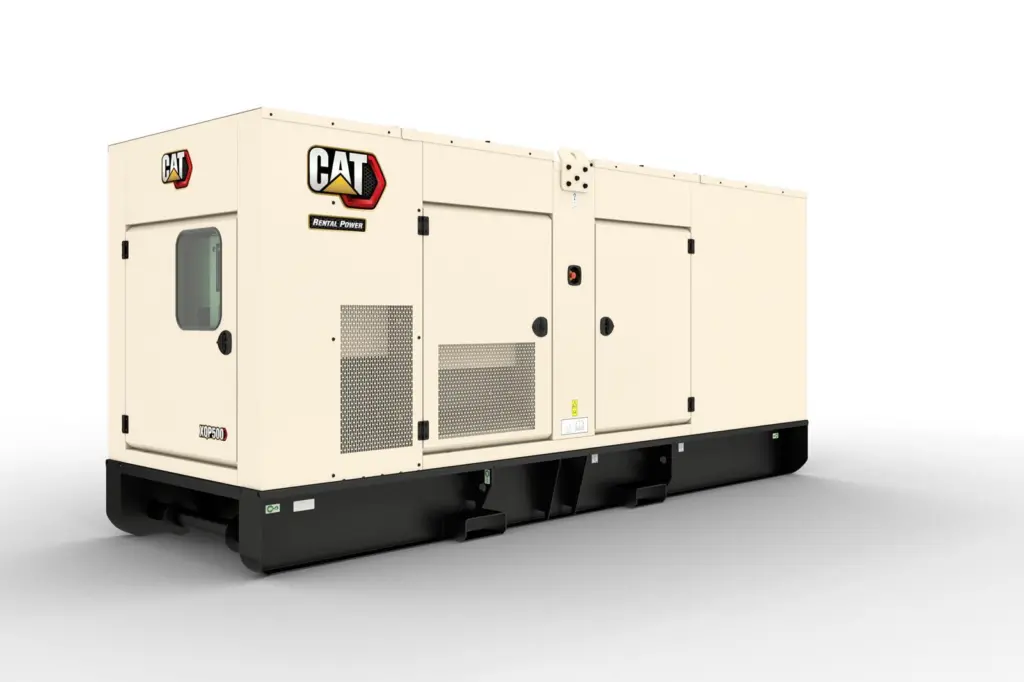
Temporary shore-power installations can be rolled out in days rather than years. Finning Power Rental supplies containerised Cat generator sets typically ranging from 20 kVA to 550 kVA, supported by transformers, cabling and switchgear. These systems are modular, which means they can be scaled for different vessels or combined to provide higher loads.
A benefit of these temporary systems is that they don’t require major capital outlay. This is particularly useful where ports don’t have the grid infrastructure in place already, and it means they don’t have to rush to commit to any permanent solutions to meet short-term demand. Instead, they can rent the units and use them on a temporary basis or scale them based on seasonal demand.
The generators are delivered by truck or lifted into place by crane, then connected through distribution panels and commissioned by Finning engineers. Each unit is housed in an acoustic enclosure and fitted with exhaust after-treatment, helping ports meet local air-quality and noise limits, which is an important consideration for sites operating close to residential areas.
Battery and hybrid options
Finning Power Rental has also upgraded its fleet with the addition of its first battery energy storage system (BESS). This includes the Cat XES120, which delivers 72 kW of nominal output and 127.9 kWh of usable storage.
The unit can operate on its own or work alongside a diesel generator in a hybrid arrangement, where the generator manages higher demand periods, while the battery supplies zero-emission power during low-load windows, such as overnight.
All systems are fitted with remote monitoring and control, enabling Finning engineers to adjust runtime schedules, voltage settings and alarms without attending site. Fuel choice is another factor. All these Cat Stage V generator sets can run on hydrotreated vegetable oil (HVO), which can cut lifecycle greenhouse gas emissions by up to 90% when sourced from certified waste feedstocks.
Testing by doing
Another benefit of temporary shoreside installations is that they give ports the opportunity to learn by doing. These technologies can be used to test load profiles, cable management, ship-to-shore interfaces and safety protocols that will later inform full OPS rollout. In doing so, ports can avoid the risks of locking themselves into any one single solution.
Temporary and hybrid power isn’t just for cruise ships or container terminals either. Smaller vessels such as pilot boats, harbour tugs and hybrid ferries can all benefit. Compact Stage V generator sets and mobile battery units can provide charging and auxiliary power where permanent infrastructure doesn’t yet exist, or during construction and maintenance work when grid access is limited.
While deployments are still limited, several Cat projects across the world are beginning to integrate battery-electric and shoreside power technologies. At the Port of Long Beach, for example, Pacific Harbor Line has operated the “Joule” battery-electric locomotive for several years.
Other ports are exploring similar approaches. Elsewhere, various ports in the US have explored using microgrids to support hybrid vessel charging, optimise electric crane operations, and reduce reliance on grid power as electrical demand increases.
A path to permanent shore power
As permanent systems expand through new government funding, temporary and hybrid power will play a complementary role. They enable ports to take immediate action, demonstrate emissions savings and build the operational experience required for long-term grid-based solutions.
This means that port operators don’t have to wait years for infrastructure upgrades to begin decarbonising. These hybrid and temporary shoreside power systems can help operators prepare for the future today.
Related Articles
 ENERGY & TECHNOLOGY GREENPORT
 ENERGY & TECHNOLOGY GREENPORT
 PRODUCTS & SERVICES GREENPORT