![GreenPort[PortStrategy]](https://www.portstrategy.com/greenport/wp-content/uploads/sites/4/2026/09/GreenPortPortStrategy.svg)



EXCLUSIVE: Bringing speed, safety and sustainability to automation
As decarbonisation targets tighten and demands for efficiency and safety grow, the ports industry is embracing electrification and automation at an unprecedented pace.
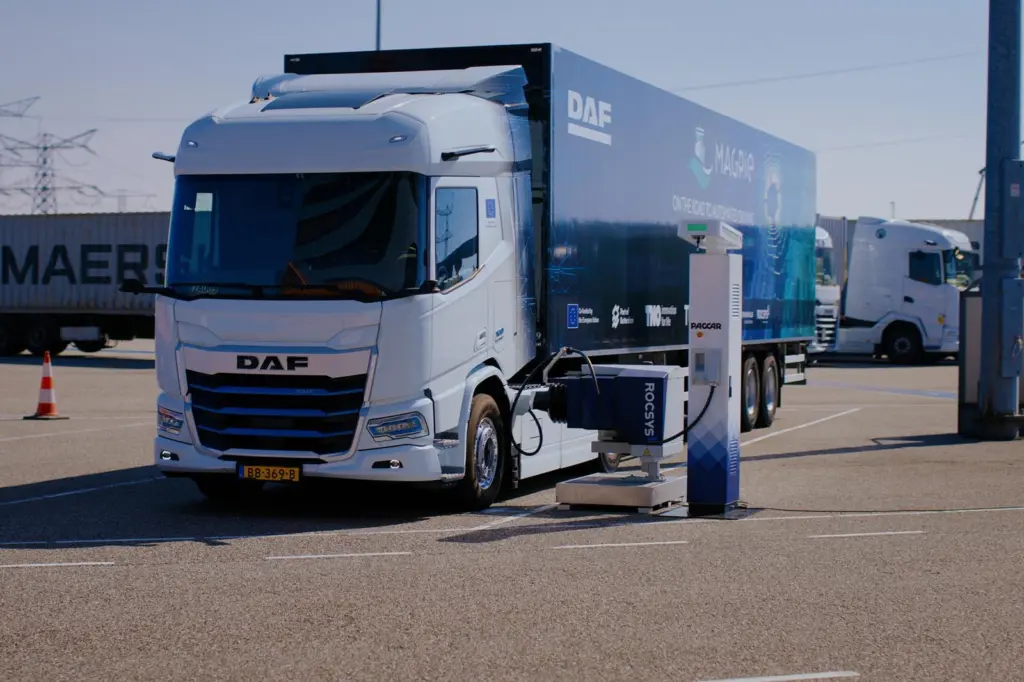
Among the companies at the forefront of this transformation is Rocsys, a pioneer in hands-free, autonomous charging solutions that are helping terminals meet operational demands while slashing emissions.
Speaking on the Portside Perspective podcast, Rocsys CEO and co-founder, Crijn Bouman, outlines why the company’s technology is increasingly seen as a critical enabler of port automation and how the opportunities extend far beyond the world’s largest container hubs.
Decarbonisation imperative
“Decarbonisation is a topic in any port around the world,” Mr Bouman says. “We’re still at the start, but there’s a clear trend – every terminal is looking into electrification and sometimes automation if it makes sense.”
Western ports and the main Asian hubs are all actively exploring pathways to reduce emissions, although the pace differs from site to site.
In some cases, operators pursue both automation and electrification from the outset he says; in others, electrification comes first and autonomy later. “It’s more a question of the time frame,” Mr Bouman notes.
One thing is certain: There is no standard template. “It’s never one-size-fits-all in the ports,” he says. “Every terminal is different.”
Why charging matters
Switching to electric fleets adds an entirely new operational requirement – keeping vehicles charged.
“When terminal operators switch to electric vehicles, they get new responsibilities and one of them is charging,” Mr Bouman explains.
“They have to fit it into the contractual labour situation, they have to fit it into the operation.”
Rocsys’ technology removes the need for manual intervention.
By automatically connecting vehicles to their chargers, the system ensures they are ready when needed – that is charged before shifts begin, or during planned breaks in activity – without slowing the wider operation down.
Automation meets electrification
One of Rocsys’ flagship projects is at APM Terminals’ Maasvlakte II facility in Rotterdam.
Thirty autonomous terminal trucks – electric and driverless – will be deployed to support the rail operation, moving containers from the stack to the rail area.
“This is a €1.2 billion expansion,” Mr Bouman says. “It’s a gigantic project involving ten cranes and will take three to four years to implement.”
Rocsys’ role is to make sure each vehicle is charged and operational when required.
The rollout is deliberately phased. “We’re slowly phasing in over the next two years until we are at full capacity,” Mr Bouman says.
Lessons from the field
Beyond Rotterdam, Rocsys has projects in Los Angeles, Long Beach and at the Port of Monroe in Michigan, USA. From these deployments, several clear lessons have emerged.
Firstly, Mr Bouman says it’s important to involve the people on site from the beginning.
“They understand the site, they understand the dynamics,” he says. “It’s better to train those people either as a remote operator, or for physical service and maintenance.”
Secondly, site integration and infrastructure can be a barrier.
Rocsys’ pallet-based design allows chargers to be placed without the need for major civil works. This is especially valuable in the US, where construction costs are high and in California, where earthquake regulations add further complexity.
Avoiding heavy groundwork not only cuts costs but makes it easier to rearrange terminal layouts in future without losing any return on investment.
Third, Mr Bouman says connectivity and oversight are vital. Rocsys’ system gives terminal operators full visibility over charging operations so they can intervene if needed.
“We are developing new features on our portals to enable operators to do a better job there,” he adds.
Opportunities for smaller ports
While large, automated terminals are often the focus, smaller facilities also stand to benefit – particularly where charging responsibilities were never part of existing work agreements.
“With charging, there’s a new responsibility all of a sudden, which wasn’t in the playbook previously,” Mr Bouman explains.
Rocsys’ system can automate that task, with local supervisors monitoring via beacon lights or control interfaces.
For smaller operators, the cost advantage of Rocsys’ low-impact installation is significant.
“There are no or minimal civil works required because it’s a very simple low-power connection,” Mr Bouman says.
“We really thought about the smaller terminals and the system is suitable for them too.”
The human factor
Addressing concerns about automation reducing human input at ports and terminals, Mr Bouman says he sees autonomy as a tool to improve efficiency and sustainability, rather than a replacement for the workforce.
“Automation can make people’s jobs safer and actually make their job nicer,” he says.
The key is careful planning for the transition from manual to supervisory roles, which requires open discussion with all stakeholders.
Mr Bouman also advocates for standardisation – both in hardware and IT – to make investments last longer and work across multiple sites.
Rocsys’ systems use CCS-compliant connectors from the automotive and trucking industries, ensuring compatibility with a wide range of electric vehicles across different sectors.
New generation challenges
Traditional AGVs ran in fenced-off environments with no unexpected human presence. Newer fully automated vehicles, equipped with LIDAR and cameras, can work in mixed-traffic environments – a major advantage, but also a challenge.
“That requires different kinds of planning,” Mr Bouman says. “There’s a lot of other situations which can occur.”
For the Rotterdam project, Rocsys has been working from day one with Terberg, the automated vehicle supplier and Embotech, the autonomous driving system provider.
This collaboration covers everything from scoping the operational challenge to detailing safety protocols and integrating systems.
“You can’t see one of the elements as a separate element,” Mr Bouman says. “You have to think about the whole terminal design and how it works all together.”
This integrated approach ensures that automated charging, autonomous vehicle navigation and operational workflows are all aligned for maximum safety and efficiency.
Next there is the charging issue. Charging times – often 30 minutes to an hour – make it impossible to centralise the process in the same way as diesel refuelling.“It’s spread out over the terminals, so charging becomes a big new responsibility,” Mr Bouman says.
He likens it to a laptop and its power supply: “Everybody looks at the laptop, but forgets about the adapter. Without the adapter, the laptop doesn’t work and charging is the same.”
Engaging with the charging provider early he says allows effective designs to be built into the operation from the start.
By ensuring vehicles are always charged when needed, Mr Bouman says Rocsys’ system supports the retirement of diesel-powered fleets and helps ports meet both climate targets and local air quality goals.
Automated charging reduces the risk of human error, such as missed or incomplete charges, extending battery life and reducing waste. It also integrates smoothly with automated operations, eliminating the need for manual plug-in processes.
Looking ahead
Mr Bouman’s advice to operators is straightforward: “Everything starts with understanding your terminal deeply and how the operation runs. When you’re switching to electric vehicles, make sure the charging side is engaged early so you can make effective designs and ensure success.”
Mr Bouman emphasises that while the move towards automation and electrification is inevitable, the pace and approach can be very different depending on the terminal.
“It’s absolutely going to happen. It’s more a question of the time frame,” he says, adding that factors such as budget cycles, contractual labour frameworks and site-specific operational models can all shape the way projects unfold.
For example, at APMT Rotterdam, the integration of 30 autonomous electric terminal trucks into a brand-new facility is a complex, multi-year undertaking for Rocsys.
In contrast, at smaller ports like the Port of Monroe in Michigan, the implementation process was more targeted, addressing specific operational needs without overhauling the entire terminal system.
This variability means that suppliers like Rocsys need to be agile, tailoring solutions to match the operational and economic realities of each site.
“Every terminal is different,” Mr Bouman reminds us. “Never one-size-fits-all.”
In discussing large-scale automation projects, Mr Bouman highlights the importance of close cooperation between all technology providers from the earliest stages.
Another recurring theme for Mr Bouman is the value of engaging with charging providers early in the electrification journey.
“We like to get involved as early as possible to paint a picture of what that would mean and how you can make that a success,” he concludes.
Because charging infrastructure must be woven into the physical and operational fabric of the terminal, late-stage integration can lead to costly redesigns or sub-optimal placement.
By addressing charging at the planning stage, terminals can avoid these pitfalls and ensure that electric fleets are fully supported from day one.
Related Articles
 ENERGY & TECHNOLOGY GREENPORT
 ENERGY & TECHNOLOGY GREENPORT
 PRODUCTS & SERVICES GREENPORT