![GreenPort[PortStrategy]](https://www.portstrategy.com/greenport/wp-content/uploads/sites/4/2026/09/GreenPortPortStrategy.svg)



EXCLUSIVE: Charging ahead: Faster power for electric ports
There has been a rapid expansion in the electrification market in the ports and terminals sector and increased demand for faster charging solutions, writes Jesse Makkonen, head of marine and port at Kempower.
Port electrification is still in an early but accelerating phase: Operators have moved from pilots to execution, motivated by sustainability objectives, regulatory drivers and improving economics.
Total Cost of Ownership (TCO) parity for electric container‑handling equipment is expected within roughly two to eight years, according to an estimation by the Zero Emission Port Alliance (ZEPA).
This all equates to a rapid expansion in the electrification market in the ports and terminals sector and increased demand for faster charging solutions.
Charging solutions
Kempower develops modular, scalable DC fast charging systems for both passenger EVs and heavy-duty and industrial applications.
Our diverse portfolio of DC fast charging solutions cater for cars, buses, trucks, marine and port vehicles.
It’s a product range which emphasises reliability, flexible power distribution and software‑enabled charging management to minimise downtime, particularly crucial in demanding port environments.
Kempower’s modular structure provides a flexible power range from 40 kW to up to 1.2 MW, providing redundancy and the highest uptime for port electrification.
In the case of a failure, only minimal power loss occurs due to the redundant power structure, in which modules are able to operate independently of one another.
When space is tight at an operation, Kempower Satellite chargers offer an efficient and space-saving charging solution, cutting cable weight by 60%.
There is also the Kempower Megawatt Charging System – a dedicated solution for electric trucks and other heavy electric vehicles, including port vehicles, providing high charging powers above 1 MW. In addition, we offer lower power fleet charging for smaller commercial vehicles, which facilitate fast charging either overnight or during scheduled stops.
Scalable power
The scalability of Kempower systems is central to making them work both operationally and cost effectively across port environments of all sizes. Our charging systems are typically based around a Kempower Power Unit, which can be scaled up with additional power modules over time, delivering power to a number of connected Kempower Satellite or Control Unit charging dispensers. These can also be increased in number as the system is expanded. Also commonly used in port settings is our Station Charger, a compact, scalable all-in-one solution combining the Power Unit functionalities with up to two charging points.
Scalable hardware means that CAPEX can be deployed in phases, in line with many ports’ gradual electrification timelines.
Many port operators opt to start with pilot systems that can be tested and, when performance and suitability are confirmed, built on later with additional modules as part of a sensible asset replacement plan.
Full integration is achieved through the combination of hardware, software and service provided by Kempower. Kempower’s distributed system and in-house software, ChargEye, can be fully integrated with other upper-level software systems being used by port operators to build a flexible, fast and interoperable configuration.
One of the biggest objectives for port operators is to optimise the operation of electrical systems and this software integration capability grants them real-time access to charger performance data.
This supports quick fault-finding and fixing, visibility of how charging interacts with wider operations and the ability to make informed improvements to the system.
Electrification challenges
Electrification is still largely new to the ports industry, which has been operating for generations with traditional methods and customs.
The transition to e-mobility brings a huge shift and port operators need reliable guidance to get it right – it’s not possible to operate an electric port in the same way as a traditional port.
Further, every port is different in its layout, typical operation structure and specific requirements. Not one solution or system fits all, which complexifies the integration of charging infrastructure.
One of the major reasons for Kempower’s success thus far in the ports segment is that we are actively involved in the space, up-to-date on the factors affecting ports and, therefore, able to provide the best possible guidance.
We act as more than just a merchant to our customers – we serve as a partner that can deliver the support and know-how to ensure operators can confidently electrify, guided by industry and technical experts.
It’s important to take the time to understand how each customer operates and what machines they need to power, which helps us to design bespoke systems which integrate naturally.
Again, given that our solutions are designed to be flexible and scalable, they lend themselves well to complex charging scenarios.
Charging projects
By way of example, in Tema, Ghana, Kempower delivered West Africa’s first and largest port electrification project for Meridian Port Services.
The 1.8 MW installation includes three 600 kW Power Units and dual 300A Satellites housed in 40ft containers to protect equipment from harsh coastal conditions.
Delivered with Paterson Simons, the system supports Shacman terminal tractors and Sany empty container handlers as well as other light duty vehicles.
For terminal operations, the impact is significant.
The distributed charging setup enables simultaneous high-power charging across multiple machines, helping maintain equipment availability during demanding shift patterns.
Containerised infrastructure improves durability and simplifies installation, supporting reliable performance in a challenging environment while reducing downtime risk.
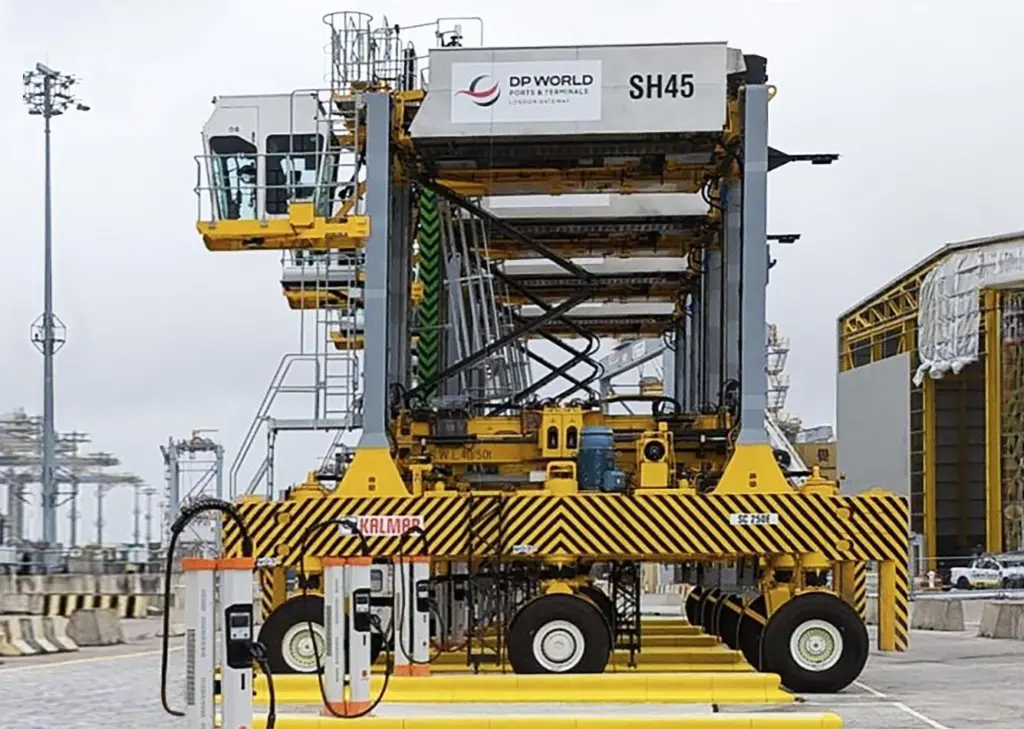
Another example of this type of project is at DP World London Gateway in the UK.
DP World launched one of Europe’s largest port charging installations at its flagship site, with 11.2 MW of installed power to support 20 electric Kalmar straddle carriers.
Kempower’s modular system includes multiple 500 kW and 600 kW Power Units, liquid cooled Satellites and MCS dispensers, designed to ensure both high availability and operational redundancy.
For terminal operators, this design aligns charging cycles with real working patterns. The system at London Gateway delivers three to four hours of continuous operation, matching driver break schedules and reducing disruption to container flows.
Built in phases across 2025 and 2026, the project demonstrates how large-scale electrification can be integrated into daily operations without compromising productivity or operational safety at a high throughput terminal.
The path to electrification
Electrification is the major strategic route to meeting sustainability goals and lowering long-term operating costs.
It does bring challenges: It requires new operational thinking and coordinated planning across port operators, machine OEMs, port operators, charging suppliers and grid companies.
This is where strong industry expertise of your partners will serve you well.
To port operators, I’d recommend planning the whole electrification project and then breaking it down into smaller phases. This will generate savings in construction, equipment and cabling costs, and make the overall effort more manageable from a logistical and operational perspective.
We know that the transition of ports will require time and effort. But with a structured roadmap and the right partners, it becomes a strategic upgrade rather than a disruptive overhaul.
Those who approach it proactively will not only meet compliance requirements, but also secure long-term cost efficiencies, cleaner operations and a stronger competitive position in an increasingly low-carbon maritime economy.
Related Articles
 ENERGY & TECHNOLOGY GREENPORT
 ENERGY & TECHNOLOGY GREENPORT
 PRODUCTS & SERVICES GREENPORT