![GreenPort[PortStrategy]](https://www.portstrategy.com/greenport/wp-content/uploads/sites/4/2026/09/GreenPortPortStrategy.svg)



EXCLUSIVE: Considering an electric future for your port equipment?
As port operations prepare for the future of clean power, Lucien Robroek, president, technology solutions for Hyster addresses some key considerations.
With a growing global focus on sustainability, the port and terminal industry faces significant pressure to pursue decarbonisation. The electrification of container handling equipment at ports is in its infancy, but the landscape is evolving relatively quickly.
With governments and companies setting timelines for reducing emissions, C-suite terminal executives with technology and sustainability responsibilities are considering the kinds of solutions that will be necessary to achieve those goals while satisfying the performance requirements of their operations.
Where are we at?
The port industry is in the early adopter phases, with product development and pilots underway.
Two major forces are the primary drivers for port operations increasingly evaluating and moving toward adoption of electric-powered equipment: Government action in the form of regulations and incentives and corporate sustainability initiatives.
It takes time for manufacturers to demonstrate that viable electric trucks for these applications can be produced in volume at an attractive price point. But there are promising pilots in progress.
For example, a test field for hydrogen-powered port logistics, with the corresponding hydrogen refuelling station, has been established in the Port of Hamburg. A Hyster hydrogen fuel cell-powered terminal tractor is currently being tested in this port application.
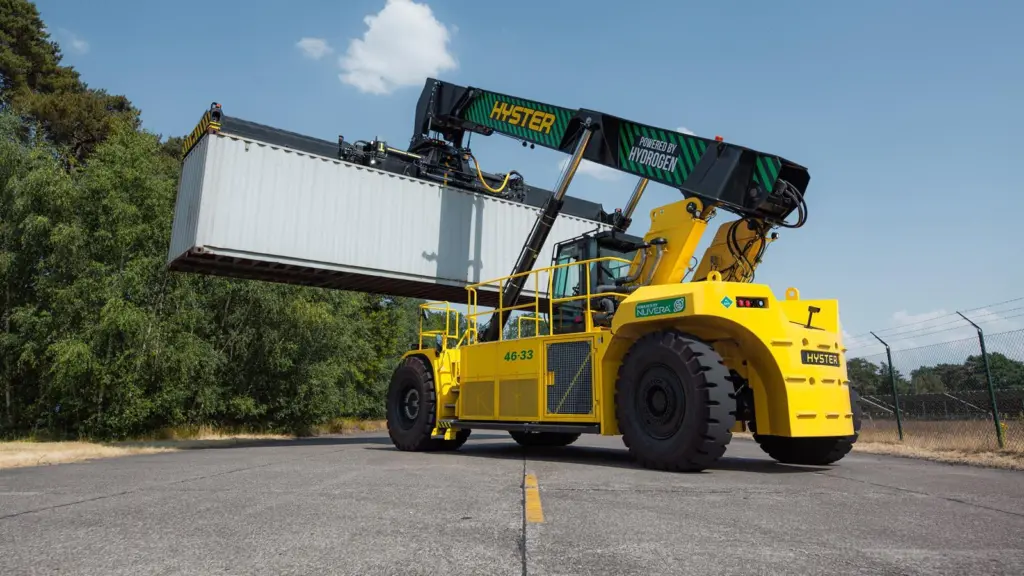
Similarly, a hydrogen fuel cell (HFC) Hyster ReachStacker has been delivered to the Port of Valencia in Spain. It arrived at the MSC terminal for testing in September 2023, making it the first ReachStacker application in Europe using HFC technologies for port handling equipment in real operating conditions.
The innovative zero-emission solution uses a Nuvera E-Series Fuel Cell Engine to convert hydrogen into electricity. It was developed for use in the Port of Valencia as part of the H2Ports project, funded by the Fuel Cells and Hydrogen Joint Undertaking (FCH-JU) and coordinated by the Fundación Valenciaport. The EU-funded project aims to implement fuel cells and clean technologies in port operations.
The hydrogen is stored on board the ReachStacker in high-pressure tanks which can be refilled in 10 to 15 minutes. The hydrogen fuel cell delivers power to either the electric motors or back into the batteries depending on the demand of the task, all while reducing greenhouse gas emissions and noise pollution compared to a diesel alternative. The elimination of the diesel engine, transmission, and other mechanically-driven components from the ReachStacker may also help ports to reduce operating costs.
The first-ever HFC-powered top-pick laden container handler is also currently being tested at Fenix Marine Services at the Port of Los Angeles. Building on the industry standard Hyster H1050-1150XD-CH top-pick container handler design, the truck is powered by two 45kW hydrogen fuel cell engines from Nuvera.
There is currently a significant cost differential between container handling equipment fuelled with diesel and alternatives powered by electric motors. Yet, as more electric-powered equipment enters the market, economies of scale will help drive parity.
The EU has a goal of net zero emissions by 2050, with an interim target of 55% emission reduction by 2030. A typical container handler has a lifespan of about ten years in a port setting.
Although deadlines aren’t imminent, now is an important time for ports to do research and understand the options, because a smooth shift to electric equipment involves significant preparation. Determining and implementing the right solution for each operation requires careful evaluation of power choices, charging or refuelling equipment, along with utility grid changes or the production and transportation of hydrogen fuel.
Do your research
Ports and terminal operations should take this opportunity to gather information about the development and prospects of various power technologies and to test and iterate at a small scale before pursuing the adoption of entire electric fleets.
For instance, terminals can pilot a single electric container handler or trial electric alternatives for some of their lower-capacity equipment before transitioning additional units. While most container terminals typically rely on only five heavy-duty forklifts for every 40 or so container handlers, this equipment can be a good starting point. That is because in some cases, electrification of this forklift equipment is more mature relative to container handling equipment with much higher capacities.
Supplying electric power, whether from the grid or hydrogen, is a responsibility that port authorities must anticipate, not only for the demands of a single truck but also for multiple units or even a full fleet. Neither electricity nor hydrogen are primary fuels, so understanding the complete carbon impact requires looking at the feedstocks from which they are produced.
What about run times?
Zero-emission options are being designed to provide enough capacity to keep operations moving and avoid the need to stop in the middle of a shift to recharge, or in the case of hydrogen fuel cells, refuel. But the required time and frequency of recharging or refuelling are very important considerations and highly variable based on the application requirements.
An operation’s duty cycle, the charging strategy, battery size, charger size and charge rate of the truck all influence how quickly a battery electric solution can be recharged and how long it can operate between charges. Powering equipment with HFCs can mitigate many of the questions or concerns about the ability of electric alternatives to stand up to demanding run times, as operators refuel a tank of hydrogen similar to the process for refuelling with diesel.
For large equipment like container handlers, it can take just 15 minutes to fill the empty tanks with hydrogen – providing enough energy for up to ten hours of continuous run time. And while green hydrogen is not yet universally available, there is a growing number of locations where the access to this energy source makes it a very viable solution.
Operators need to consider factors including duty cycle, utility grid capacity and fuel availability when deciding between electric power or internal combustion engines (ICE).
Hyster electric trucks are designed with ICE-like power. For example, forklifts engineered with factory integrated lithium-ion power in load capacities up to 18 tonnes. Those models feature 350 V lithium-ion battery power that delivers performance comparable to traditional diesel power in 10 to18 tonne load capacities, helping heavy-duty applications achieve emissions goals and more easily transition to clean power without compromising performance.
While recharging batteries and refuelling with hydrogen pose a new set of challenges compared to ICE-powered equipment, electric drivetrains have fewer moving parts and less complexity, which can reduce the downtime required for maintenance. With electric equipment, batteries and certain wearable components, like switches, require replacement over time. But many time-consuming maintenance tasks are eliminated.
However, electric solutions may not be viable under certain conditions. For example, areas with weak electric grids can experience brownouts that slow down operations and time spent charging equipment must not compromise operational schedules.
While electrification is moving forward, it is not yet the right solution for every application. Switching to greener fuel types, such as Hydrotreated Vegetable Oil (HVO 100), may offer a stop-gap solution for some businesses to reduce their carbon footprint while moving towards electrification. HVO 100 is a bio-based, renewable, liquid fuel diesel alternative that meets the standard EN15940 for paraffinic fuels.
HVO 100 is reported to eliminate up to 90% of net greenhouse gas emissions (such as CO2) and reduce nitrogen oxide (NOx) particulate matter (PM) and carbon monoxide (CO) emissions. Produced from renewable materials, such as vegetable oils and animal fats, treated through a hydrotreatment process, HVO 100 is almost chemically identical to conventional diesel.
A strong relationship with a supportive dealer is very important. They should have the experience and expertise to provide a solution that helps meet emissions reduction and performance goals.
Related Articles
 ENERGY & TECHNOLOGY GREENPORT
 ENERGY & TECHNOLOGY GREENPORT
 PRODUCTS & SERVICES GREENPORT