![GreenPort[PortStrategy]](https://www.portstrategy.com/greenport/wp-content/uploads/sites/4/2026/09/GreenPortPortStrategy.svg)


EXCLUSIVE: How AI is reshaping green port operations
In the rapidly evolving maritime sector, the race towards digitalisation is no longer a theoretical discussion, it’s a regulatory necessity, an operational imperative and increasingly, a competitive advantage.
Karno Tenovuo, Co-founder and CEO of Finnish technology company Awake.AI, has spent the past seven years helping ports and terminals reimagine what’s possible when automation, data and artificial intelligence (AI) are applied with purpose.
Speaking with GreenPort exclusively, Mr Tenovuo offers both a candid assessment of where the industry currently stands and a clear vision of where it could and must go.
“A few of the big ports and terminals have started already,” he says. “Then you have a big group of midsize or smaller ports and operators who have not even started their journey in digitalisation.”
Gaps in adoption and data
The challenges, Mr Tenovuo explains, are as much cultural and procedural as they are technological.
Many ports and operators “Don’t know how to buy software as a service; they only know how to buy IT capex projects.”
He adds that for an industry accustomed to investing in hardware, quays and concrete, the idea of procuring AI tools through subscription-based models still feels foreign.
The second obstacle is data, or rather, the lack of it. “If you go to ports and terminals around northern Europe, you have open APIs. If you go outside Europe, many times you have no data at all,” Mr Tenovuo says.
Without reliable port call information, the potential for developing AI models or making accurate predictions becomes more challenging.
Awake.AI positions itself as the trusted AI partner to bridge these gaps.
“Ports and operators should not be experts in AI—that’s not their core business,” Mr Tenovuo stresses.
Regulations as a catalyst
Over the last five years, regulatory pressure, particularly from the EU, has accelerated the digital shift. The maritime sector now faces binding targets – for example, a 70–80% emissions reduction by 2040 and net zero by 2050.
“If you want to get to net zero, about half comes from electrification and new fuels and the other half comes from digitalisation,” Mr Tenovuo says.
“Digitalisation, in our case meaning optimising the port turnaround and waiting times, can already bring 20 to 30% emissions reduction starting tomorrow.”
The incoming Maritime Single Window requirement in Europe, soon to be rolled out globally, is another game-changer.
By replacing manual processes with digital portals, ports and operators will be able to eliminate missing data issues and facilitate real-time decision-making.
Meanwhile, new reporting obligations, such as Scope 3 emissions under CSRD, mean digital tools are no longer optional, they are essential for business.
Two sides of the same coin
Awake.AI’s mission is rooted in the belief that efficiency gains and emissions reductions can and should happen simultaneously.
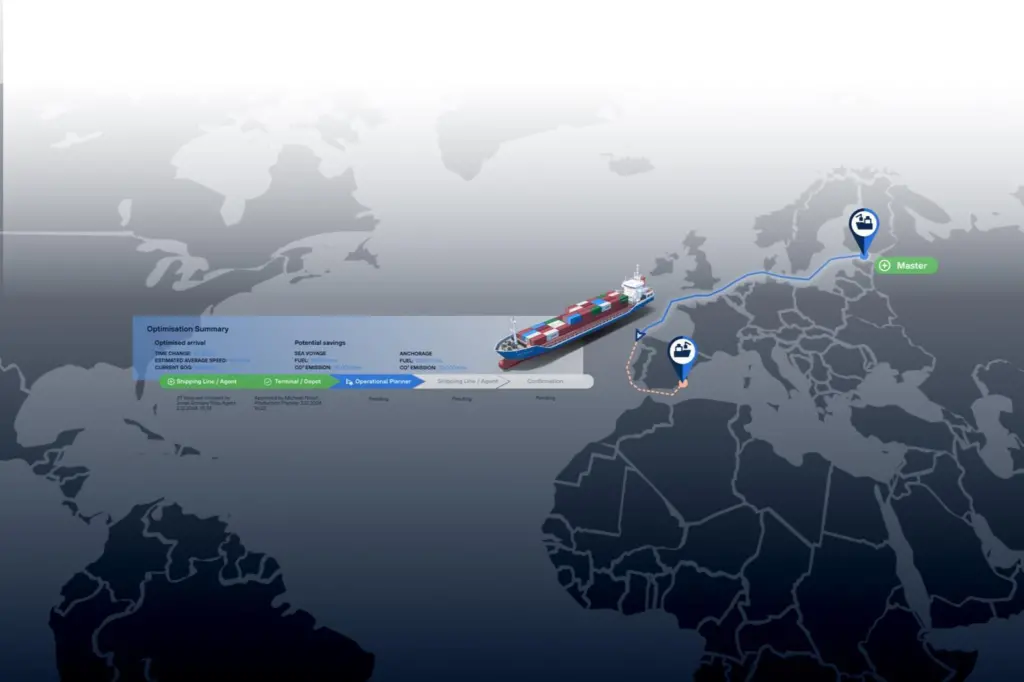
Nowhere is this more evident than in its work on “just-in-time” (JIT) arrivals and port call optimisation.
“In a midsize port, JIT arrivals could mean even €20 million in annual cost savings,” Mr Tenovuo explains.
The model is simple: vessels book berth slots as early as possible, avoiding the wasteful practice of “rushing to wait” at anchor. Shipping companies save fuel, terminal operators avoid costly overtime and weekend work and ports enjoy faster turnarounds and greater throughput.
“It’s a real win-win situation for every party involved,” he says.
The cost savings are matched by environmental benefits, with 20 to 30% annual emissions reductions achievable through optimised arrivals and departures.
For ports with net zero ambitions, this is a “here and now” solution, delivering measurable results without waiting for 2030 or beyond.
Tailored solutions
One of Awake.AI’s key market insights is that ports are at vastly different stages of their digital journeys.
Some have integrated master systems, ERP platforms, Port Community Systems (PCS/PMIS), or Vessel Traffic Services (VTS), while others still rely on “pen, paper and Excel.”
To serve this spectrum of difference, Awake.AI offers two primary solutions – AI Sea analytics and the Port Vision application.
AI Sea uses AI analytics modules that integrate seamlessly into existing systems, enabling advanced capabilities without replacing the port’s core systems.
Port Vision is a standalone application designed for smaller or midsize ports and operators that do not have a master system yet, providing full AI-driven functionality out of the box.
For smaller operations, Port Vision offers an accessible entry point to digitalisation. It can function as a standalone system or integrate with existing infrastructure, providing dashboards for planning, berth slot bookings, notifications, emissions tracking and even negotiating just-in-time port calls.
Users can explore features through an interactive, clickable demo and pilot the solution before committing.
A recent addition is a marketplace feature to automate the buying and selling of port services and products, streamlining commercial interactions alongside operational ones.
Offering flexibility means Awake.AI can engage with a port regardless of its individual digital starting point, focusing on immediate needs such as situational awareness, vessel predictions, congestion forecasting and emissions monitoring.
From there, it can help operators to progress to more sophisticated optimisation capabilities such as just-in-time arrival negotiation tools and fleet optimisation.
From Gothenburg to Finland
The Port of Gothenburg, the largest in the Nordics, embarked on its collaboration with Awake.AI in 2021 by upgrading its planning system.
Winning a subsequent tender to digitalise the entire port call process, Awake.AI targeted one of the port’s hardest operational challenges: JIT arrivals for tanker vessels.
With tankers spending 11% of their time at anchor, the potential for emissions and cost savings was significant.
The port’s new Digital Port Call system enables shipping agents to book berth slots well in advance, with savings proportional to prior waiting times.
In the UK, Peel Ports sought to replace a manual vessel-planning process with an integrated digital system. Awake.AI delivered the upgrade in a matter of weeks, accelerating the operator’s digitalisation journey without disrupting operations.
Meanwhile, Fintraffic, Finland’s VTS operator, faced a different challenge: Visibility.
Previously, ports had just 24-hour advance notice of ship arrivals. Awake.AI’s analytics now extend that to 72 hours or more, with less than 5% error margin in arrival time predictions, enabling better resource planning and reduced waste.
“That’s really the low-hanging fruit of saving emissions and costs,” Mr Tenovuo notes.
Overcoming reluctance
Despite the clear benefits, some ports and operators remain hesitant to embrace digitalisation and AI.
Mr Tenovuo says that cybersecurity concerns are real, with increasing attacks on logistics infrastructures.
Awake.AI’s response is to build “the most trusted platform from the beginning,” applying security-by-design principles honed at Rolls-Royce.
Data governance, ie deciding who can see, edit and share information, is equally critical.
“We have invested millions into solving that,” Mr Tenovuo says, warning against quick, cheap solutions that can create far bigger issues down the line.
More often, reluctance stems from uncertainty in building a business case though.
Ports can easily calculate ROI on physical assets like equipment or berths, but struggle with software.
Awake.AI’s answer is to analyse a year’s worth of avoidable waiting time and translate it into specific financial and environmental savings, making the value of investment clear.
Planning for digitalisation
Mr Tenovuo’s advice to ports and operators considering automation projects is pragmatic.
Firstly, he says that ports should avoid the “Not Invented Here” syndrome. By that he means that ports and terminals cannot be the best in everything, including AI. He says it’s important to choose and use the best partner companies for specific areas.
Secondly ports and terminals should learn to procure software as a service – it should be treated differently from IT capex procurement and bring in talent experienced in SaaS.
The next key consideration is to set a vision.
“AI or digitalisation by itself doesn’t mean anything. It should be a means to an end,” Mr Tenovuo says.
Lastly and arguably the most important, is to involve stakeholders. With up to 30 different stakeholder groups in a port, inclusivity is essential to success.
For Mr Tenovuo, involving all parties is non-negotiable: “If you don’t involve them, you don’t get the full benefits. Still it is best to start with the coalition of the willing, so involve in the beginning only those parties that support the vision and your plan.”
Ports, he says, should also incentivise data sharing, offering tangible returns, such as accurate predictions, to those who contribute their data.
The road ahead
Looking forward, Mr Tenovuo envisions “a connected logistic platforms world” where collaboration replaces siloed systems.
But he cautions that this should be a system of semi-automation, where thousands of manual processes remain. Only the simple and repetitive tasks should be automated, he says.
“I don’t believe in 100% automation of every process,” pointing to the blend of scheduled and walk-in approaches in sectors like healthcare as a parallel for port operations to look to.
He predicts that adoption will follow regulatory timelines, with around one-third of ports implementing digital solutions by 2030, unlocking 20–30% emissions savings through optimisation.
“Together we can make an impact and save our planet,” he says.
From emission-cutting JIT arrivals in Gothenburg to predictive analytics across Finland, Awake.AI’s work shows that efficiency and sustainability are not competing priorities but mutually reinforcing goals.
The journey to a digitally optimised, low-emissions maritime industry may be uneven, but with clear business cases, adaptable solutions and collaborative platforms already there, Mr Tenovuo believes the course is set.
“In the end,” he says, “digitalisation is not about technology for its own sake, it’s about creating value for every stakeholder and making a measurable difference for the environment.”
Related Articles
 ENERGY & TECHNOLOGY GREENPORT
 ENERGY & TECHNOLOGY GREENPORT
 PRODUCTS & SERVICES GREENPORT