![GreenPort[PortStrategy]](https://www.portstrategy.com/greenport/wp-content/uploads/sites/4/2026/09/GreenPortPortStrategy.svg)





EXCLUSIVE: Kinetic energy storage systems for ports
Timo Pauel, business development manager, QuinteQ Energy, explains why flywheel energy storage solutions are turning ports into modern, refined peak shaving machines.
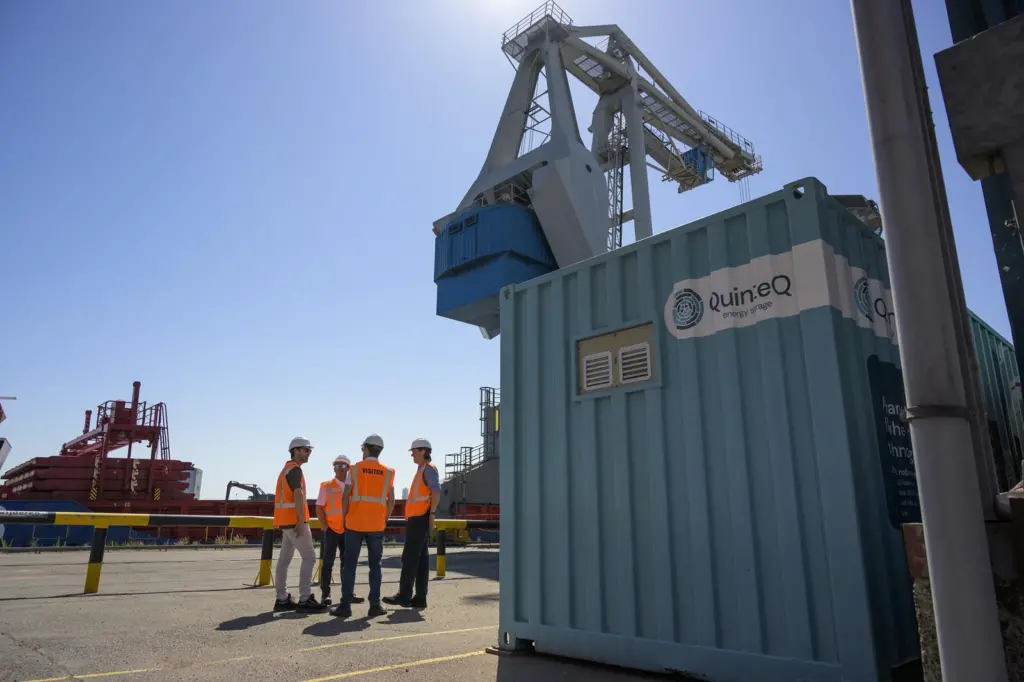
Flywheels are kinetic energy storage solutions. While conventional batteries (think lithium-ion) use chemical reactions to store and release energy, flywheels use kinetic energy instead.
The flywheel concept of energy storage is very old, but with new materials and advanced engineering, we are able to turn this concept into a modern, refined peak shaving machine for ports.
When energy is delivered to the flywheel from the grid or a generator, the motor-generator begins to speed up a heavy spinning rotor in the system. The more energy, the faster the rotor spins and the vacuum environment inside the flywheel allows the rotor to keep spinning with minimal energy loss.
When energy is needed from the flywheel, for example, when a crane hoists a load, the rotor slows down and the brake energy is converted through the generator into electricity and delivered where needed (in this case, the crane), with the ability to deliver high bursts of power in very little time.
Containerised solution
Rather than building large, heavy flywheels that require bunkers to store, QuinteQ builds smaller systems that rotate at high speeds, allowing us to deliver a containerised solution.
A 1.2 MVA system fits in a 20ft container and does not require a bunker for safety. The flywheel system is installed near the substations on the port where cranes are connected.
The flywheels will peak shave the high-power peaks of the cranes, reducing their power demand on the grid by up to 80%. So, for example, if your crane operations normally demand a 2 MVA grid connection, QuinteQ’s flywheel system can reduce that to 400 kVA.
Because the flywheel continuously charges and discharges between hoists (we can also capture and reuse regenerative power), the flywheel never runs empty. It can support a 24/7 operation with peak shaving.
By peak shaving these power peaks, flywheels are able to free up space in the port’s energy system. This means that ports can expand their operations or electrify current fossil fuel cranes while minimising the impact on the electrical grid infrastructure.
Meeting demand
The flywheel is an important tool for any port looking to electrify. Electric cranes, shore power and electric machinery all drive up power demand.
In fact, electric cranes are often the largest power users in ports, but they consume relatively little energy. This huge power pull puts limits on a port’s energy usage. As you know, infrastructure upgrades are costly, take too long, or are impossible to carry out due to grid congestion.
Flywheels can optimise a port’s power demand, peak shaving the power usage of electric cranes and machinery to smooth the power profile. An 80% reduction in power demand is a huge efficiency gain on your infrastructure. We allow terminal operators to grow or electrify more with existing infrastructure by rigorously optimising the substation usage from the cranes.
Think about my example above. If you have a 2MVA connection right now for your cranes, you cannot connect anything else on that point at the same time. But if you peak shave 1.6 MVA off, the cranes now only need 400 kVA to run the existing crane operation. You now have 1.6 MVA available on that substation for shore power, charging stations, reefers, or more cranes.
System benefits
While we think that flywheels can be used in tandem with hybrid port equipment, the real goal is full electrification of ports and we support any technology that works towards that.
That being said, our flywheels are specialised for use with electric cranes, helping ports transition away from diesel cranes. We also enable bandwidth on port grid connections.
The benefits of flywheel systems for peak shaving when compared to other solutions, namely batteries and capacitors, are numerous.
While batteries have great use cases for storing energy, they are less equipped to handle the extreme power profile of cranes. A chemical battery can handle around 5,000–8,000 cycles in their lifetime and that is only when they are being (gently) charged and discharged once per day.
A flywheel, on the other hand, can handle multiple cycles per hour with a lifetime of at least 250,000 cycles and 15 years of service life, due to it being a mechanical solution.
There’s also no risk of thermal runway. Because the flywheel is a mechanical solution, there is no risk of a lithium-induced fire. Not only is this a safer solution for a terminal, it also means that there are less legal restrictions when installing the system. For example, containerised battery systems cannot be placed directly next to buildings, but flywheels can.
Flywheels also have longer lifespans. The degradation of the flywheel is much slower than that of chemical alternatives. A flywheel can last 15 years, with at least 250,000 cycles. A refurbishment of certain components can extend the life of the flywheel even further.
They’re also fully recyclable and they do not rely on rare and toxic minerals – so no nickel, no lithium.
Pilot studies
In collaboration with the Port of Rotterdam (PoR) and their tenants Rhenus Logistics, we conducted a pilot study in 2024, running tests with our flywheel to prove the concept’s application in a port setting.
We implemented a prototype of our containerised flywheel system to supply energy to three port cranes at PoR, with the system charging during idle periods and then discharging during power-demanding moments, such as hoisting operations.
After three weeks of continuous testing and measuring, our flywheel system was found to decrease the power demands of the port by 65%, a reduction of just under 400kW, freeing up plenty of space on the connection for a potential new shore power connection without needing a grid upgrade.
This helped solidify what we already knew: That our flywheels are a cornerstone in any port’s electrification efforts.
In another pilot project, we conducted a multi-week pilot project in July 2025 with the C. Steinweg Group at their Moerdijk, Netherlands site, demonstrating the capabilities of our flywheel system.
The system successfully reduced the cranes’ peak power demand by 70%, which significantly lessened the strain on the local electrical grid and facilitated potential operational expansion. Furthermore, the flywheel improved power quality by providing compensation for the reactive power typically generated during crane operations.
Sound advice
First of all, you can’t wait for the grid to catch up. Solve the problem locally. While TSO’s are working hard to upgrade the grid, society is working harder to electrify.
Current predictions say that it may take up to ten years before the grid is ready, but who knows what developments will come to the surface in those years that put an even bigger strain on the grid? Take for example the recent uplift of AI datacentres that require 100’s of MW of power. The future is unknown, take matters into your own hands. Optimise locally and reduce your dependence on fossil energy.
Secondly, our advice to port operators is to not only view electrification as an energy problem but also start seeing it as a power problem and to match the solution with the problem.
Is your challenge energy related? Consider using batteries. A great solution for storing solar energy. But if it is (also) power related? Then look beyond batteries and consider flywheels. Don’t send a marathon runner to do a sprint. It is often much more cost efficient to free up a few hundred kW of power on a grid connection with a flywheel than it is to install a MWh battery.
Chemical batteries are great for holding energy for hours (energy density) but suffer when required to discharge large power bursts multiple times per day (power density). This is where kinetic energy storage is best, as it can cycle hundreds of thousands of times without degrading like chemical batteries. There is a lot of unused potential in people’s infrastructure that we can help unlock.
Grid congestion is becoming increasingly prevalent, preventing terminal operators from electrifying their operations due to lack of availability. We see that our technology fits in the port electrification market by allowing ports to avoid or minimise grid upgrades by decreasing their power demand, making room for them to expand and electrify.
Additionally, in this time of geopolitical instability, ports are seeing the need to (and value of) keeping their operations running while even the area around them is suffering power outages.
A key example is our recent project in Ukraine’s Port of Odesa, a lifeline for the country and thus a crucial component required to be in working order around the clock.
QuinteQ has partnered with Container Terminal Odesa (part of HHLA), the Dutch Ministry of Economic Affairs and the Lockheed Martin Corporation to convert the local terminal operator into a microgrid, making it much more resilient to hostile attacks on the Ukrainian grid.
Related Articles
 ENERGY & TECHNOLOGY GREENPORT
 ENERGY & TECHNOLOGY GREENPORT
 PRODUCTS & SERVICES GREENPORT