![GreenPort[PortStrategy]](https://www.portstrategy.com/greenport/wp-content/uploads/sites/4/2026/09/GreenPortPortStrategy.svg)

EXCLUSIVE: Rethinking energy on the inland waterways
Integrated solar, battery and hybrid propulsion systems are reshaping inland waterways by linking vessel decarbonisation more closely with port energy management strategies.
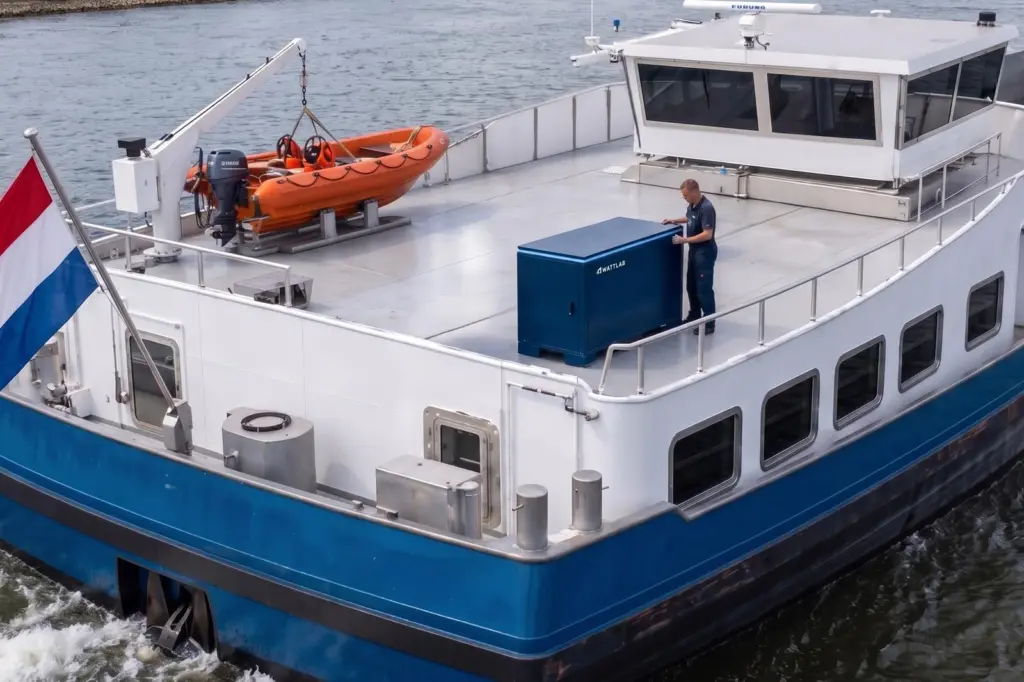
As European ports and inland terminals face mounting pressure to reduce emissions under tightening environmental regulation, technology providers are increasingly focusing on how vessels, charging infrastructure and renewable energy systems can operate as a coordinated logistics ecosystem.
According to Wattlab CEO, Bo Salet, the future of inland waterways will depend less on isolated technologies and more on integrated energy management across the wider supply chain.
“The biggest opportunity is to stop looking at decarbonisation as a collection of separate technologies and start treating it as one integrated energy system,” he tells GreenPort.
“If ports, vessel operators and technology providers optimise their own part independently, there is a real risk of creating an unnecessarily expensive and over-dimensioned infrastructure.”
Integrated approach
Mr Salet believes this integrated approach will become increasingly important as inland shipping operators seek commercially viable routes towards vessel decarbonisation without creating operational disruption.
While early maritime solar projects often focused on auxiliary onboard loads, Wattlab’s work with inland vessels including Blue Marlin and MS Helios have demonstrated how solar power can contribute directly to wider vessel energy systems when combined with batteries and intelligent energy management.
“It is an important shift, because it shows that renewable energy onboard inland vessels can be integrated into the vessel’s wider energy system, not only used for lighting, HVAC or other auxiliary loads,” Mr Salet explains.
“Projects such as MS Helios and Blue Marlin helped demonstrate what is technically possible when solar generation, batteries and energy management are combined intelligently.”
However, Mr Salet stresses that batteries remain central to accelerating decarbonisation across Europe’s inland waterways.
Wattlab’s WEstack modular battery system has been developed to reduce generator runtime, improve fuel efficiency and make hybrid operation more accessible for inland shipping operators.
“At the same time, we see the biggest near-term decarbonisation potential for inland shipping in the battery system itself,” he says.
“Solar can be a valuable addition where the vessel profile allows it, but the battery is the enabling technology that creates flexibility in how energy is generated, stored and used onboard.”
Bigger picture
For ports and terminals, the implications extend far beyond vessel technology alone.
Mr Salet argues that shore power deployment and charging infrastructure planning must evolve alongside onboard battery adoption to avoid unnecessary investment pressure on already constrained electricity grids.
“A good example is shore power,” he says. “If every berth has to be equipped to deliver the maximum charging power every vessel might need, the required grid capacity and investment become enormous. In many regions, grid congestion is already a major constraint.”
Instead, onboard battery systems could allow ports to deploy more flexible charging strategies while improving overall energy management efficiency across terminals and logistics hubs.
“If vessels are equipped with onboard battery systems such as WEstack, those batteries can act as energy buffers,” Mr Salet says.
“Ships can charge at lower, more manageable power levels over a longer period, while still having sufficient energy available.”
According to Mr Salet, this integrated approach could significantly reduce the scale of grid reinforcement projects required at ports while accelerating adoption of lower-emission inland shipping operations.

Energy buffers
Mr Salet adds that battery systems already provide immediate operational benefits, regardless of wider charging infrastructure availability.
“They reduce generator runtime, improve fuel efficiency, lower maintenance costs and increase operational flexibility, regardless of whether shore charging is available,” he says.
“That means batteries are not simply an enabler for future infrastructure, they are valuable assets today.”
Beyond infrastructure considerations, Mr Salet believes the long-term evolution of inland waterways will depend on stronger coordination between vessel operators, ports, terminals and technology providers as part of a wider lower-carbon logistics chain.
“Over the next decade, we believe the greatest progress will come from designing the entire logistics chain as one coordinated energy ecosystem,” he says.
“By combining onboard storage, smart charging infrastructure and renewable energy in an integrated way, Europe can accelerate decarbonisation while making much better use of the investment capital and grid capacity that are both in limited supply.”
Related Articles
 ENERGY & TECHNOLOGY GREENPORT
 ENERGY & TECHNOLOGY GREENPORT
 PRODUCTS & SERVICES GREENPORT