![GreenPort[PortStrategy]](https://www.portstrategy.com/greenport/wp-content/uploads/sites/4/2026/09/GreenPortPortStrategy.svg)

EXCLUSIVE: Seabound’s vision for port-led carbon capture
For ports and terminals grappling with maritime decarbonisation, carbon capture is emerging as a practical near-term solution, says Alisha Fredriksson, CEO and co-founder of Seabound.
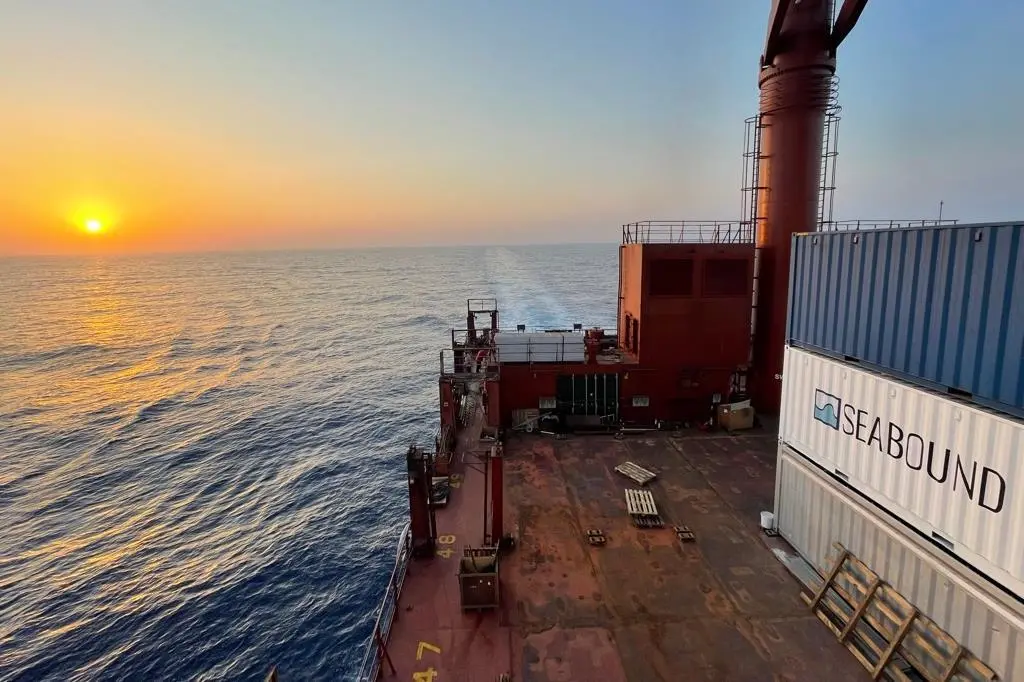
While alternative fuels dominate long-term strategies, their delayed commercialisation has left a widening gap for existing fleets that will remain operational for decades.
In our latest Portside Perspective podcast Mr Freriksson explains that it’s against this backdrop, onboard and port-based carbon capture is gaining traction as a complementary pathway that ports themselves can help to enable.
Ms Fredriksson argues that ports and terminals can play a decisive role in accelerating carbon capture deployment, both alongside vessels at berth and as enablers of emissions reductions at sea.
“The reason for Seabound when we started was essentially to help the existing fleet to reduce their emissions, which still have 10, 20, maybe even 30 years of sailing time to go,” Ms Fredriksson explains.
“Carbon capture was seen as something that could be available in the shorter term, with the hope that fuels would eventually come online and complement it. Unfortunately, those fuels are still very far away and the need for carbon capture has increased in light of that.”
The delayed transition
Ms Fredriksson entered the shipping sector through her work on alternative fuels, including e-methanol and she well recognises their long-term role.
However, she is candid about the current challenge. Regulatory uncertainty and delays to global frameworks have slowed investment and made it harder to commit capital to new fuel production.
“Most of the focus in the shipping industry so far has been on developing future fuels,” she says. “Unfortunately, they are still just as far away as when I entered the industry years ago, and the recent delay of the IMO net zero framework has made it much more difficult to finance new facilities.”
For Ms Fredriksson, this reinforces the case for carbon capture as a complementary solution that can deliver emissions reductions now with no heavy expenditure on infrastructure, while longer-term alternative fuel pathways mature.
Seabound’s technology
Founded in 2021, Seabound was founded by Alisha Fredriksson and Roujia Wen who met while studying at Minerva University.
Seabound’s onboard carbon capture system is based on calcium looping, a second-generation emissions capture process adapted for maritime conditions.
Ms Fredriksson explains that the company began with a technology-neutral approach, assessing land-based solutions before selecting one suitable for shipping’s operational constraints.
“When we started Seabound, we had a hypothesis that carbon capture on board vessels could be a new category to decarbonise the sector,” she says.
“We looked at all the different technologies being used on land or developed in labs and tried to figure out which would be most suitable for maritime-specific constraints. We ended up picking calcium looping because it could be the most cost-effective, most scalable and most suitable for shipping.”
The system uses calcium hydroxide, commonly known as lime, housed within containerised capture units roughly the size of a standard 20-foot shipping container. Exhaust gases from a vessel’s engine are routed through the container, where carbon dioxide reacts with the lime to create limestone.
“Essentially, we connect pipes from the ship’s engine to the Seabound Containers and the CO₂ in the exhaust gas is soaked up by the lime,” Ms Fredriksson explains.
“They transform into limestone, which is also known as calcium carbonate. Effectively, we’re making limestone on ships and trapping the CO₂ into the limestone.”
From vessel to quayside
A defining feature of Seabound’s approach is what it does not do onboard. Unlike some carbon capture concepts, the system does not attempt to separate, purify or compress CO₂ at sea.
“The only thing we do on board is trap the CO₂ into limestone,” Ms Fredriksson says.
“Some other approaches aim to re-separate the CO₂ from the binding material and compress it on board, which is technically possible but very energy intensive.”
When vessels return to port, the filled containers are lifted off, emptied and refilled with fresh lime.
The captured limestone can be sold or used as a construction material onsite, particularly where ports are undertaking land expansion or reclamation projects.
“That’s the simplest approach and the most scalable,” Ms Fredriksson says. “It gives us the most logistical flexibility and where possible the hope is to use the material locally to reduce transport costs.”
A second option involves recycling the limestone to regenerate lime and release a pure CO₂ stream for utilisation or sequestration.
“That closed-loop process is what we eventually want to get to in some of the bigger ports around the world,” she explains.
“It allows us to reuse the same material, reduce costs overall and have a reliable supply of green lime for our shipping partners.”
Demonstrating capture at port
Seabound’s port-based work began with a pilot project in early 2025 at the Port of Long Beach in California, delivered in partnership with Stax Engineering.
The project integrated one of Seabound’s prototype capture devices onto a barge treating exhaust from vessels at berth.
“That was a pilot project to demonstrate the integration of our technologies and to show what’s possible with port-based capture,” Ms Fredriksson says. “As far as we understand, it was the world’s first CO₂ capture at port.”
The project demonstrated that carbon capture could support compliance with port-based emissions regulations and potentially offer an alternative to shore power in certain contexts.
Moving towards deployment
Building on this milestone, Seabound secured funding through Innovate UK’s Clean Maritime Demonstration Competition to advance a UK-based project focused on the Port of Southampton.
“The aim was to go beyond piloting the technology and to start developing a full-scale, continuous operation. This funding round is specifically for pre-deployment trials.”
Seabound’s work at Southampton includes refining system design, improving lime efficiency and strengthening integration. Subsequently, the company has now constructed its first full-scale capture units.
“We have built, for the first time, the first full-scale Seabound Containers,” she says. “We’re currently testing them on land using a large diesel generator to simulate a marine engine.”
While technical progress is advancing, Ms Fredriksson is clear that large-scale deployment will depend on regulation and customer appetite.
“There is unfortunately quite limited incentive for ports to reduce emissions at berth, at least in Europe until 2030,” she says. “From my perspective, this feels like a wasted low-hanging-fruit opportunity.”
Earlier adoption is therefore likely to be driven by ports willing to act ahead of regulation.
“If we see really large-scale deployments before 2030, it will be because there is a first-mover customer that is keen to be reducing their emissions,” Ms Fredriksson explains.
Why ports matter
Ms Fredriksson says that for ports and terminals, carbon capture should be considered as part of a wider portfolio of decarbonisation solutions.
“I think the advice would be to consider carbon capture as part of the portfolio of potential solutions for reducing emissions of vessels at berth, but also for facilitating emissions reductions for vessels at sea,” Ms Fredriksson says.
“Emissions at sea are still the bigger component, so facilitating those reductions can be the most impactful thing ports can do.”
She highlights that Seabound’s modular system can be deployed both at port and onboard vessels, allowing ports to build experience that directly supports ship-based deployment.
Another advantage for ports lies in the relatively low capital investment required to trial carbon capture compared with fixed infrastructure projects.
“The CapEx investment for a port is orders of magnitude different. That makes it much more accessible to trial new technologies,” Ms Fredriksson says.
This means that ports can start small, which could be much more financially viable.
“Ports don’t have to make a big decision off the bat,” she says. “They can trial carbon capture with just one or two modules, get comfortable with the technology and then decide whether it makes sense to expand.”
Looking ahead, Ms Fredriksson believes the remaining challenges are commercial and regulatory rather than technical.
“Ports and port operators can play a really interesting facilitative role in the transition,” she concludes.
“But it requires being a little bit creative and a little bit courageous about trying new things and seeing what the response is.”
Related Articles
 ENERGY & TECHNOLOGY GREENPORT
 ENERGY & TECHNOLOGY GREENPORT
 PRODUCTS & SERVICES GREENPORT