![GreenPort[PortStrategy]](https://www.portstrategy.com/greenport/wp-content/uploads/sites/4/2026/09/GreenPortPortStrategy.svg)


EXCLUSIVE: Smarter ports: Monitoring for a resilient future
Despite its global significance, the maritime and port sector faces increasing challenges from rising sea levels and extreme weather events that threaten port operations, coastal infrastructure and maritime safety, writes Lars Ivar Leivestad, commercial manager, Miros.
Beyond environmental pressures, ports operate under intensifying commercial demands. Vessel sizes are increasing, turnaround times are shrinking, and global supply chains leave little room for weather-related disruption.
Even minor delays caused by uncertain sea conditions can lead to significant economic consequences. At the same time, port authorities are facing stricter regulation, along with growing scrutiny from investors and insurers demanding higher standards of safety, resilience and environmental performance.
For these reasons, advanced ocean monitoring is fundamental.
Spain’s monitoring network
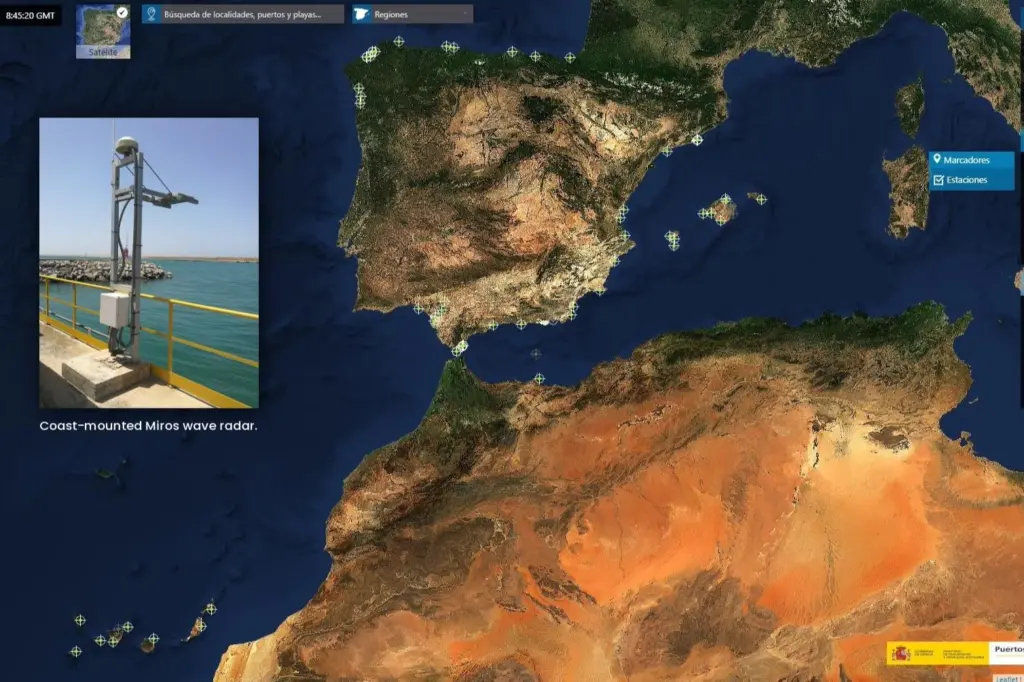
In Spain, the National Port Authority, Puertos del Estado, manages one of the world’s largest and most advanced port ocean monitoring networks, including the REDMAR (Red de Mareógrafos) tide gauge network.
Originally launched in 1992, REDMAR has evolved into one of Europe’s most advanced sea level observation systems.
Today, the network comprises 41 strategically positioned stations along Spain’s coastline. These provide continuous measurements of sea level, tides and wave parameters, including significant wave height and mean wave period.
The system underpins safe vessel navigation, dredging activities and berthing coordination, while also supplying the long-term datasets needed for resilient harbour design, breakwaters and coastal protection.
At the same time, it helps environmental agencies and researchers monitor sea-level trends, storm surges and coastal erosion and generates data that gives the public early warnings about hazardous sea conditions.
The network contributes data to international networks and oceanographic data programs such as GLOSS (Global Sea Level Observing System), the Copernicus Marine Service or EMODnet.
Modernising the system
In 2005, Puertos del Estado began modernising REDMAR, replacing its acoustic tide and submerged pressure sensors with a more low-maintenance, higher-precision coastal monitoring system.
As part of this modernisation, Puertos del Estado commissioned Miros to supply its first dry-mounted radar system, RangeFinder, capable of continuously measuring sea level and wave parameters with comparable measurement accuracy.
This led to a partnership between Miros and Spanish marine services specialist, SIDMAR, which served as a local distributor and systems integrator, overseeing installation, calibration and ongoing maintenance.
Unlike traditional systems, where wave and current data are gathered by in-water equipment, such as buoys, Miros’ advanced radar-based RangeFinder sensors deliver real-time data on sea levels, tides and non-directional waves with millimeter-accuracy in all weather conditions.
Being dry-mounted, the sensors help lower costs and reduce maintenance issues associated with submerged equipment, which often require frequent dive inspections and cleaning to remove marine growth like barnacles and algae, which can cause corrosion and signal problems.
By opting for Miros’s RangeFinder radar-based sensors, Puertos del Estado reduced costly maintenance downtime, improved safety and lowered operating costs. Above all, it futureproofed its hardware for an innovative new era.
Expanding the operational window
Subsequently, over the following 20 years, Spain’s national sea level monitoring network REDMAR has developed into a world-leading coastal monitoring network.
But while successful, rising sea levels, complex storm patterns and more frequent extreme weather events have created new challenges for coastal infrastructure along Spain’s coastline, including more localised issues.
The network has monitored sea level changes across a wide range of frequency ranges, from waves to infragravity waves, meteotsunamis, tides and mean sea level.
To ensure the continuation of high-level monitoring, Puertos del Estado has recently commissioned a new wave of Miros’ advanced radar-based RangeFinder sensors for the REDMAR network.
Real-time data can be accessed directly from the instrument, integrated with third-party systems, or viewed via PORTUS, the oceanographic and meteorological information system of Puertos del Estado. This is all accessible via the web, designed for the visualisation, analysis and distribution of data on the marine environment.
It offers real-time data and forecasts (waves, sea level, currents, temperature) to optimise the safety and efficiency of port operations.
Historical and live measurements are accessible anywhere, anytime, on any device, enabling secure collaboration between port and coastal operators, stakeholders and vessel traffic managers.
By continuously monitoring the sea state, Miros’ RangeFinder not only improves the safety of port operations, vessels and personnel, but also supplies operators with reliable information to optimise berthing, navigation and cargo handling.
This results in increased efficiency, fewer delays and higher throughput.
By using high-frequency dry-mounted radar sensors, Puertos del Estado has developed tools to detect anomalies in real-time, thereby enabling earlier warnings and faster operational adjustments. This level of precision offers clear commercial value.
The importance of certainty
In maritime logistics, where uncertainty drives conservatism, if confidence in data is low, ports widen safety buffers and delay manoeuvre or suspend operations “just in case”.
While necessary, these extra margins reduce uptime and create ripple effects across supply chains. But with accurate wave measurements, ports gain greater certainty around actual sea-state conditions.
Decisions can be based on verified data rather than precautionary assumptions, effectively widening operational weather windows without compromising safety. For ports handling major energy cargo and high-value freight, even modest gains in uptime can translate into significant economic benefits.
Wave sensors enhance safety, efficiency and long-term planning. The advantages of high-quality wave sensors are clear and immediate.
Practically, the sensors help port authorities predict dangerous sea conditions, prevent collisions, improve vessel management and schedule dredging with minimal interruption.
If a sudden rise in wave height is detected, port managers can adjust berthing plans to safeguard infrastructure and ships.
Beyond daily operations, wave data supports long-term strategy. Historical and real-time measurements inform the design of resilient harbors and coastal defenses and contribute to climate adaptation planning.
Continuous data streams feed modelling systems for waves, storm surges, tsunamis and coastal flooding, helping ports and surrounding communities prepare for both routine operations and extreme events.
Smart port creation
As Spain continues to upgrade REDMAR, the focus is on maximising data to create smarter, more adaptable ports.
Real-time measurements feed predictive models, helping ports anticipate changes in sea state, optimise vessel scheduling and prepare for extreme weather events before they happen.
In the broader context of climate adaptation, REDMAR plays a crucial role, especially when rising sea levels and more frequent storms make historical tide and wave data essential for designing resilient infrastructure.
The latest phase of modernisation reflects Puertos del Estado’s continuing strategic investment in advanced ocean-monitoring technologies.
By equipping Spanish ports with reliable sea level and wave sensors and predictive monitoring, the authority is enhancing operational efficiency, safety and climate resilience and providing a blueprint for other countries seeking to integrate real-time monitoring with local operational expertise.
The modernisation of REDMAR underscores the importance of long-term partnerships in maritime technology.
By combining Norwegian innovation from Miros with SIDMAR’s local operational expertise, Puertos del Estado guarantees seamless integration, maintenance and interpretation of real-time sensor data.
Based on more than 20 years of collaboration, this partnership not only provides valuable sea level data but also enhances operational safety, efficiency and climate resilience across Spain’s port network.
Related Articles
 ENERGY & TECHNOLOGY GREENPORT
 ENERGY & TECHNOLOGY GREENPORT
 PRODUCTS & SERVICES GREENPORT