![GreenPort[PortStrategy]](https://www.portstrategy.com/greenport/wp-content/uploads/sites/4/2026/09/GreenPortPortStrategy.svg)
EXCLUSIVE: The need to focus on integration and collaboration
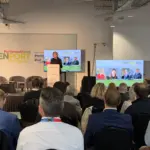
Two days of presentations and panel discussions at GreenPort Congress 2023 covered everything from carbon neutral to carbon capture, from energy transition to ESG, writes Felicity Landon.
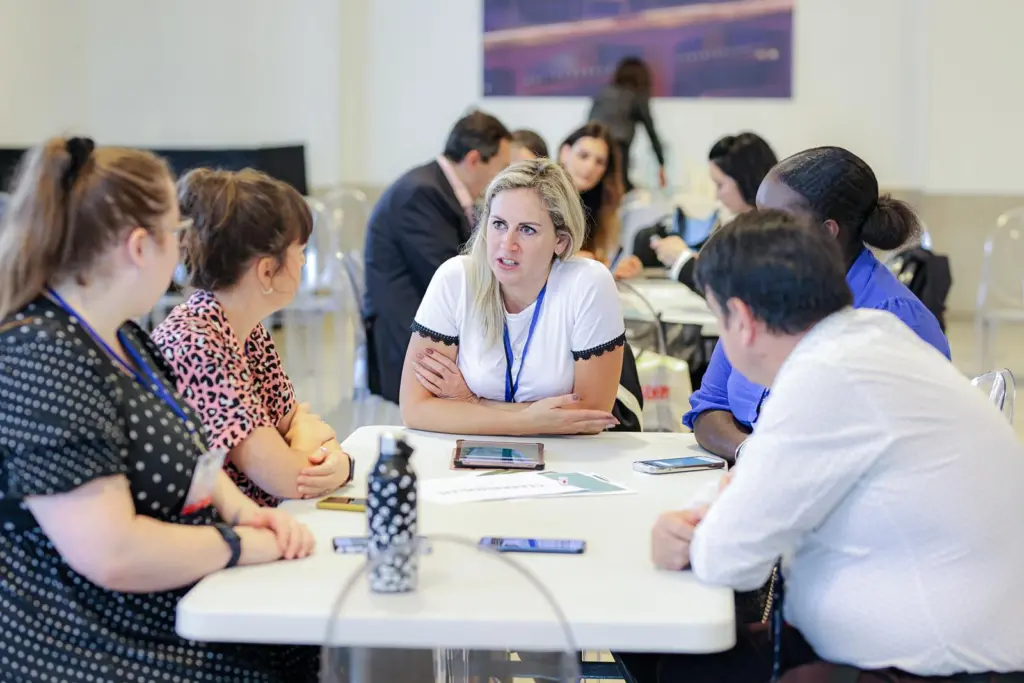
But throughout the programme, common themes emerged – the need for integration and collaboration.
Conference chairman and moderator Christopher Wooldridge told delegates in his final day summary: “There were so many topics and issues covered but time and again we have heard of the need for an integrated approach and collaboration. Twenty-five years ago, ports would say ‘we don’t do environment’ – now look at the best practice between you and what you are sharing.”
The only way forward
A green port will handle more goods and be more successful, he emphasised. “You can’t have sustainable development without development. You balance that development with a better environmental management programme.”
“We have heard splendid examples of surveys, monitoring, management, digitalisation, automation – and, in the end, it absolutely comes back to the people who break the rules and make the rules. That has a profound effect. We have to bring people and society with us as we move towards sustainable development.”
Notably, there were calls for fairness and a level playing field in the transition – particularly relating to the extension of the European Union’s Emissions Trading System (ETS) to shipping from January 2024. The ETS, part of the EU’s Fit for 55 package, attracted some strong comment during the GreenPort keynote panel discussion entitled ‘Climate Change: energy efficiency, GHG emissions reduction & adaption’.
Isabelle Ryckbost, secretary general of the European Sea Ports Organisation (ESPO), noted: “Green and sustainability is the only way forward. We do not discuss the goals/aims. But now we are getting into the phase of implementation [of European regulations] – and it has been a lot of very ambitious initiatives at the same time – we already see some problems and some difficulties.
“Ports start getting into the details of what it will mean – and for ports it is a very strict framework, whereas for ships there is quite a lot of flexibility. For ships, there is room to evade [Fit for 55] and go to ports outside Europe. Also implementation can be quite costly – investments can be quite risky.”
Building resilience
Competitiveness and resilience are key, said Lamia Kerdjoudj, secretary general of the Federation of European Private Port Operators (FEPORT), which has since raised alarm over potential cargo diversions as a result of the ETS regime and called for an immediate study into its impact.
Ms Kerdjoudj emphasised the importance of dialogue with policymakers. “At the end of the day, it is also about trying to remain competitive. Environmental ambition has a cost – who is going to pay for that? For the moment, it is not so clear,” she said.
She explained: “We are of course taking very proactive action within the EU when it comes to the environment and this is something we should be proud of but at the same time, other regions are not taking the same legislation, so competitors close to Europe are not going to take the same rules. That is of great concern. We want close monitoring by the European Commission on the impacts – because, as you know, when cargo leaves a port, it generally doesn’t come back.”
Isabel Moura Ramos, executive board member at the Port of Lisbon Authority emphasised the need to think about new business models inside the ports – “There is no way out,” she said.
She described the port’s discussions about the future of inland navigation to achieve a modal shift – “but we talk with operators and they say, who is going to pay for the movements in the terminal to the barge and from the barge to logistics and we say – we all need to pay it, it is not just the port authority. We are already paying that with the external negative impacts we have from the trucks that go out of our terminal. This is a difficult exercise but there is openness to new business models.”
Level playing field
Maja Markovčić Kostelac, executive director of EMSA, said: “Competition is the fuel of a market economy; of course it will always exist but here we are talking about a higher stake. If we don’t act, the price which we normally all pay, as consumers, will be much higher. We as Europe are not just introducing high standards to implement them, but we are really trying to spread and promote a global approach.
“The risk is global, maritime transport is global, so solutions should be found on a global level. Nevertheless, we all know that the global community is not a nice family sitting around the table sticking to agreement. We are not naïve.”
Ms Markovčić referred to the significant progress made in summer 2023 with the launch of the IMO’s revised GHG strategy and said she wanted to avoid an “us and them” focus.
“If you are discussing with the shipping companies, they say ‘we have to abide by the rules, but still don’t know what the best technology will be’. But what about supply? Are we going to be able to bunker our ships with ammonia, methanol? I would say the concerns are equal on both sides.
“Luckily for us in Europe, at least we have a number of different funds which can support this transition. Not all of it – we also expect private funds.”
On the other hand, it is vital to ensure that there is a level playing field on the global scale and that also includes using resources to support the less privileged and less resourced if there was to be a transition at global level, she said.
“We should bear in mind that this transition is also offering great competitive advantages for all those who think green and act green.”
Industry insight
Larger ports tend to get most of the media attention for their ‘green’ ambitions and achievements but smaller ports are also doing a lot and should not be underestimated, said Anaëlle Boudry, senior policy adviser for sustainable development, energy and blue growth at ESPO and EcoPorts coordinator.
Speaking at the launch of the ESPO Environmental Report, she said that monitoring the top ten environmental priorities of the ports sector helps to establish priorities. The analysis showed that the top three concerns remained the same as 2022 – climate change, air quality and energy efficiency and the same as 2021, although in that year air quality was ahead of climate change.
The other concerns in the top ten were noise, water quality, ship’s waste, relationship with the local community, land-related port development, port waste and, a new entrant at number ten, water-related port development.
Seventy percent of the port responders are adapting existing infrastructure to increase their resilience to climate change, 57% have onshore power supply available in one or more berths and 42% have LNG bunkering at the port.
Sixty-three percent of ports now offer reduced port fees for greener vessels, based on metrics such as waste management and segregation, GHG emission reduction, noise reduction and environmental certification.
‘I am doing my part’
The importance of everyone being able to say “I am doing my part” was emphasised by Nuno Matos, managing director of ECO-OIL, at a conference session considering waste management and the circular economy.
Mr Matos said the first sustainable fuel oil certified by the ISCC had a part to play in decarbonisation. EcoGreen Power Plus, a 100% recycled, low carbon alternative, could be a solution for maritime fuel, he said.
“To reach a new energy, we need to have a transition. There is uncertainty – no one knows what happens in the future. We have been talking about methanol, ammonia. The future might be a mix.”
Effective use of digitalisation as a tool for sustainability was discussed at another session. Miika Murremäki, head of digital solutions at Kalmar, focused on data quality and ownership. “Everything starts with data and when you start discussing it, you need to discuss who owns it,” he said. “That is a big topic across all industries.”
Complex challenges require data-based decision-making with a remote and collaborative approach, he added.
Pablo Galán, head of business development at the University of Valencia’s Simodar Training Solutions, urged delegates to ‘be positive’ about AI and automation. The implementation of AI would be more of a cultural issue [of acceptance] and is not going to be a threat, he said. “All the hassle with ChatGPT will be repeated with other aspects such as automation. Be positive – it is something that is going to improve the process,” he said.
Describing use cases and experiences using data analytics, AI and simulation to increase productivity, sustainability and safety, Mr Murremäki gave details of predictive maintenance cases including brake dragging, wheel alignment and hydraulic pump issues, with associated analysis and action to save costs and avoid breakdowns, as well as examples of equipment simulation and demand planning.
Related Articles
 ENERGY & TECHNOLOGY GREENPORT
 ENERGY & TECHNOLOGY GREENPORT
 PRODUCTS & SERVICES GREENPORT