![GreenPort[PortStrategy]](https://www.portstrategy.com/greenport/wp-content/uploads/sites/4/2026/09/GreenPortPortStrategy.svg)




EXCLUSIVE: Unlocking terminal efficiency through grab optimisation
Entering its second century in business, Nemag continues to play a specialist role in bulk cargo handling by helping ports and terminals improve productivity while responding to increasing environmental and economic pressures.
Operating in a market defined by rising operational costs, intense competition and growing expectations around efficiency and sustainability, Nemag has positioned grab optimisation as a critical lever for performance improvement.
For Martine Dekker-Grootveld, co-owner and sales manager at Nemag, the company’s objective is explicit and unchanged.
As she explains in a recent Portside Perspective with us, “What we want to achieve with our grabs in general is for our customer is to have the highest productivity against the lowest maintenance cost per tonne. I think that’s the main thing that we have in mind with everything we do.”
Small component, big win
Throughout the podcast discussion, Mrs Dekker repeatedly stresses that although the grab is often regarded as a relatively small component within the bulk handling chain, its influence on terminal performance is substantial.
Faster unloading, smoother crane operation and reduced downtime all translate directly into lower energy use, lower emissions and improved commercial outcomes.
“The grab is considered to be a very tiny part in the whole supply chain or logistics chain, but it has a major impact on the total efficiency. It’s a small component, but it can really have a big influence on your total efficiency of the installation,” Mrs Dekker says.
This observation reflects the wider challenges facing ports and terminals today. She describes an industry under pressure, where handling rates are increasingly constrained while costs and return-on-investment expectations continue to rise.
“What we see happening for quite some time now is a trend in the bulk industry that handling rates are under pressure,” she explains. “Meanwhile, the requirement for return on investment is getting higher and higher, but also the costs are getting higher.”
A hidden leverage point
According to Mrs Dekker, optimising grab performance is one of the most effective ways to improve terminal efficiency without extensive changes to infrastructure.
By improving unloading speed and consistency, a well-matched grab can shorten vessel turnaround times, reduce demurrage exposure and ease congestion within busy terminals. These operational improvements also carry environmental benefits, as vessels spend less time alongside and cranes operate more efficiently across each cycle.
Mrs Dekker highlights that grab optimisation directly affects energy consumption and operational rhythm.
“If you are able to be more efficient in your unloading, you’re also saving on energy costs, on wages and everything,” she explains.
She adds that inefficient equipment can disrupt crane performance, noting that operators need “a nice smooth operation with a consistent back and forth rhythm.”
When that rhythm is interrupted, average productivity across the shift is reduced and energy use increases.
Despite this, awareness of the grab’s impact often remains limited.
Mrs Dekker acknowledges that terminal operators are frequently focused on larger system components, such as cranes or berth infrastructure.
“Because this grab is really a small component in the chain, sometimes there’s not much awareness of the effect it can have on your total efficiency of your total terminal or installation,” she says.
Nemag’s experience, however, consistently demonstrates that relatively small changes at the grab level can deliver significant operational and environmental gains.
Consultancy led engagement
A defining feature of Nemag’s approach is its consultancy-led engagement with customers.
Rather than offering a single standard solution, the company works closely with terminal operators to understand their specific operating conditions, cargo profiles, tonnages and performance objectives. This approach is particularly relevant in multipurpose terminals, where operators are required to handle a wide variety of commodities throughout the year.
Mrs Dekker explains that even in these complex environments, optimisation is possible.
“If you have a more multipurpose environment, it is still just as important,” she says, adding that terminals can still identify the most suitable solution by examining which commodities dominate annual volumes and operational patterns.
This tailored approach allows terminals to improve efficiency without sacrificing flexibility.
The consultancy process also helps challenge common assumptions around grab sizing. Mrs Dekker notes that customers often request the largest possible grab, believing it will automatically deliver the highest productivity.
“Sometimes a customer just wants the biggest grab available,” she explains, “but sometimes it doesn’t really bring the most productive approach.” Oversized grabs can affect crane speed, operational stability and the smooth continuation of work, ultimately reducing overall efficiency.
A case study from Brazil illustrates the value of Nemag’s consultative approach. A major logistics operator approached the company after a new crane and grab combination failed to meet performance expectations.
By analysing the operation and adjusting the grab specification, Nemag was able to deliver immediate results. “By only changing the grab, they achieved a 15 percent increase in productivity,” Mrs Dekker says.
When the terminal later introduced Nemag’s Nemax grab, further gains were achieved, resulting in more than a 20 to 25 percent improvement in overall installation performance.
Research-driven approach
Innovation and research form the foundation of Nemag’s optimisation strategy.
Mrs Dekker emphasises that research and development are core elements of the company’s culture rather than peripheral activities.
A long-standing cooperation with Delft University of Technology has enabled Nemag to develop a simulation tool that allows engineers to visualise grab design interacting with bulk materials before equipment is manufactured or deployed.
“This means that we can monitor, for instance, the filling degree in a grab, or if we make changes in the design, we can see what effect it has,” Mrs Dekker explains.
“Instead of trial and error in the field, we can already predict quite a lot with our simulation tool.”
This predictive capability reduces development time, avoids unnecessary material use and ensures that equipment is optimised before it reaches the quayside.
Mrs Dekker also notes that the research process itself delivers valuable insight.
“It’s not only the goal, but it’s also the road towards it that gives us a lot of added value,” she explains.
The knowledge gained through simulation supports continuous improvement across Nemag’s product range and strengthens the company’s ability to advise customers accurately.
Efficiency and adaptability
Nemag’s grab portfolio reflects its focus on efficiency, adaptability and long-term performance.
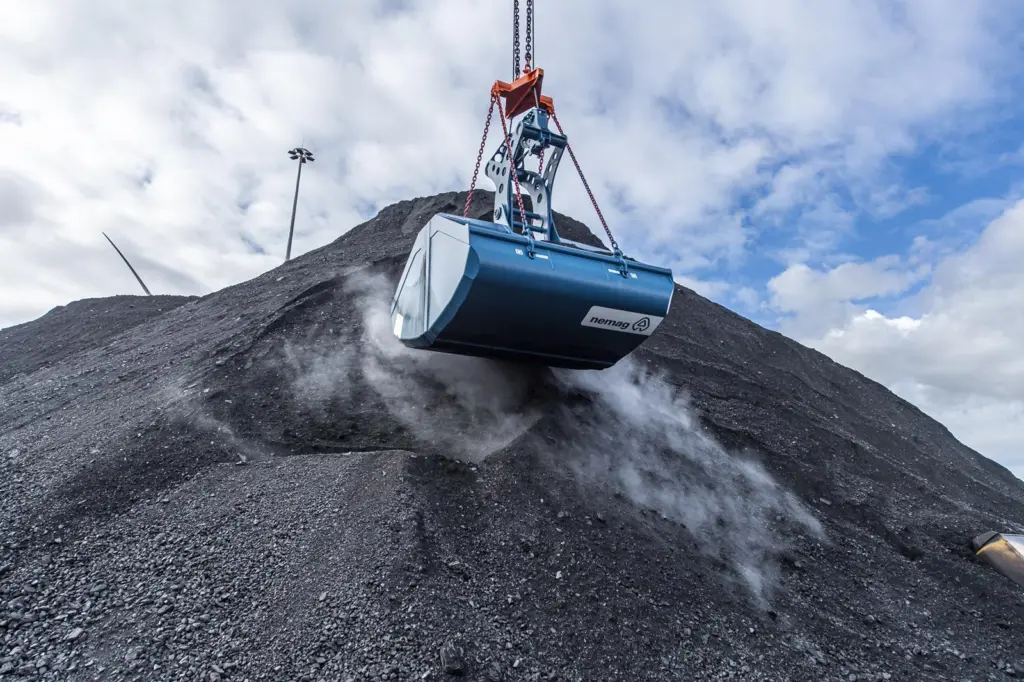
The clamshell grab remains a highly versatile option, offering lightweight construction and high capacity across a wide range of bulk materials. It can also be equipped with environmentally friendly features such as full closure or special sealing plates to minimise dust emissions and cargo spillage.
The scissor grab, developed by Nemag more than six decades ago, offers fast opening and closing, strong stability and effective trimming capabilities. Mrs Dekker notes that this grab type is particularly suitable for heavier or lumpier materials, where speed and control are essential to maintaining efficient unloading cycles.
Nemag’s Nemax grab represents the latest stage in product development.
Combining the advantages of clamshell and scissor designs, the Nemax offers high capacity, rapid cycle times and reduced maintenance due to a lower number of moving parts.
Mrs Dekker describes it as “combining the advantage of a clamshell being very lightweight and big in capacity with the advantage of the scissor grab.”
Initially developed for iron ore and pellets, the Nemax has since expanded its use into lifting concentrates, bauxite, aggregates, clinker and limestone, with a coal version now also under development.
Way forward
Throughout the podcast, Mrs Dekker makes clear that efficiency and environmental performance are closely linked.
Faster handling reduces the energy required per tonne of cargo, while consistent operation reduces wear and extends equipment life.
These factors lower operating costs and reduce the environmental footprint associated with maintenance and replacement.
Mrs Dekker also highlights that efficient grabs complement broader industry trends, including crane electrification.
Improved grab performance allows crane manufacturers and terminal operators to achieve higher productivity or maintain output with lower energy input. In some cases, this even enables cranes to be scaled down while maintaining performance, delivering additional energy and cost savings.
Looking to the future, Mrs Dekker believes early engagement will become increasingly important for terminal operators.
She encourages ports and terminals to consider grab selection early in project planning, whether replacing equipment, procuring new cranes or developing entirely new facilities. “Even in early stages of projects, we already like to be there as a consultancy-based company,” she says.
For Nemag, the focus remains on continuous improvement, research and close collaboration with customers.
The aim, Mrs Dekker concludes, is to help terminal operators achieve the highest possible efficiency by selecting the right grab for the right application, delivering lasting environmental and operational benefits.
Related Articles
 ENERGY & TECHNOLOGY GREENPORT
 ENERGY & TECHNOLOGY GREENPORT
 PRODUCTS & SERVICES GREENPORT