


Greening container logistics in seaports
Port Feeder Barge is a self-propelled container pontoon, equipped with its own container crane, which will contribute to carbon reduction in ports
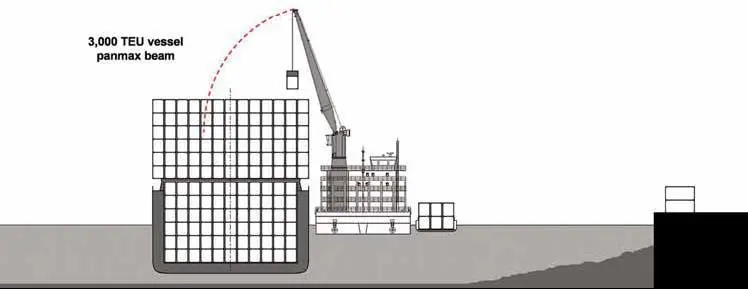
A new type of harbour vessel has been developed by Port Feeder Barge GmbH in Hamburg, aimed at reducing the environmental footprint both of the internal logistic procedures within container ports as well as of the intermodal transport chains routed via such ports. It will achieve this by:
1. shifting container haulage within the port from road to waterway,
2. easing transhipment procedures within major container ports,
3. increasing the share of inland navigation in hinterland transport.
The internationally patented Port Feeder Barge is a self-propelled container pontoon, equipped with its own heavy duty container crane mounted on a high column on one side of the vessel. The barge is of double-ended configuration, intended to make it extremely flexible. It is equipped with two electrically driven rudder propellers at each end in order to achieve excellent maneuverability and the same speed in both directions.
While half of the containers are secured by cell guides, the other half is not, enabling the carriage of containers in excess of 40ft length as well as any over-dimensional boxes.
The vessel will meet the highest environmental standards. A diesel-electric engine plant with exhaust scrubbers for lowest emission values has been chosen to supply the power either for propulsion or crane operation. The vessel can be operated by a crew of three. The Port Feeder Barge will offer a daily round trip in the port of Hamburg connecting all container facilities with each other. Due to its own gear, the vessel can load and discharge independently from quayside gantries.
Trucking
Some 250,000 boxes are currently trucked within the port of Hamburg (mostly between the terminals) – producing high emissions and often causing road congestion resulting in further emissions.
Somewhat surprisingly, road hauliers are supporters of this concept: they often lose money by trucking boxes just within the port due to the congestion on the roads and at the terminal gates.
Despite the argument that barging is too slow and runs the risk of containers missing their feeder connection, it is suggested that 80percent of trucking within the port is not time critical, and the Port Feeder Barge will be even faster for jobs consisting out of 20-30 boxes.
Feeder
Feeder operators are already a big customer of the truckers. Feeder vessels have to follow their customers – that is: they have to call at all the terminals where the deep sea vessels are berthing. On average, each feeder vessel has to berth at four different terminals per Hamburg call! This is very costly, time consuming and from a safety aspect very critical.
If the Port Feeder Barge collects and distributes containers for the feeder vessels, the feeders could concentrate on the major terminals only, thus reducing the number of vessel shiftings, reducing their time in port and related costs, improving safety and increasing terminal and berth efficiency.
From the terminal’s point of view, all vessels with less than approx. 100 boxes to handle are critical with respect to profitability anyhow. However, in Hamburg two thirds of all terminal calls by feeder vessels are below that figure!
Inland navigation
Inland navigation suffers even more than the feeders as these vessels have usually the lowest priority at the terminals. Some vessels need two days in Hamburg just to handle just a few boxes, hopping from one terminal to another. However, for environmental reasons, inland navigation has to take a bigger portion of hinterland transport. The Port Feeder Barge can act as a ‘floating terminal’ for inland waterway vessels. Once a day, the Port Feeder Barge will call at a dedicated berth to meet with the inland waterway vessels. The containers will be exchanged ship-to-ship, independently from any terminal equipment. Not even a quay is required but transshipment can take place somewhere at the dolphins.
The Port Feeder Barge will distribute and collect the containers for inland navigation within the port in the course of its daily round voyage. If the terminals could delegate the inland waterway vessels to the Port Feeder Barge, the inter-modal connectivity for inland navigation would be improved substantially, thus helping to increase its share in hinterland transport. Ports can dispense with the construction of dedicated terminals for inland navigation.
Further applications
The Port Feeder Barge can also be used in ports in developing countries, to enhance their container handling ability which is often limited by shallow draft and/or insufficient quay facilities such as missing container cranes. Instead of heavy investment in the port’s infrastructure, the Port Feeder Barge can be used as a floating terminal, using its own gear for serving the deep sea container vessel at anchorage somewhere off the coast and shuttling the containers to small sites on the coast which do not even need a crane. A reachstaker and a minimum draft of 4 m would be sufficient to start container operation ashore. This would enable bypassing notoriously congested ports in developing countries to smaller nearby places where Port Feeder Barges are based. This could be a viable option to reduce all the ecological consequences from the port and related road congestion.
Most container ports are not prepared to avoid oil spills by damages to lighter grounded container vessel’s hulls. Although some ports have conventional floating cranes for heavy lift operation available, they are not suitable to quickly discharge container vessels of panmax beam and more. A Port Feeder Barge could help to fill that gap in emergency response capability.
Port Feeder Barge: Main Data
|
Type: |
self propelled, self sustained, double-ended barge |
|
Length o.a.: |
63.90 m |
|
Beam o.a.: |
21.20 m |
|
Height to main deck: |
4.80 m |
|
Max. draught (as seagoing vessel): |
2.00 m |
|
Max. draught (as harbour vessel): |
3.10 m |
|
Deadweight (as seagoing vessel): |
1,000 mt |
|
Deadweight (as harbour vessel): |
2,500 mt |
|
Gross tonnage: |
approx. 2000 BRZ |
|
Power generation: |
diesel-electric |
|
Propulsion: |
2 x 2 electrical rudder propeller of 4 x 280 kW |
|
Speed: |
7 knots at 3.1 m draught |
|
Capacity: |
168 TEU (thereof 50% in cellguides), 14 reefer plugs |
|
Crane: |
Liebherr CBW 49(39)/27(29) Litronic (49 t at 27 m outreach) |
|
Spreader: |
automatic, telescopic, 6 flippers, turning device, over height frame |
|
Accommodation: |
6 persons (in single cabins) |
Related Articles
 PRODUCTS & SERVICES GREENPORT
 ENERGY & TECHNOLOGY GREENPORT
 ENERGY & TECHNOLOGY GREENPORT