![GreenPort[PortStrategy]](https://www.portstrategy.com/greenport/wp-content/uploads/sites/4/2026/09/GreenPortPortStrategy.svg)


Harnessing the transformative power of data
PortXchange was born from a vision to provide the maritime industry with digital solutions for predictable and sustainable shipping, says Adriana Belei, PortXchange.
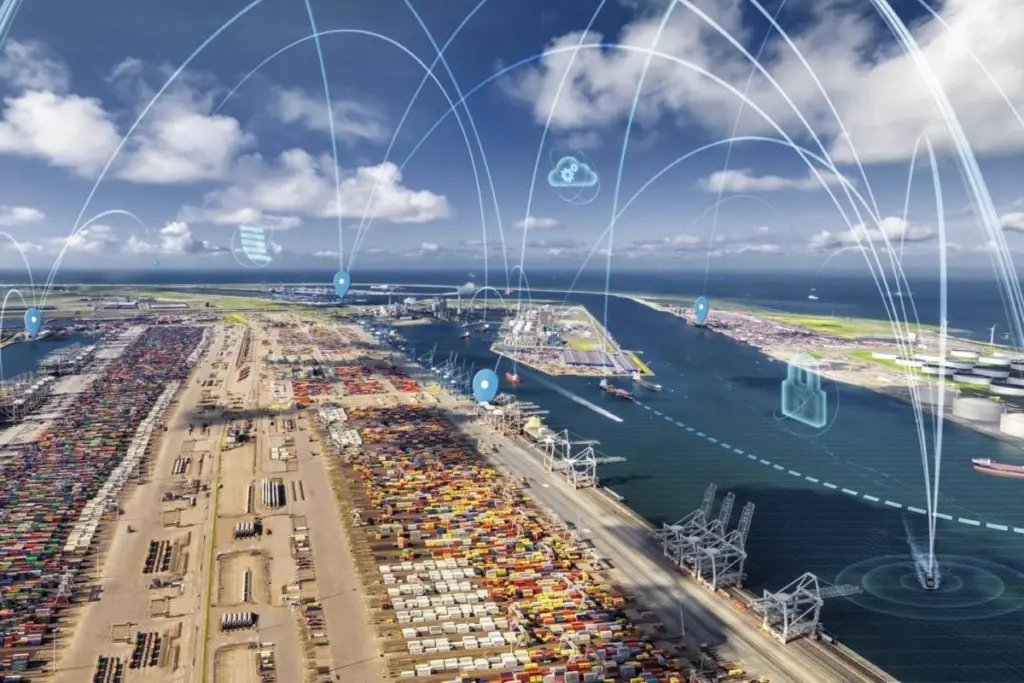
Its fundamental principles are deeply grounded in leveraging cutting-edge data science to enhance ocean supply chain efficiencies while prioritising sustainability, thereby significantly increasing productivity and reducing CO2 and NOx emissions.
This is particularly crucial for coordinating Just-in-Time arrivals through our Synchronizer platform and offering effective emission monitoring solutions with EmissionInsider. In doing so, we aim to become a vital facilitator in the maritime industry, not just as a solution provider but as a collaborative partner working toward a more efficient and sustainable ocean freight ecosystem.
Global potential
Tracing back to our origins, PortXchange evolved from Pronto, an innovative port call optimisation platform pioneered by the Port of Rotterdam in 2018. Witnessing its tangible impacts and after the success of comprehensive trials, there was a unanimous agreement on the potential this platform could offer globally.
This led to the birth of PortXchange in 2019 as an independent entity, aiming to share this vision with ports worldwide. The traction has been exceptional, with over 50 stakeholders leveraging our platform to optimise more than 100,000 port calls.
Monitoring isn’t just a procedure; it’s a cornerstone of ensuring environmental sustainability for ports and terminals around the globe. With the maritime sector standing resolutely to decarbonise and meet or better the International Maritime Organization’s (IMO) rigorous emission reduction targets to undertake the journey toward these ambitious benchmarks, one must first understand where they are starting.
This is where the importance of real-time and accurate monitoring comes to the forefront. By embracing the digital transformation wave, ports are increasingly leveraging innovative platforms like PortXchange’s EmissionInsider and Synchronizer to gain this essential opening benchmark. These platforms centralise data in real-time, providing the starting points and bringing to the fore a host of opportunities for change.
The benefits of such platforms don’t just stop at environmental positives; they present immediate and scalable solutions that strike right at the heart of maritime decarbonisation while ensuring cost-effectiveness.
One example is historically, ports operated on the ‘first-come, first-served’ principle, which, while straightforward, often led to operational delays and an inflated carbon footprint. A paradigm shift is possible with meticulous monitoring: Ports can transition to a data-centric model, optimising port calls and minimising unnecessary idling, thus reducing fuel consumption.
Moreover, the value of precise emission monitoring is manifold. It paves the way for a well-documented emissions inventory, giving ports a wealth of insights. By harnessing this data, ports can make decisions that optimise their operations and make themselves decarbonisation hubs, making them more attractive to eco-conscious businesses and supply chain partners looking for clean shipping.
Beyond operations, ports are intricately woven into the fabric of local communities. Their actions, or the lack thereof, directly affect the health and environment of their and neighboring regions. By actively diminishing emissions, ports ensure a cleaner, healthier atmosphere for all.
Looking into the horizon, the path forward for ports is unmistakably green. A rigorous commitment to monitoring positions them not just as trade hubs but as decarbonisation hubs, the vanguards of sustainable progress. They must do so with an unwavering commitment to the planet and its people.
Practical solution
In the changing dynamics of the maritime industry, EmissionInsider offers a practical approach for ports aiming for zero emissions.
Beyond just providing insights into the emission level, it serves as a strategic guide assisting ports in making both environmentally and economically informed decisions, especially regarding emissions from ships, trucks and rail. Distinguishing itself from other generic solutions, EmissionInsider employs a nuanced three-step method designed to address each port’s individual environmental and financial intricacies.
At the heart of any effective change strategy is a thorough understanding of the status quo. EmissionInsider immediately undertakes an exhaustive emissions analysis. This process meticulously identifies emission hotspots’ primary contributors, spanning all transport types and activities. In doing so, it lays the bedrock of data that is pivotal for any substantial decarbonisation move.
Stage one is the evaluation stage, or emissions strategising phase.This phase leverages the intelligence accrued from the assessment stage. Here, EmissionInsider creates a precise emissions inventory, the catalysis upon which operational and strategic decarbonisation pathways are identified.
What distinguishes EmissionInsider is its ability to enable ports to simulate their own decarbonisation scenarios. From data points provided by EmissonInsider, ports are able to create their own “what-if” scenarios over time, enabling them to look at each strategy’s environmental, fiscal and logistical implications. For instance, on the operational front, ports are presented with innovations like Just-in-Time (JIT) arrivals induced port fee structures.
Such incentives coax vessels to streamline their timings, effectively minimising idle durations and, by extension, emissions. Further, ports can also dive deep into the potential ripple effects of transitioning to greener fuel options, electrifying operations, or integrating state-of-the-art shore power mechanisms.
Secondly, there is the implementation phase – or th journey to zero emissions. Post evaluation, EmissionInsider doesn’t merely hand over a blueprint and recede into the background. Instead, it sits alongside ports in its decarbonisation journey.
A robust sustainability strategy is unfurled, and its efficacy is continually gauged through persistent data monitoring and reporting, all benchmarked against the initial assessment data. This iterative approach ensures that ports remain agile, recalibrating their strategies in real-time, keeping them at the forefront of sustainable maritime operations.
In a marketplace inundated with solutions, EmissionInsider stands out. Its holistic, customised approach and commitment to drive tangible change make it an indispensable ally for ports, fervently charting a course towards a greener, more sustainable maritime future.
Into the future
Standing still is equivalent to moving backwards in the fast-paced realm of maritime operations. PortXchange, fully aware of this adage, is gearing up with fresh endeavours to enhance the operational prowess of shipping conglomerates. Their ambition is clear: to be at the forefront of driving efficiency while reducing the environmental footprint.
A flagship initiative in the pipeline is facilitating operational enhancements, including Just-in-Time (JIT) arrivals. This strategy directly resonates with the maritime world’s larger goal of reducing emissions. The premise is straightforward: If vessels can time their arrivals to dovetail seamlessly with port readiness, the idle time — and consequently, emissions — can be substantially minimised.
Parallel to this, PortXchange is not resting on its laurels with EmissionInsider. The company recognises that as the maritime environment evolves, so must the solutions that serve it. Hence, it is perpetually enhancing the capabilities of EmissionInsider with a vision to ensure that this tool remains the gold standard in aiding ports worldwide as they chart their pathways to strategic decarbonisation.
In the unfolding narrative of emission monitoring, the chapters ahead promise profound technological leaps and methodological refinements. The direction we’re headed in essentially traces back to the proactive commitments made by port authorities to solutions that champion decarbonisation.
Future ports won’t merely be data collectors. Instead, they’ll evolve into analytical powerhouses, capturing nuanced emissions information with a precision hitherto unseen. The depth of this data will illuminate not just the ‘what’ but the ‘why’ and ‘how’ of emission trends, paving the way for more granular insights.
More intriguingly, ports are poised to harness the prowess of predictive analytics. Gone will be the days of mere retrospection. The modern port will forecast and simulate the environmental repercussions of potential actions, giving them a window into the future. This crystal ball, so to speak, will empower them to foresee the consequences of their decisions, allowing for preemptive measures to mitigate negative impacts.
The horizon promises a paradigm shift from passive monitoring to proactive, predictive analysis. This evolution signifies not just a technological transformation but a philosophical one. It underscores the maritime industry’s steadfast commitment to making sustainability not just an aspiration but an informed, actionable reality.
……………………………………………………………………………………….
Rotterdam’s journey with EmissionInsider
The Port of Rotterdam found itself grappling with a persistent issue: The lack of visibility of its transport emissions. In 2021, with its handling of over 468.7 million tonnes of cargo, the port’s footprint in the emissions landscape couldn’t be ignored. The challenge? Gaining insight into the extent and nuances of these emissions.
For years, the port tried to gauge freight emissions using scattered studies, each reliant on varying assumptions and datasets. This inconsistent approach provided no clear view of emissions evolution or a track toward achieving net zero. But Douwe van der Stroom, recognised this shortfall. He embarked on a mission to overhaul these practices, leading to the embrace of a groundbreaking product: PortXchange EmissionInsider.
PortXchanges’s EmissionInsider demystifies transport-related carbon emissions, offering ports like Rotterdam a clear view into this complex problem. Now, the Port of Rotterdam doesn’t just have data; it has the precision to narrow down emissions by modalities – sea-going vessels, barges, trucks, and rail. This granularity assists in creating focused strategies for reduction in emissions across the different modes.
For instance, ships, the dominant pollution players in ports, now have their emissions dissected by EmissionInsider on various parameters like vessel type, facility, and even their emissions when docked. This detailed insight proves invaluable, especially when exploring sustainable initiatives like shore power projects.
The port now has a trio of advantages.
Consistent reporting gives the port an annual review of progress toward stringent emission reduction targets, anchored by data from EmissionInsider.
EmissionInsider also gives a prioritised strategic approach to decarbonisation, based on precise emission data. Van der Stroom cited an example of the Maasvlakte 2 canal expansion. Before its initiation, the port, using EmissionInsider, could estimate emission savings from the project – offering insight even before the first brick was laid.
Rotterdam’s engagement with EmissionInsider also goes beyond its docks. It’s a clarion call for collective action, underscoring that while individual ports can make significant progress, the aggregated impact of all ports on a vessel’s route collaborating can be transformative. Imagine a scenario where every port a ship docks at, from its point of origin to its final destination, harmonises its decarbonisation strategy. In such a coordinated effort, the potential for emission reduction could exponentially surpass what any single port could achieve in isolation.
Though scattered across different geographies and governed by different entities, ports share the common waterways that vessels navigate. Their combined efforts in understanding, monitoring, and reducing emissions will not only set the maritime sector on a more straightforward path to sustainability. Still, they will also ensure that the entire logistics chain — from the smallest tugboat to the largest cargo vessel — is aligned in the fight against climate change.
In essence, with tools like EmissionInsider and a spirit of collaboration, the maritime sector can collectively anchor itself in a future where zero emissions isn’t just an aspiration but an achievable reality.
Related Articles
 ENERGY & TECHNOLOGY GREENPORT
 ENERGY & TECHNOLOGY GREENPORT
 PRODUCTS & SERVICES GREENPORT